News

Sunday Review: Oliver Dixon’s “Human Form”


Oh dude. Early shifts can knock the life out of you. You guys’ll have to forgive me if I don’t make show of my usual sprightliness in today’s post, but I’ve just got to drag myself to a bbbeeeeddddddd….. (the last word is to be read in a World War Z style voice).

BUT – I’d never do that without making you privy to the day’s most important news, which is of course the fact that we’ve got a new review up for the delight of gentle-folk. ‘Tis of the book Human Form, by Oliver Dixon, reviewed by Judi Sutherland. Read it by clicking on this link, or else on this other link (it doesn’t matter, they both lead to the same destination.

Have a great Sunday!

(And now – bed!).

Poetry Guest-Appearing in Games #2: Dishonored


Like Mark of the Ninja, 2012’s Dishonored is an action-stealth game and a shining example of that genre. It’s also credited with introducing gamers to one of the most memorable fantasy worlds of recent times: the plague-ravaged fishing city of Dunwall, a kind of steampunk Victorian East London powered by whalefat batteries (the whales are implied to be Godzillarish mutants with connections to another dimension). Automatic gun turrets and electric ‘walls of light’ exist alongside flintlock pistols and duelling sabres, as the protagonist, Corvo, traverses titanic iron bridges and vast stone fortresses to revenge himself against the corrupt ruling classes.

Taking a design cue from Bioshock, also set in a city gone wrong, the lore of the world is revealed to the player mostly through notes and books he or she finds scattered about the place, often near decaying corpses. Reading them is entirely optional and has little bearing on the plot; they’re there to add flavour to the world, to make it feel inhabited by more than the main characters and a legion of disposable guardsmen. And wouldn’t you know it: out of all the various material I found, two were definitely poems.

The first, found in the second level of the game near a homeless plague victim, is the stronger of the two. It’s called ‘Death in the Month of Songs’, with a notation explaining that it’s both an excerpt from longer work and a translation (from ‘old Serkonan’, if you were wondering). This is a clever move by the writer, as it provides an explanation for the poem lacking the sense of an ending, and also excuses a little of the tinniness, since translations tend to be difficult beasts. That said, it does read like an honest attempt at a decent poem. It consists of four stanzas of three lines, with an implied narrative and use of repetition in the first lines of each: “She was shy in the Month of Hearths” through to “She was dying in the Month of Songs”. It apes the style of the romantics somewhat, and has the odd moment of interesting imagery:

She was wed in the Month of Clans
To her sailor cousin from Cullero
A shrill bird, drilling at my chest

The last line, though, is pretty poor: “A terrible kiss on her distant lips”. ‘Terrible kiss’ has that try-hard vibe about it, and the internal rhyme is heavy-handed. She’s dying from a disease at this point, but why are her lips distant? Distant, perhaps, from the narrator, who is her suitor but who ultimately loses her to the cousin. In fact, I have to hand it to the poem: it does manage to tell a tragic story with very few words. The lady in question marries a sailor instead of the narrator, who loves her, because she has a head for adventure. A cruelly short time later, she dies from a tropical illness.

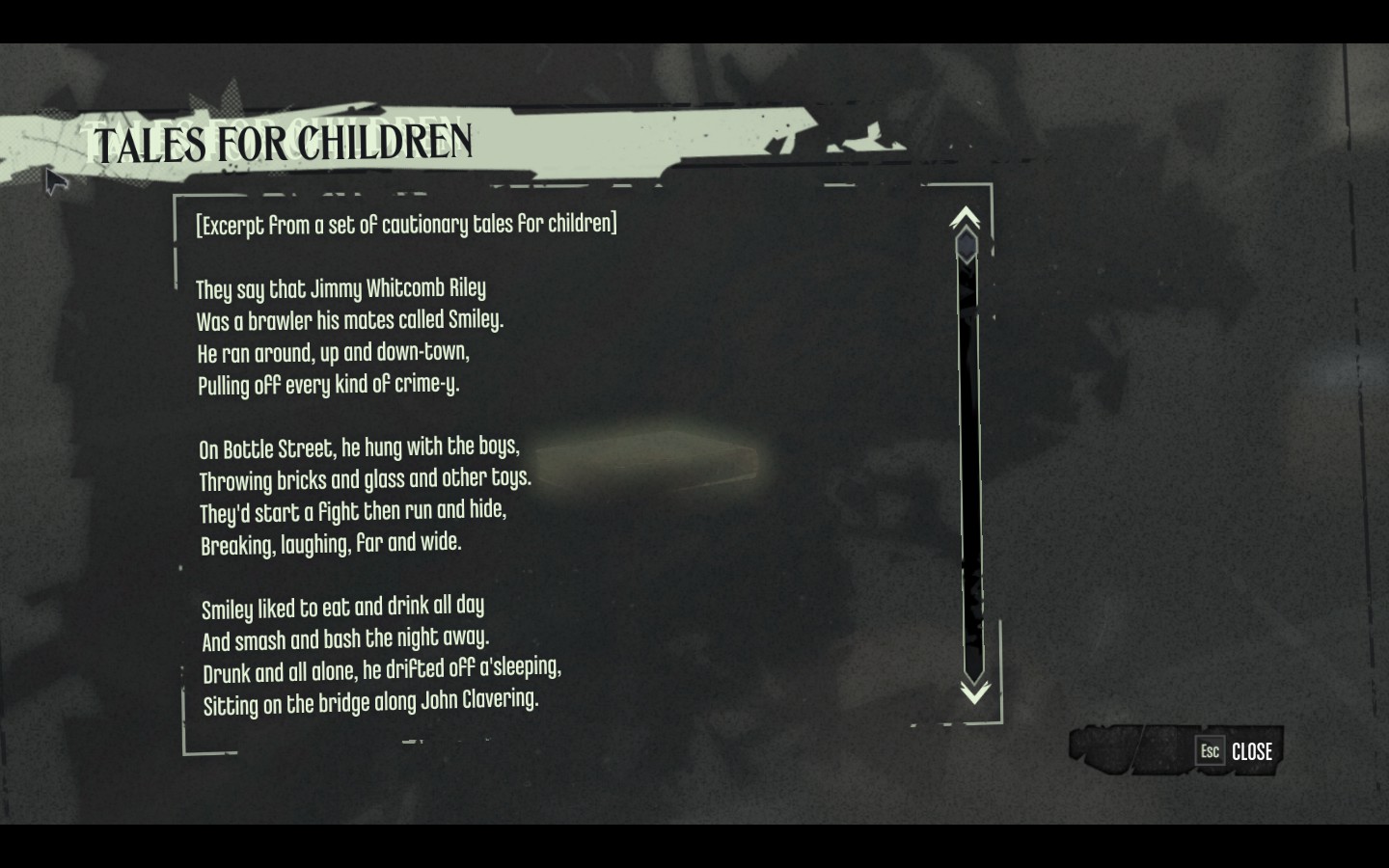
The second poem is depressingly bad. It purports to be an excerpt from ‘a set of cautionary tales for children’ and is obviously intended as a sort of macabre nursery rhyme or folk ballad:


Here’s the thing about rhymes and ballads though: they tend to scan. The rhythm is such that the lines roll off the tongue. Here we start with:

They say that Jimmy Whitcomb Riley
Was a brawler his mates called Smiley.
He ran around, up and down-town,
Pulling off every kind of crime-y.

Which is all kinds of awkward. And what’s the point of forcing a rhyme with the ending ‘y’ if it’s not even a full rhyme? Two stanzas later, we get ‘a-sleeping’ rhymed with ‘Clavering’. This is as lazy as it gets. On top of that, the rhyming pattern established in the first stanza, which is basically a variation on a limerick, is abandoned in the second through to fourth, presumably because it was too difficult to find more than one rhyme for ‘boys’ or ‘day’.

But the worst thing about this effort is that there’s no real story. If you’re going to half-arse the poetry for the sake of telling a ‘cautionary tale’, you should at least have a tale in mind. This one starts off describing a typical no-good character. Then, in stanza four, he wakes up as a fish! That’s it! Even McGonagall had something he actually wanted to tell us about.

Someone on the Dishonored writing team obviously decided that inserting poetry into the game through these books and documents would help give the world credibility. It’s one of those little details that makes an imaginary people seem real. Indeed, ever since Tolkien, it seems to be an unwritten rule that every fantasy world must have its ballads, tavern songs and poems as a sign of the richness of its culture. This makes sense. But it also leaves you wondering: why, then, don’t games developers hire a poet to write them their poems? Poets tend to come very cheap, and many would embrace the challenge of writing in whatever style you wanted.

I suppose the answer is that for all that the ‘idea’ of poetry still holds sway, the average person’s familiarity with it is so lacking that they can mistake an awful, rushed attempt for a convincing approximation.

Loading … 25%


To recap: this month, we’re trying to crowdfund half the printing costs of Sidekick’s next book, Coin Opera 2: Fulminare’s Revenge. This means we’re asking our allies and admirers (and, more to the point, the wider gaming and literary communities) to effectively pre-order the book, or the deluxe edition, or pledge more for bonus extras, through a Kickstarter page. If you pledge £12, you’ll be buying the book and helping us to reach our target of £1,500, but if we haven’t hit that target by the end of the campaign, we get nothing! Any money you pledge won’t be taken from you until the second week of July.

What follows is our week 1 update:

Progress report from Dr Fulminare:

“The sun rises, albeit in leisurely fashion, upon my empire! The task is under way and a score or more fearless pioneers have dared to join me and my team in our most radical mixing of two unstable elements. You are to be commended, you most intrepid of intrepids! But still we need more, of course. More curious cats, drawn in by the smell of conflict and crackling words. More wandering wildmen, unable to ignore the sound of poets taking games apart to see what makes them tick, unleashing their characters, recklessly confusing our world with theirs. Let us go out together and find them, so that this most unnatural thing may live!

Yours,

Dr F (still alive / doing science)


Progress report from the editors:

Huge thanks to all the backers who’ve helped us pass the quarter-way mark in the first week!  As Dr F says, you are adventurous souls – this project is an unusual proposition, almost a one-of-its-kind, with the first Coin Opera being more of a tentative experiment. A quarter of the way there is exactly where we need to be right now, but from our point of view, it’s no excuse to rest on our laurels. Most of the work still lies ahead of us!

Here’s a round-up of the publicity we’ve managed to snag for ourselves in the last week:


We’ve also been hard at work producing related features and writing, just to keep things a bit interesting. Here are two articles we posted to our blog this week that explore matters related to both literature and gaming:


We’ve also added a short Q&A:

Is Coin Opera 2 a light-hearted sort of affair or a serious literary endeavour?
It’s both. We believe games are under-appreciated as artifacts and as both abstract and non-abstract art, and that their forms, their mathematics, their ways of expression ideas and conflict, are ripe for fruitful exploration. A better understanding of the way games work, the way  they engage us, informs a better understanding of ourselves, and poetic expression is one of the ways humans reach towards this greater understanding.

But at the same time, the way games engage us is through play, and one of the best ways of engaging them is through play. Most of the poems we’ve collected for this anthology demonstrate a creative-critical approach, a light touch, and an awareness of tropes and of the surreality – sometimes absurdity – of game-worlds. These are not poems which need to be run through a factory of academics in order to be understood. They’re packed with visual and verbal jokes, and a sense of wild experimentation runs through the collection.

I don’t know much about games. Is this book going to be pretty heavy-going for me?
While there’s obvious a lot that will be familiar to gamers, the poems collected are not rammed with in-jokes, and are no less accessible than poems about countries you’ve never been to or events you’ve never witnessed. At least a part of the delight in a literary focus on games is the re-recognition of their strangeness, the way they occupy a space similar to dreams or myth: recognisable, but at one remove from our own world. If you have a taste for literature that falls in any way outside the bracket of domestic realism or historical account, you should find much to like in Coin Opera 2.

I don’t know much about poetry. Is this book going to be pretty heavy-going for me?
Poetry is, of course, like any art, easier to grasp the more you read of it, but many of the young writers who are included in the book are well practised in writing for new audiences and have a background in live performance. If you’re remotely interested in the subject matter, and so long as you’re willing to embrace a certain amount of ambiguity and word-play, you shouldn’t have any difficulties with Coin Opera 2.

Sunday Review: Luke Wright’s Mondeo Man

posted by the Judge


Time for our Sunday review again! It’s a funny coincidence because after dealing with Emma Wright last week, now we’re handling Luke Wright, and his collection Mondeo Man. Are the two related? Are they lost siblings who now reconnect their forsaken genetic link via the ethereal chains of language? (I haven’t bothered googling this, but if it turns out that the two *really* are siblings, I swear I’m dropping poetry and going into occultism).

This mystery and many others shall be revealed in Harry Giles’ review, which you can read by clicking here.

Enjoy your Sunday!

Gender / Gaming / Literature


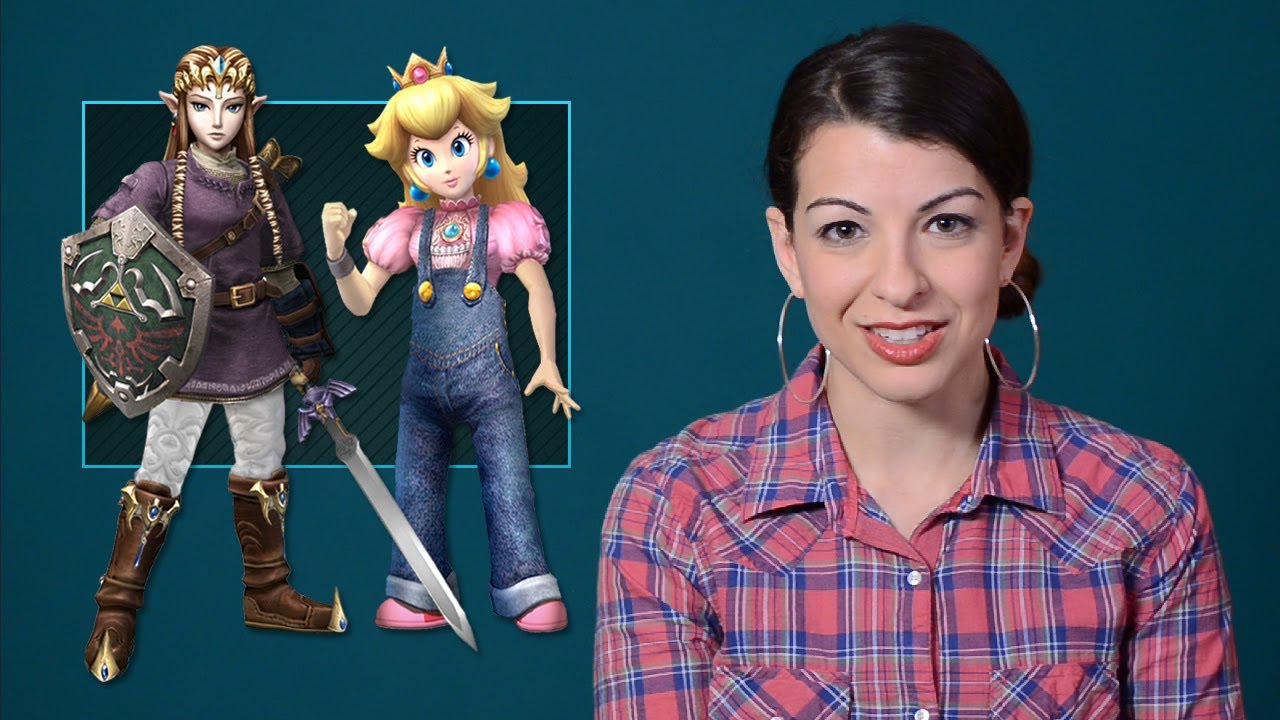
That there is a major issue with gender representation within both gaming and literary culture is now so widely accepted that it’s easy to forget the claim is even contested. But contested it is; the worst that can be said about Anita Sarkeesian‘s Tropes vs Women series so far is that it’s a succession of statements of the obvious, but that hasn’t prevented a wave of antipathy and attempts to discredit Sarkeesian, even to the point of publicly accusing her of fraud for asking for too much money from her supporters.(1)

Even if we ignore this resistance to eminently sensible criticisms, just because a problem is widely acknowledged doesn’t mean it shouldn’t be discussed. One argument deployed when feminist critics like Sarkeesian emerge, or when statistics are released that point to comparable problems in literary culture, is that we’re only seeing a reflection of wider problems with equality in society. Games developers cannot employ more women if women aren’t applying for the jobs and female authors can’t be published if they aren’t submitting work. Similarly, if there is a lack of female protagonists, characters and perspectives in games and literature, it’s because the public aren’t interested enough in them.

Firstly, it should be pointed out that this is a case of neutrality as complicity. The metaphor of the travelator(2) is useful in characterising what’s happening. There is a cultural drift towards inequality – not just to the detriment of women, but to the detriment of minority ethnic groups, the poor, gay people, transsexuals, the disabled and others. We can debate about who is responsible for that cultural drift and whether or not it’s part of human nature; what’s important for now is to understand that if you aren’t resisting – if you aren’t walking in the opposite direction along the travelator – then you’re being pulled towards accepting greater and greater inequality, into a position where you’re more likely to find basic notions of freedom and fairness unrealistic or fanciful. The most common complaint against feminists is that they’re too visible, too attention-seeking, too forceful. This complaint ignores cultural drift and the fact that you can’t create a countercurrent without considerable noise and activity, nor without making demands.

Secondly, literature and gaming in particular should be at the forefront of positive change. Games are spaces where we can play. Books are spaces where we can exercise our imaginations. Creative mediums are where we can take stock of what is unhealthy in our world by imagining a better one, where we can test outlandish theories, and explore our most dangerous instincts in a safe environment. They’re where we can visualise and articulate internal conflict. In short, they’re areas where notions of what is realistically achievable in society should give way to idealism and social experimentation, where everything we think we know should be regularly turned on its head. This already happens; it just needs to happen more.

More importantly, they’re areas where change can occur relatively rapidly because of their accessibility. In most industries, systemic prejudice is so ingrained, so threaded into the system that change is generational at best. Women don’t land corporate jobs, often, because they lack the requisite aggression and competitive edge. They lack aggression and a competitive edge because these are qualities that, early on in children’s development, are identified as masculine, as unfeminine. In other areas, women lack qualification or experience or self-assurance, all because they are undermined at an early point in their lives and placed at a disadvantage. But you don’t need to land a job to become a writer. And with game creation tools like Twine and Construct 2 constantly evolving, you don’t need a job in technology to become a game developer. Best of all, the Internet provides the necessary tools for disseminating the resulting work and building an audience for female critics and creators alike.

Twine is a simple, window-based development platform for text adventures.

So what needs to be done?

One of the most important things to challenge in both literature and gaming is the idea of a type of book or game that is aimed at women, and the accompanying notion that addressing the gender imbalance will mean more of these types of games and books, at the expense of the type that we (men) typically enjoy. The scare story is that political correctness demands an overall reduction in quality.

But these are industries/environments where the full spectrum of what appeals to boys and men has been heavily explored and is collectively well understood, while women’s tastes are very poorly understood, in part due to a deficit of widely disseminated critical writing by women. The kind of games and books that are marketed to girls and women – chick-lit and dolls’ house games – are the result of this poor understanding. That’s not to say women don’t like these games and books, but that it represents only a tiny part of the full spectrum of what they might like – a spectrum which, in all likelihood, overlaps to a massive degree with men’s tastes.

If women’s tastes were more thoroughly explored and understood, what I suspect would come to light is that a multiplicity of minor changes would do much to bring more women on board while sacrificing little of what appeals to male audiences. To take an example from gaming, one of the reasons women can feel excluded by the content of a game is the proliferation of female characters whose sole purpose appears to be titillation. This is frequently misunderstood as an objection to partial nudity or attractiveness, when in fact it’s a complaint about deficit of personality and relatable goals. It would be easily resolved by introducing female characters who fill out a much wider range of roles, as well as genuinely sexy male characters. It does not necessitate censorship.

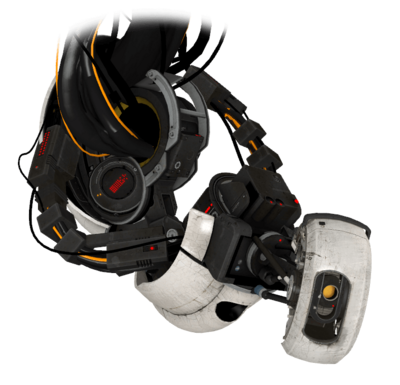
GLaDOS, one of gaming’s most unusual and memorable female characters.

Although literary culture prides itself on sophistication, there is a similar issue with crude understanding of what women want and what is distinct, if anything, about women’s writing. Famously, VS Naipaul last year attempted to reduce the entire scope of women’s fiction to ‘sentimentality, the narrow view of the world’. If this isn’t a clue as to a greater problem in how we envisage women’s role in literary culture, I don’t know what is. Even within poetry, there is a barely-remarked-on but, in my opinion, noticeable stylistic pigeonhole that women’s writing slots into. Women who write in this way (broadly: confessional, relationship-focused, formally loose) are, in my judgement, more likely to be published than women who write in any number of other ways. I would suggest that there is a subconscious, male-led selection process at work that highlights this style of poem as ‘representing’ women better than some of the other styles women choose to write in.

Let’s address the argument that better representation of women in either medium means a drop in quality, means opting for the poorer candidate to fulfil a quota. Women make up over half the world’s population. There is no scientific basis for the assumption that men are more intelligent, more creative, more individualistic or harder-working than women. If you have two local sports teams who, in totality, are equal to one another, and you make up a national side that is heavily weighted to one of those teams, as a matter of logic, you must have picked the weaker players from one team at the expense of stronger players from the other. In any culture, subculture or industry where the gender balance is skewed heavily in favour of men, the weaker candidates are already being picked. More equality should logically amount to higher quality.

Finally, I want to say a few words about Coin Opera 2: Fulminare’s Revenge and our approach to gender equality. The final ratio of contributors is 23 male to 18 female, which is 57:43 in favour of men. I consider this not ideal but within the boundaries of acceptability considering our limited resources. During the process of soliciting poems, three male poets approached me with unsolicited poems, while no female poets did. At one point, I did make a concerted effort to get more female poets on board because I felt we didn’t have enough. Not one female poet turned us down on the basis that she didn’t play games, and the games they played ranged from pinball tables to Skyrim. Some found that the games they wanted to write about had already been covered, and so declined. One, whose relationship with games was mostly through her children, specifically bought and played the game they wanted to write about for the first time, in the interests of getting a more in-depth perspective. Some poets of both sexes said they would have a think but ultimately didn’t get back to us.

I would say that, on the whole, the collection is definitely richer for its inclusion of a good number of female poets and gamers and that their work does not betray any notion that there is a strict segregation of tastes or styles between men and women. I don’t think of this as providing a service to women (albeit I hope that providing a platform for more women to respond to games and gaming is helpful) but as something that improves the overall quality, accessibility and range of the book.

Further links

Coverflip: Maureen Johnson on gendered book covers
Jane McGonigal, game designer and games culture activist
Helen Lewis writing in the New Statesman on female protagonists in games

Footnotes

(1) Prior to writing this article, I’d only seen the fraud accusation made in the seething jungle of comments sections on news sites. But I only had to type ‘Sarkeesian fraud’ into Google to find this page in the top two results.

(2) I first stole and redeployed this metaphor here.

Poetry Guest-Appearing in Games #1: Mark of the Ninja


Mark of the Ninja is a 2012 stealth action game developed by Klei Entertainment. It’s a first rate example of the stealth genre, forcing the player to stick to the (plentiful) shadows, glide through vents and take advantage of distractions in order to get the jump on an enemy. The protagonist is a nameless ninja charged with mounting a solo assault on a private military company in revenge for an attack on his clan, although a broader and more sinister picture reveals itself to him as he advances through the various missions.

The game’s writer, Chris Dahlen, blogs here about the research he undertook in order to create a realistic history for the fictional Hisomu clan and the decision to employ poetry – specifically haiku – in the telling. Conscious of the fact that using audio logs to relate a non-interactive potted history is difficult to do well inside a fundamentally interactive medium, and concerned that these audio logs should fit the pace of the game, Dahlen opted for haiku “because haiku are short, and they’re enigmatic”.

The resulting poems can be accessed by finding hidden scrolls, three per level, scattered throughout Mark of the Ninja. After touching each scroll, a poem is recited by ‘the voice of the Hisomu’. Taken together, they fall under the title of ‘A History of the Hisomu Clan as Written by its Masters’.

From the first recital, however, it’s apparent that these are not really haiku in the strict sense:

Five hundred men lie
vanquished before Tetsuji.
Takes off his blindfold.

Dahlen uses the 5-7-5 syllabic form that is commonly taught as a rough approximation of the rules governing haiku in Japanese, but in most of these poems, he misses the most fundamental element of the form: the kigo, or seasonal reference. Without this, the form is much closer to senryū, a similarly structured poem whose subject is usually people, rather than nature.

More arguable is the presence of a caesura or kireji (cutting word), which is used in haiku to implicitly compare two images. This is not necessarily easy to recognise, but Dahlen achieves, at the very least, a similar effect here by ending the second line with a full stop, which suggests we reflect on the relationship between the removal of the blindfold and the dead five hundred.

The second poem is more troublesome:

We snap off a branch
to make a weapon; but the
tree must bear the wound.

Here, the syllabic structure is rather more forced, conflicting with the natural intonation. In the game, the voice actor audibly pauses after ‘the’ to denote the line break, but it sounds odd and adds nothing to the meaning of the poem – the natural pause is after ‘weapon’. Also, ‘but’ makes the intended contrast explicit where it should be implicit. It would be a stronger poem, and more ‘haiku-ish’, if it went something like: “We snap off a branch / to make a weapon / The tree bears the wound.”

This poem is, however, a clever allusion to the role of the player in the story, and Dahlen’s aim here, and with many of the poems that follow, is to provoke the imagination, to get the player guessing at what various strange and slippery images refer to. While some of the poems are blunt and direct in moving the storyline along, others apparently relay no information at all. These, however, are all the more interesting for that, and closest to the effect one might expect from poetry:

On a starless night
an unkindness of ravens
lands along the wall.

A raven, or something similar, signifies a checkpoint in the game. When you pass these points, the raven appears to fly away. Does this poem allude to them being set up beforehand, and consequently the fact that the protagonist’s path through the game – and through his life – is the result of his being manipulated?

The poems in Mark of the Ninja ultimately achieve two things: they are a foreshadowing device within the plot, causing the player to anticipate various revelations and the protagonist’s ultimate fate. They’re also a flavouring device, grounding the story more thoroughly in elements of Japanese culture and creating the illusion of a succession of writers contributing to a generation-spanning narrative.

You can listen to the compiled audiologs here.

Sunday video review: The Flower and the Plough by Piercey & Wright

posted by the Judge


After dedicating our first video review to something of a big dog in the UK poetry scene, I’m now changing target completely and reviewing Rachel Piercey and Emma Wright‘s The Flower and the Plough. They’re all new & fresh & talented, and they’re worth looking into, despite some shortcomings. You can read the review here…. no hold on a second, that’s what I used to do with text reviews. Ok, scratch that. All you have to do for this review is click on the ‘Play’ icon above.

Or, just as interesting, take a look at the site of The Emma Press itself. Do so by clicking here.

Have a great Sunday evening!


Reads Like A Dream

I don’t think I’ve enjoyed an event in ages as much as I did ‘Reads Like A Seven‘. It’s tricky to run an event themed around computer games and keep it varied, entertaining and the right balance of accessible to non-gamers and interesting to those who do play. RLA7 got it spot on.

New Statesman Deputy Editor and keen gamer Helen Lewis kicked off proceedings, discussing women in gaming and the rise of female participation (we’re going to overtake the guys if the pattern continues, apparently). She discussed the online lynching of feminist games critic and documentary-maker Anita Sarkeesian and the hostility towards even questioning the culture of booth babes and jiggling Lara Croft’s relics.

We went up next, with some preview poems from Coin Opera II, which we will be (drumroll!) launching a Kickstarter for, as soon as KS have approved the project. Covering Streetfighter, Pinball Dreams, Portal and many more, we had a grand time (and I got to do my GLaDOS impression). The audience gave us a lovely welcome and it struck me that mixing poetry and micro-talks is the ideal format in which to bring out the strengths of both forms.

Guardian Games Correspondent Keith Stuart took us through the trauma of having your world destroyed by children. Your Minecraft world, that is. Following explicit instructions to offspring to stay away from his saved state, he returned to find his virtual world literally up in flames.

Guardian writer Steven Poole, who by the way has a magnificent reading voice, waxed lyrical on zombies and our cultural obsession with them. He explored the phenomenon through games such as Resident Evil, suggesting we might even be envious of such creatures, who can shamble about without “phoning in sick to the zombie office”, worrying about nothing but the odd shotgun to the face

Following an interval, broadcaster and game developer Ste Curran took us through the parallels between computer games and cricket, in a hypnotic looping piece about the rules and interactions of both. It was interesting to see gaming brought into the light, to stand beside classical games and be counted.

Our host, and the organiser of the event, New Yorker games correspondent Simon Parkin, read a fascinating piece on Japanese RPGs, and the lack of peer-aged protagonists in today’s games for lifelong players who began in the 80s.

Christian Donlan, senior staff writer at Eurogamer, closed the night with a beautifully-written, funny and magical description of sharing LA Noir with his Dad, discussing the ways in which it depicted the 1940s Los Angeles in which he’d grown up. It was incredibly poignant and funny, with descriptions of dysfunctional ancestors and Donlan’s grandfather, a beat cop not wanting to kill his target, shooting the criminal in the arse.

Afterwards, as the cherry on top of a great night, we also received a frankly delicious gold parcel of home-made goodies from the gentleman who’d invited us to read, writer and raconteur Bruno Vincent. Thank you Bruno – they were delicious!

A great mix and a night in which I learned a great deal via sheer enjoyment. A bit like a good game in that respect.

Only low point was finding out today that my childhood hero from the show Bad Influence, Violet Berlin, was there and I didn’t get to meet her! Actually perhaps it’s for the best. I would have just spat while I talked or something, or mentioned my embarrassing Arkanoid habit before slinking off, muttering “stupid…stupid…”.

Looking forward to the next #RLA7. Very much so.

Sunday review: Jude Cowan Montague’s ‘The Groodoyals of Terre Rouge’

posted by the Judge

I’ve got no idea what a groodoyal is.

I say this because when I blog about our Sunday reviews I usually add a pic that has something to do with the book we’re reviewing. But since this week we’re doing Jude Cowan Montague‘s The Groodoyals of Terre Rouge (or to be more precise, Charles Whalley is ‘doing’ it), I found myself kind of at a loss for words. I mean, pics.

Fortunately there seems to be some kind of unwritten rule on the internet that when you’ve got no idea what image to use in any given context, you can add pictures of stormtroopers. So here ya go. Solved.

You can read the review by clicking on this link.

Once you’ve done that, enjoy what’s left of your Sunday! (Seven minutes, from where I stand).

Is Poetry a Subculture?

written by the Judge


Is poetry a subculture? It might be worth asking ourselves that question. I’m not a sociology student and I’ve never been part of a subculture myself, so my point of view can only be partial. (But then isn’t a monocular focus only on one’s own field itself characteristic of subcultures? Isn’t my failure to represent perspectives on poetry that originate outside of poetry a fact symptomatic of subcultural hermeticism, and evidence that I belong to this subculture – for the good and for the bad?).

A subculture is more than just ‘a group of people with common interests’, like a bridge club or bungee jumping. It has codes, beliefs, clans, heroes. For me, the term is one I most readily associate to music. The two words that immediately spring to my mind when I hear it are ‘punk’ and ‘goth’. There are others, of course. There are also many subcultures that are not really defined by music, though they may be related to it in some ways or another (hippies, to name a big one). And there’s supposed to be a whole world of sexual subcultures, especially in the gay community, but I’m even more ignorant of those than I am of the musical ones.

Here’s the thing though – there is a substantial difference between the way these groups are perceived and represented in (popular?) culture and the way that poetry and poets are (or are supposed to be). Not to put too fine a point on it, all of the above are understood as peripheral to our culture, as living in the margins, as colourful but – at least when taken individually – not essential to the workings of society. They allow for the kind of vocabulary that everyone else can use to crack a mild joke: Cartman’s celebrated phrase, ‘it’s all a bunch of tree-huggin’ hippie crap’, is funny because it’s so easy to relate to it (no offence, hippies).

But poetry is supposed to be central. It’s meant to be one of the barometers of a culture’s vitality; poets encapsulate and represent an age for the generations later to come; they define and shape the identity of nations. Surely something’s a bit off when you put them in the same category as your neighbour and the four nerd friends of his who get together every Saturday night (!) to play fantasy role and/or board games about dragons fighting unicorns.

So what exactly is a subculture? Ken Gelder identified six key ways to recognise them:
1.     Their often negative relations to work (as ‘idle’, ‘parasitic’, at play or at leisure, etc.);
2.     Their negative or ambivalent relation to class (since subcultures are not ‘class-conscious’ and don’t conform to traditional class definitions);
3.     Their association with territory (the ‘street’, the ‘hood’, the club, etc.), rather than property;
4.     Their movement out of the home and into non-domestic forms of belonging (i.e. social groups other than the family);
5.     Their stylistic ties to excess and exaggeration (with some exceptions);
6.     Their refusal of the banalities of ordinary life and massification.

(In passing, I don’t have a clue who this Gelder guy is – I’m only using him because his was one of the clearest of the quotations I found onWikipedia – but what he says seems to make sense, so until a real sociology student comes along, let’s roll with it.)

I’d say that one, two and six are pretty obviously true of poetry. Three is plainly off – though it’s true that poets do not associate with property, I wouldn’t say they do so with territory either. Four and five are a bit more debatable, but I’d say poetry flicks the switch for both. Poets do, on the whole, display a movement out of the home and into non-domestic forms of belonging, notably when they first go to university and start forming ties with other aspiring poets; it’s at that point that they first come in touch with the community, one which does not speak to / with their family or their other social circles. In brief, the literary community does something that is typical of subcultures – it assists its member(s) in the formation of a new, non-domestic identity. This process usually starts in the academic arena, and it works so well that many poets never even leave it – witness the number of artists who work in universities. But it is certainly not limited to that territory (hence, I don’t think #3 holds).

Number five, the stylistic ties to excess and exaggeration (note on the run that Gelder allows for ‘exceptions’), revolves around the word ‘stylistic’, and brings us to one of the primary differences between the poetic subculture and the others I mentioned (the music ones in particular). The latter appear to be much more interested in external appearance and clothing; their codes are embedded in the way they dress. Superficially, this doesn’t seem to be the case with poetry – I say superficially because I’m of the opinion that there is such a thing as a dress-code common to poets, too, it’s just much harder to pin down. Since the leading principle is that of rule number six (see above), clothes are used to reject mainstream codes; they are therefore used – not necessarily in a conscious manner – to go against expectations. The problem is that while a fan of goth music has the common and relatively transparent codes of mainstream music that s / he can simply turn on their head to express his / her rejection, poets each respond to their own societal codes. So it is perfectly possible – and consistent – for a poet to ‘go against expectations’ by dressing in seemingly shabby clothes while another does the same by wearing a gala suit. This does not mean that their identity as poets may not correspond to the same societal construction, and therefore not share a drive in terms of social expression – but I digress.
Ginsberg’s outrageous head-wear
 To return to the initial point, though it is true that you can find a great deal of excess and exaggeration in the haberdashery of poets if you look for it, you can hardly make of that a consistent rule. But hear me out – while there may not be so much excess and exaggeration in terms of clothes, there is in terms of ideology. Ultimately, the two things are not even that distant. The fact that poetry can express itself directly through language – and the fact that all members of this subculture are poets, while not all punks are musicians – makes the self-expression allowed by clothes a bit redundant. And yet extremity is very common in terms of the statements made, the positions held and the emotions expressed in the actual verse.

So yes – if Gelder’s little list is anything to go by, poetry does have a lot in common with subcultures. In sociological terms, it operates in much the same way. It also has some traits which make it differ. One example is the effort, within the poetry subculture, to expand its borders and get poetry to more people and wider audiences. This contrasts with the attitude taken by more traditional subcultures, which are rather content with the marginal state in which they subsist (though they too can be flustered and frustrated when the media misrepresent them). It might be the result of poetry’s inability to recognise itself as a subculture, insisting instead that it is more ‘central’ to society. An identity crisis, if you will, but on a grand scale. Or it might be one of the individual characteristics of this subculture, the same way that a drive towards political anarchy is (I think) one of the drives of punk.


And here is my point. Poetry is central to society, just not thispoetry. Not the community. Not the subculture. Attempting to expand poetry in these terms means attempting to get more people be like us – while a more effective strategy would be that of having your poetry speak to those who are not like us. This is not as obvious as it sounds – there are some people out there who genuinely do not deserve being spoken to. Furthermore, it might involve letting go of just those values that we hold so dear about our community, like our point number six, the ‘refusal of the banalities of ordinary life and massification’. Most people don’t refuse these things, and are not interested in investigating the possibility; communicating with them, therefore, might involve relinquishing this refusal. Is this something you are ready to do? And if poetry really involves non-conformism, then here’s the thing – could it be that the best way for you to write it is to do what others don’t do – and stay the hell away from this community, and not even read this article in the first place?