News

Three London Arts Nights Every Poet Should Know About

Whilst you’ve probably heard of, or been to, regular nights like Jawdance, Poejazzi, Utter! and Bang Said The Gun, all of which have built up a dedicated audience and a name for themselves, there are a great many distinctive lesser-known events off the beaten track. Here are three of my favourite hybrids, what makes them different and who might enjoy them.

1. Bingo Master’s Breakout


What be this?

One of the most joyfully anarchic and welcoming poetry nights in the capital, this merry stew of poetry, karaoke and bingo (yes, you heard right) is run by Kevin Reinhardt of the Vintage Poison collective. This evening has been running for years, but its existence is still a surprise to many people.

What makes it special?

Sheer variety, for starters. A typical night consists mainly of floor spots in which each performer goes up to read a poem of their own or one from a pile brought by the organisers, followed by a karaoke song of their choice. In between these spots, BMB presents a featured poet doing a longer set, who then goes on to call the numbers for a cash prize bingo game which everyone is free to play, and a band performing a karaoke set of their own songs, complete with inflatable guitars. Plus, the one-poem-one-song cap means you’re never stuck listening to an interminable mic-limpet.

Who might enjoy this?

Anyone who likes their readings a little less formal, a little less on the slam side and a lot more participatory. And of course anyone who enjoys karaoke.

Cost?

Free.

Where can I find out more?

Follow BMB on Twitter or check out their Facebook page.

2. Open Arts Cafe


What be this?

Run by the charismatic singer-songwriter Maya Levy, Open Arts Cafe is a variety extravaganza, showcasing new work from upcoming artists. Each show is themed (past themes have included Smoke & Mirrors, Seafaring and I Gave My Love A Cherry) and submissions to perform take their cue from this.

What makes it special?

Well for starters, it’s in a synagogue. For my fellow gentiles, it’s not often the opportunity really arises to go explore a synagogue, and practically, it makes for outstanding acoustics. But aside from the brilliant venue, the quality of acts is always outstanding. I guarantee that even grizzled veterans of London entertainment will discover something new here. Past performances have included poetry, acrobatics, stand-up, film screenings, live theatre and an improvised jazz board game with full audience participation. There’s also an art exhibition to look round during the interval, as well as snacks and drinks.

Who might enjoy this?

Anyone who likes their poetry set like a gorgeous stone in a big old crown of other artforms; anyone who wants to discover new acts; anyone who wants to be thoroughly entertained.

Cost?

Pay what you can (£6 suggested donation, which goes to the artists). Snacks are free, wine’s £3.

Where can I find out more?

Open Arts Cafe website
Twitter
Facebook page

3. Scaledown


What be this?

As the name suggests, Scaledown is a night of micro-sets, hosted by Mark Braby, Shaun Hendry and poet Jude Cowan Montague.

What makes it special?

A jamboree of poetry, monologue, music and performance art, the last Scaledown I played, I was performing alongside a sound artist collaging a soundscape from language learning tapes, an incredible experimental violinist, gorgeous folk music, a costumed band straight out of a Frank Zappa daydream and the hosts kicking off with an acapella song. Special enough?

Who might enjoy this?

Anyone who (not unreasonably) dreads a poetry set going over 15 minutes. With its quickfire lineup, Scaledown flat-out refuses to let you get bored.

Cost?

Free, but do, as they say, check out the Table of Wares and support the artists if the fancy takes you.

Where can I find out more?

Scaledown website

Five Fixes For Contemporary British Poetry Culture #2: Character & Flavour

THE NUMBER of poets writing today, it’s frequently argued, is reaching a kind of critical mass. Our finest are being buried in mediocrity, and the bulk of what is being written is ‘landfill‘. Who gassed the gatekeepers? What blunts the blades of the critic-gardeners, so that our flowerbeds are choked with dandelions? How will future generations pick through the mess?

Another way of looking at it


This angst over the quantity of poetry being published is really the result of the limited way we’ve come to talk about poets, poems and poetry. As the number and diversity of its practitioners flourish, still we repeatedly fall back on the trope of the giant among men, the axe smashing the ice, the quality of ‘greatness’, to describe the value and appeal of what is being written. I don’t mean in one specific mode of exchange either – this need to elevate is a common denominator in publicity, criticism and casual conversation. Elevate, that is, in lieu of meaningful differentiation.

The result is the appearance of multitudes laying claim to the same tiny throne, with no point of reference for what is described beyond other, weaker variations of itself. You do not expand your audience by saying, “This is the best kind of what it is” without saying what ‘it’ is. You simply create the impression of a mass of sameness.

The marketing of poetry in particular reveals that we struggle to move beyond the comparative, and come armed with only limited ways of illustrating its effects. Too many book blurbs deploy a smorgasbord of stock traits while simultaneously laying claim, through bare assertion, to uniqueness. This runs through to our reviewing culture as well, which frequently constitutes an ever-more finely balanced game of using different words to convey the same message. Think, for example, how many poets reportedly fit a description along these lines: ceaselessly inventive and original, utilises precise, finely wrought language, deft musicality, addresses themes of identity, place, change in luminous, startling lines, often wry and funny, unafraid to take risks – in short, the real thing.

Yes, this goes beyond claims to grandeur and eminence, but the repetitiousness of such depiction doesn’t get us very far.

The fatigue felt all round is, therefore, not a reflection of the sameness of the poetry itself but its presentation, and we’re fooling ourselves if we ignore how much of our own impression is informed by that consistency of presentation. This accounts for a range of apparently small-minded behaviours – from the self-styled representative of ‘ordinary people’ who dismisses whole generations for abandoning formal conservatism, to the finely articulated manifesto as to what constitutes ‘real poetry’, to the frustrated avant-gardist who disavows anything with a narrative pulse. All means of avoiding tangling with the unruly cosmos of poetic possibility, most of which lies unknown and threatening beyond the shallow sweep of our descriptive language. To know much of it well requires a dedicated and thorough immersion that is beyond most of us. Instead, we tend to find our own corner of a friendly star system, settle on a hospitable planet, and turn our telescopes inward, while the public at large clings tightly to the safety of school-taught verse.

Taking cues


What we should be doing is making our cosmos navigable, not just for ourselves but everyone outside of poetry – so not merely to the person who is prepared to burrow through hundreds of academic papers but also (and more importantly because these are more numerous) the person browsing a bookshop display or events listing. I may have poked fun at the clichés of poetry selling five years ago with Vitally Urgent: The Game of Blurb, but I’m not for a moment suggesting it’s easy to find ways of articulating the individual qualities of a poet or book so that they can be understood at a glance. Look across, however, at some of the mediums and genres whose audiences have expanded exponentially over the last few decades: manga, anime, games, science fiction and fantasy. These are areas – if not industries – which afford roles and employ to thousands of creators, filling large convention halls with fans who will queue for autographs from writers of all ages. It would be somewhat delusional to imagine that poetry could transform itself into a similar model of success, but we might at least pick up a few lessons in breaking out of a niche.

One such lesson is what I’d call the Character Select Screen Principle. Character select screens have appeared in certain genres of computer games since the days of arcade cabinets, typically proffering an array of protagonists, one of which the player must select as their avatar. They are designed to convey, in as immediate a manner as possible, the fundamental traits of each character, so as to help the player identify one which suits him or her best. Posture, expression and clothing, as well as numerical statistics and brief biographical information, are employed as suggestive devices – broad strokes that serve to make a memorable impression.

What the character select screen appeals to – and what, in their different ways, so many pop culture properties make use of – is our need to explore, develop and demonstrate our identity through the choices we make. We pick favourites – to play, to root for, to fantasise over – as a way of describing who we are, to ourselves and our surroundings. Witness also the proliferation of ‘Which ___ Are You?’ quizzes on Facebook, the results of which are shared for comment. The significance of a choice shouldn’t be apparent only to ourselves but to those who see we have made it.

In other words, people are more likely to buy and read poetry if their choice of what to read tells other people something about them.

❖And where do we start? 


Both cover art and cover copy are already used to accentuate the individual flavour of a poetry book, with varying degrees of success. Publisher livery can serve as an obstacle (all Carcanet books are predominantly red, black and white) or provide a framework. It’s fair to say that Faber have at their disposal a simple but effective means of distinguishing their poets (and their poets’ books) from each other, by using colour as the major design feature of their cover design, harking back to one of the very first ways we learn to mark our identities as children, by having a favourite colour. Some poets – Luke Kennard and W. N. Herbert come to mind – have a talent for cartoonifying themselves. All of this is good groundwork.

The most successful critical analysis also strives to find ways of describing its subject that make a lasting impression. In fact, I’d go as far as saying that this is the major useful function of a review. In a world where we simply do not have a practice of poetry criticism that is sufficiently removed from the writing and publishing of poetry, memorable description is more important than maintaining the cracked illusion of critical distance. In other words, a bad review that paints a striking portrait of a poet or collection is providing more of a service to the poet, and to readers, than a good review that deals in subtle nuances. To the extent we believe our critical culture is a project of assessment – of holding gemstones to the light and rating their flawlessness – we are mistaken. Its value to us is as a way of generating the ingredients for our own character select screens – simple, stark phrases that colour one poet or book differently from another – even if this function is too often buried beneath politesse and the affected gestures of judgement.

What I suggest, therefore, is a project, building on these beginnings, towards broad-stroke characterisation – of poems, poets, poetries, books – with the measure of success being this: that the person browsing the bookshop display be able to skim their eyes across a range of covers and brief descriptions and, even if they aren’t generally a buyer of poetry, be able to pick a personal favourite.

Objections?


(1) Look, Jon, poetry is about subtlety, the slow release of flavour. This is vulgarisation you’re talking about – caricaturing, turning books into fashion accessories.

Answer: Such subtlety can be over-fetishised – it isn’t fundamental to the art form. I also think it’s wrong to be disdainful of instantaneous appeal or announcement of purpose. It is a great thing to fall in love on sight.

(2) It’s not up to us to ‘sell’ poetry, Jon. People just need to be made less ignorant and less fearful of reading difficult texts.

Answer: Avoid the responsibility if you want, but remember, this isn’t just a problem of poetry’s public image; most practitioners and critics also seem to struggle to know what’s happening in their own art beyond a narrow area of focus. Especially the ones who think they know everything.

(3) What you’re asking for is already under way.

Answer: I agree; there are people already on the case. But this should be something many more of us are involved in and thinking about, because it goes to the way practitioners conduct casual dialogue amongst themselves as well. My experience now is that we mostly say to each other that someone or something is ‘good’, ‘interesting’, ‘clever’, ‘overrated’, ‘underrated’, and so on, in a way that makes poetry seem like an exercise in merely perpetually impressing each other – exactly what its most acid-tongued critics accuse it of being.

(4) What of the dangers of poets becoming typecast or straitjacketed by this so-called ‘broad-stroke characterisation’?

Answer: It’s always possible to reinvent yourself.

Examples


Since I should practice what I preach, I’m now going to try to sketch some of my favourite poets, on the understanding that I make no claim to critical or objective distance in what follows. You can’t trust me as an impassive assessor, but that’s not the point of the exercise. The point is: bold descriptions that accentuate individual flavour.

JOHN CLEGG.
Insatiable collector and exhibitor of curiosities. In person, he’s half lion, half mad librarian, fizzing with a seemingly inexhaustible knowledge and excitement that spills into his poems. But you can never be sure whether the specimens he proffers with such wild enthusiasm are genuine finds or brilliant fakes of his own making. Antler, his first collection, is a dusty display case of relic-tales, fragments and charms from lost and imagined civilisations, sometimes crossing into our own. The True Account of Captain Love and the Five Joaquins is his versifying of an Old West yarn about a coward who carries a horse-thief’s head in a jar. Or is it?

KIRSTEN IRVING.
Monsters and monstrousness is her area of expertise, via sex, lore and sci-fi. She throws herself at her subjects like a fireball – the resulting poems are rough-edged and crooked, like circus freaks or recalcitrant schoolgirls, too thorny and untrimmed to fit neatly among the more rarified species of poetry. They tend to land you in the middle of storm-struck emotional terrain without a map, revealing their context (and their teeth) gradually, through rows of jagged imagery. The giants, robots, cannibals and cartoon characters of her first collection, Never, Never, Never Come Back, aren’t jolly pop culture references but portraits of outsiders made beautiful and terrible by what they lack.

TONY HARRISON.
For a brief moment in the 80s, Harrison was a notorious poet – the result of a televised version of the sprawling, angry V, a long poem which ventriloquises the expletive-filled diction of a disenfranchised teen as it expounds on decay and societal fracturing. Tories wanted it banned. But for all the rage and sorrow that informs his best work, Harrison is formally conservative, somehow condensing extreme rawness and bitterness into tight rhymed couplets. You want direct? He’ll tell you what he thinks, how he feels with the force of someone jabbing a finger at your sternum. You want personal? Much of his oeuvre is effectively an autobiography of working class displacement and the splintering of his own identity.

CHRISSY WILLIAMS.
What the half-Italian Williams makes are more poems than anything else, but they’re also hybrids and creatures, the genes of other textual forms (mixtape, diary, screenplay) spliced with those of poetry. It’s all gone about with joyous, youthful abandon, so that each piece jitters like a matchbox of jumping beans. Her work so far comprises a string of opuscules – stealth raids made from the territory outside the formal poetry ‘collection’. The Jam Trap is a sequence of rapid-fire comic vignettes. Angela, her collaboration with artist Howard Hardiman, is a love letter to Angela Lansbury in the form of a nightmare-ride through her psyche. Epigraphs is a work comprised solely of epigraphs.

The above do not represent a radical new way of writing, and could stand to be sparer and more direct still, perhaps shortened to the length of a cover quote. But as it stands, and to the extent they are effective, this approach is currently vastly outweighed by the glut of writing on poetry that proclaims ‘major contribution’, ‘finest of his generation’, ‘intense originality’, ‘unblinking’, ‘extraordinary’, ‘remarkable’ and so on and so forth, even down to those biographies we circulate which do little but count out awards.

How will future generations pick through this mess? Don’t make them test dozens of similarly-worded claims in search of some pantheon. Give them a landscape peopled with innumerable well-drawn characters who are as diverse as any group of people in the whole of humanity. And grant the same to the present generation.

***

Still not got your fix? Find the full post series here.

Five Fixes For Contemporary British Poetry Culture #1: Prize Culture

General introduction: What are we ‘fixing’?
I WOULD characterise the major problem with contemporary British poetry culture like so: I have, on my shelves, a growing collection of  intensely idiosyncratic, vibrantly multifarious books, almost resonating with the small power of their grimoire-like content, connecting me to myriad lived experiences, intelligences and lives of the mind. They’re filled with play and dance, wisdom and strangeness, violent shifts in temperament and technical virtuosity. It’s a relatively modest treasury, but there is enough wealth there that I don’t expect I’ll bleed it dry in my lifetime. And that’s assuming I don’t keep adding even more books. They are talismanic; to carry one with me on a jaunt, or into work, is to shield myself just a little against the creep of anxiety and despair. They do not all agree with each other. They do not all agree with me. Some of them are vexing. Some are frightening.

At the same time, beyond my bookshelf, in the public sphere, there is this thing called poetry. Supposedly it is the same thing. When you look at the individual words and names and titles, by god, it is the same thing. But in the public sphere, where it is acknowledged and talked about, it seems to amount to the vague and unaccountable indulgences of the sentimental and the terminally comfortable. It dithers. It all looks the same. It is oddly pleased with itself, at the same time as squirming with insecurity. It constantly insists that it is Important and Brilliant, but when asked why, it sulks and storms off to its bedroom. It doesn’t want to surrender its stories or dirty its dress; it simply wants to be gazed at. The warlocks become burghers, the cosmonauts streakers. It looks like an isolated empire in opulent decline.

I don’t see any natural reason why this stark disconnect between realities should exist, why it can’t be changed. It isn’t to do with the quality or health of the art itself; it is entirely a problem of how poetry chooses to present itself to the world, a collective failure to grasp that what makes a medium rich, what draws multitudes to it, is not its common character but its genetic complexity, its resistance to easy summary. Every time poetry tries to tell the world what it ‘is’, or boasts of its vitality, or proposes its practitioners as a ‘type’, or elects a representative, it further closes itself off.

I say at the outset that the purpose of this exercise is not to assign blame, and certainly not to suggest that no one else is aware of the problem or trying to do anything about it. Systemic, cultural problems are the sum of millions of unintentionally complicit individual behaviours. In The Man Who Was Thursday, the entire anarchist council turns out to be composed of spies who are trying to destroy it from within. Similarly, I’m prepared to believe that most of the individuals comprising contemporary British poetry culture are allies in the same struggle.

So with that in mind, the first ‘fix’ on my list is

1. Acknowledge prize culture for what it is and what it does, and make it do its job better.

It shouldn’t be a surprise that prize culture features first on my list, but since it’s such a tediously contentious and oft-visited area, I’ll need to be exact about what I mean. Prize culture is poetry as a spectator sport, but one which takes place through darkly tinted glass, goes out of its way to avoid spectacle and advertises itself fraudulently as an evaluative process.

The effect of the fraud is to cause practitioners to discuss the problems with prize culture in an entirely confused way, forgetting its real purpose. The effect of the opaqueness is to make rancour out of the healthy conflicts that exist within poetry because practitioners are left guessing – or piecing together rumours – to understand a decision-making process that refuses to account for itself and its powerful aftershocks. It’s WrestleMania held at a secret location, with most of the contestants absent.

Starting further back, no poetry prize exists merely to reward ‘the best’ of anything, even if such a function could be scrupulously performed. Smaller prizes exist to raise funds for their organisers. The big ones, however – the Forward and the Eliot in particular – are primarily a service to what we might call ‘the poetry industry’. They are mechanisms for publicity, and for pot-stirring. One of the remits of the Forward Prize is “to make people who don’t usually read it more aware of poetry” (quote attributed to one of last year’s judges).

It’s important to understand this, firstly because it’s a waste of time, therefore, to spend too much time worrying about whether the selections really represent the ‘best’ of any given category. Even if you believe such objectivity is possible, that mission is completely overridden by the more measurable purpose. If the Forward or the Eliot mysteriously stopped producing spikes in sales for shortlisted books, a serious reform would be undertaken immediately, as a matter of emergency, no matter if the entire world agreed on the correctness of the selections.

The second reason it’s important to understand this is because the prizes should be much better at this task than they are. The shot in the arm they give ought to be longer-lasting and felt across the wide field of contemporary British poetry. In other words, they should be creating more readers of poetry. They are not.

Prizes could better work towards achieving this purpose, however, if the debate about strategy were more inclusive and not held behind closed doors. It’s clear to anyone with their ear to the ground that judges and officials regularly wrangle with the politics of their decisions in private, and it doesn’t take a powerful intellect to guess that part of the reason so much of a shortlist is composed of books by non-independent publishers is that these publishers are best able to supplement the resulting publicity with their own marketing muscle. Even if individual judges swear blind that this didn’t cross their mind for a moment, the panel itself will often represent a bias towards the range offered by these publishers, with at least one representative from their lists.

Strategy is certainly something that needs to be urgently revised. There is a fundamental crudeness to the way the prizes attempt to make news (and, therefore, readers) out of their processes. The appeal of any contest lies in the narratives that spring from it, but year on year, prizes return to the same tired plots: eminent poet cements reputation. Or: hotly tipped young poet still on a roll. That’s it. These are boring stories, and that’s why, in recent years, we’ve seen the announcement of shortlists flavoured firstly by weak proclamations of ‘a great year, a mammoth task’, then by controversial statements. Where are the upsets? Where the uproar that X would have won but for a quirk of circumstance? Where the rivalries between different houses, or movements, or ideas of poetry?

In answering this last question, it becomes obvious that one of the major strategic failings of prize culture is its disavowal of the fracturedness of British poetry, its aspiration towards a smooth meritocracy, free of tribal conflict. But there’s a reason why movements are remembered, why they are born, beyond generational tensions, and it is this: movements make for stories, with characters, with success and failure, and stories make for contexts in which – or through which, rather – poetry can be discovered by readers. This also helps explain why a proportion of poetry readers turn away from the present with a sneer but embrace the often more difficult poetry of the past, long-dead poets having settled into their narrative/mythological bedding.

Contrast with Fiona Sampson’s approach to current day poets in Beyond the Lyric: A Map of Contemporary British Poetry. The subtitle tells all: a ‘map’ presumes a static landscape. The nomadic tribes that move across it, meeting and mixing, are left undocumented. That is to say, clearly, our poetry is fractured, and battles are fought in key territories, but considerable effort is made to draw a veil over proceedings, to manufacture instead the image of a wholesome family perpetually engaged in warm celebration. Is it any wonder no one finds this interesting? The real story of British poetry – one of passions thwarted and rewarded, of new challengers, blacklists, alliances, ambitions, affairs and mad hopes dashed – is relegated to the realm of pub gossip while the official account reads: All calm, no ships sighted, everyone lovely. The carefully managed events surrounding the prizes, meanwhile, are designed to be condensed down into a single line in a poet’s biography. Look at what was of markedly more interest to journalists and other commentators over the last two years: the fallout from Christian Ward’s multiple plagiarisms, or the shortlistees John Kinsella and Alice Oswald withdrawing books due to ethical misgivings. Both times too many poets were eager to wave away stories which, unlike the well-worn narrative of wholesomeness, piqued people’s interest. (Here’s a joke for you: is poetry brown bread?)

It ought not be this way. The staged contest should be a mechanism for revealing the variety and energy and, yes, obsessiveness, that lies behind this art form. It should be a chance for those normally interested in poetry to find something or someone to identify with and cheer on amongst the flinting of differing ideas and ideals. The objection I sense bubbling up goes something like this: But it should be about the poetry, not personalities, not egos. What you’re suggesting is that the poetry itself be subsumed by scandal and cheap theatrics. I don’t believe, based on the lively discussions I’ve seen poets engage in, that it need be like this either. There must be something in between theatrics and fixed smiles, something which offers a wide open window to the poetry behind the posturing. And how many readers discovered Rimbaud through his reputed scurrilousness, Catullus through his obscene gossipmongering? The zealousness in dismissing drama and histrionics as beneath our contempt speaks of a failure to recognise that one of the sources of such embarrassments is deeply felt passions being diligently, ritualistically stifled. Only some of that passion is egotism; the rest is artists’ passion for their medium.

“Why isn’t the story ‘UK poetry in great shape’?” poets often ask when a journalist alights on some grubby escapade. Because that’s not a story; that’s a press release.

So to bring this section to a head, I’m calling for this:

(1) that the organisations behind larger prizes express their purpose more openly and straightforwardly, and instigate contributions and discussion around achieving that purpose;

(2) that the affiliations of all judges be loudly announced – the better to provoke them to account for any decision which may appear overly partial, the better to quell rancour that such partiality is kept hidden;

(3) that judges openly admit to and discuss the political or strategic element of their decisions – whereby a newcomer is pitted against an old hand, or a poet is included to ‘represent’ a certain strain of poetics, and so on – so that these decisions can be further discussed, and more enticing narratives can come out of the contest;

(4) that we anticipate and welcome the conflict that comes with our choosing who and what to promote and reward, instead of valorising a politeness that borders on the obsequious.

In finer summary: poetry already tries hard to be a spectator sport. It just does it badly. Do better, and people will then come on to the poetry itself.

***

Still not got your fix? Find the full post series here.

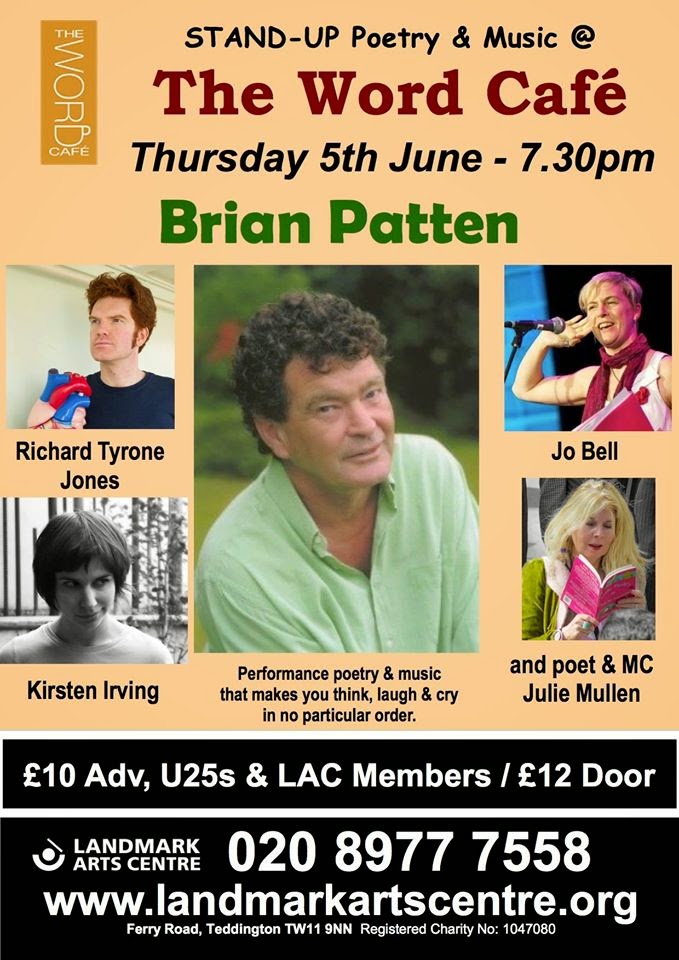
K reading with Brian Patten on Thursday 3rd June 2014!


I’m extremely excited to be reading at the Landmark Arts Centre in Teddington on 3rd June (that’s this Thursday) with Utter! MC Richard Tyrone Jones, Charles Causley Poetry Competition winner, Jo Bell, the irrepressible Julie Mullins and Brian Patten!

Fun fact about Teddington: Its famous residents and former residents include Mo Farah, Noel Coward and Benny Hill (who mentions Two-Ton Ted from Teddington in the song ‘Ernie, the Fastest Milkman in the West’).

Further fun fact about Teddington: It is but a short, Oysterable train ride from Clapham Junction or Waterloo

The Landmark announcement is here, the Facebook event is here and you’re advised to book ahead. Look forward to seeing you there!

Saboteur Awards 2014 roundup (with bonus Sidekick triumph!)

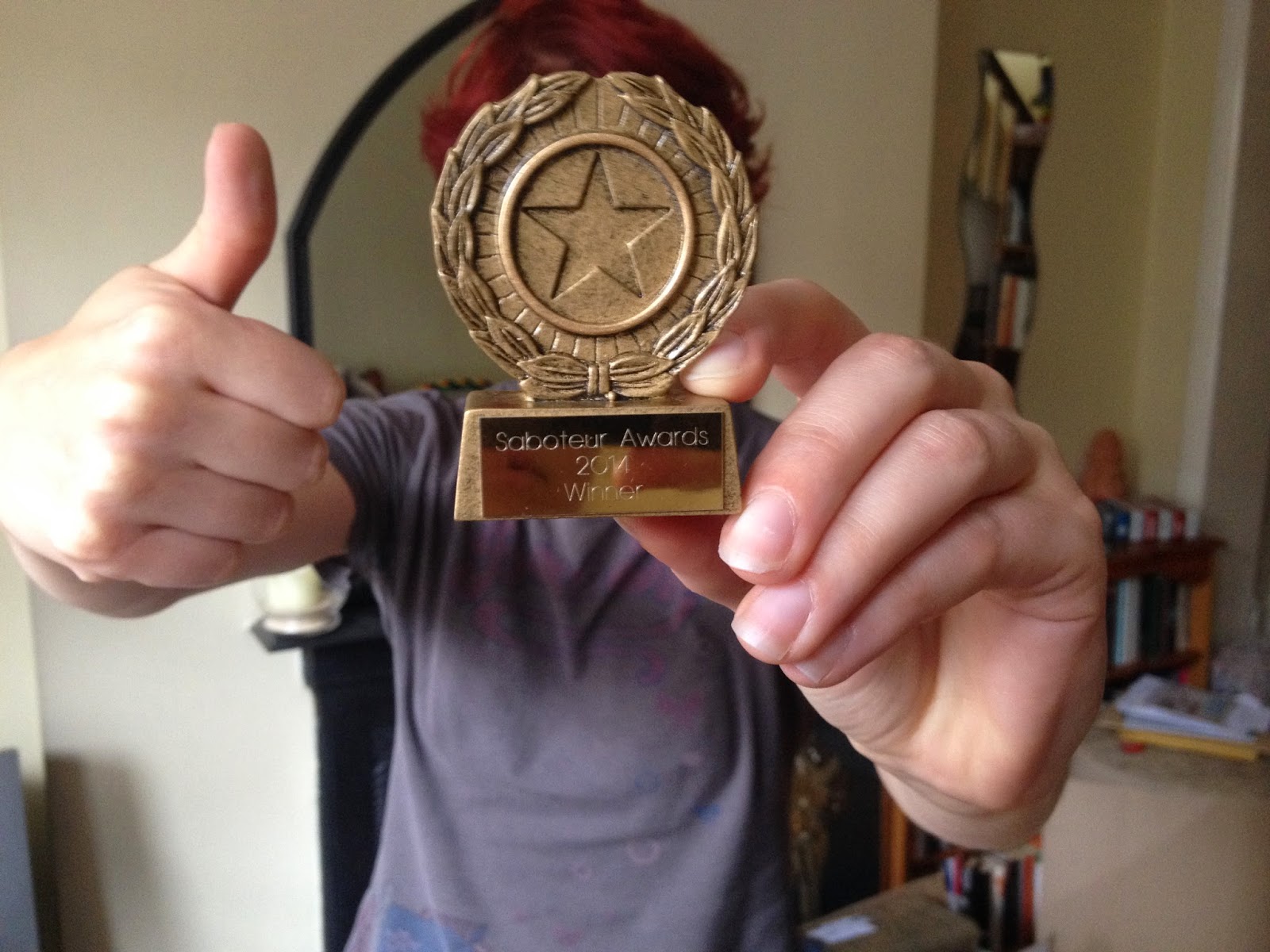
Woooo! Sidekick Books won Best Collaboration for Riotous yesterday at the Sabotage Reviews annual Saboteur Awards! Thank you to everyone who voted for us!

K following surgery to graft the trophy onto her head.

For those who don’t know the Saboteur awards, they are run by the Sabotage staff Claire Trevien, Richard T Watson and James Webster, and are an incredible force for recognition in independent publishing, particularly poetry. As with the website themselves, the awards are run voluntarily, and are nominated and voted for by readers and fans. They are also the only awards we know of in the world to recognise collaboration and anthologies.

The ceremony was held at the Jericho Pub, Oxford, and had a brilliant turnout. The accompanying all-dayer included showcases from last year’s Best Magazine champions RisingThe Emma Press (surely one to watch for next year’s awards) readings from Lucy Ayrton, Paul Hawkins and Best Spoken Word Performer winner Steve Nash. I also discovered the brilliant work of short story writer May-Lan Tan (Best Short Story Collection nominee and unofficial winner of the Best Twitter Name award) for the first time. Check out the haul:


Huge, huge congratulations to all the winners, including the brilliant Poems in Which, run by Amy Key and Nia Davies and illustrated by Sophie Gainsley.

Particular kudos is due to Nine Arches Press, winner of Most Innovative Publisher. One of the hardest-working, friendliest and most dedicated small presses active today, with a seriously impressive oeuvre. Great also to see recognition for non-London presses (and we say that as a London press).

Huge thanks to the Sabotage crew for a fantastic event, a breath of fresh Oxford air and an opportunity for us independents to show the world what we do and why. Here’s to next year!

For the full results, visit Sabotage Reviews. And while you’re there, have a good look around. This is what it’s all about.

Explaining Football to a Poet


Why do I like football? Near as I can tell, most poets don’t. I’ve tried to explain it to them sometimes. People who listened to me were usually familiar with my arguments (the tribal experience, the sway you feel when being part of something, the aestheticism of the athlete, etc.), the problem as they put it was just that they didn’t feel it. I couldn’t get them to ‘feel’ something by explaining it, of course, so I dropped it there.

I don’t want to start ridiculous comparisons, but there is at least one way in which poetry and football are similar. In both cases, people who don’t understand them usually think that the object they are looking for is somewhere inside the field or the page, and that they just can’t see it. It can be the feeling, it can be the meaning. Not many seem to intuitively grasp that they should be looking inside themselves.

Meaning is not something that you find ‘in’ or ‘inside’ a poem. It’s the result of the interaction between yourself and the poem, and that’s why there can be different meanings of the same poem that are equally valid. Football works, I think, in the same way. If you stare at the game and try to ‘find’ what it is that makes it click, you never will. Or you may get to a point where you think you found it, and will discover later (maybe a long time later) that you never did, like someone who thinks they finally discovered what a poem ‘really’ means and finds himself or herself reading it in a different light at a time when everything has changed.

You may think that I’m working towards an argument about football being as important as poetry (or as sophisticated, meaningful, interesting, etc.). Perhaps in a way I am, but not in the sense that I’m trying to raise football to nobler heights. From this as from any other sport you can draw abundant metaphors about life and the world. A man or a woman who understands football completely is a man or a woman who has understood life completely, and if you change the word ‘football’ for ‘poetry’ you’ll see what that statement really means.

I made the same mistake when I approached literature, or what you call high literature anyway. I was younger then in every way that matters and believed that there was something to ‘find’ in literature, some secret I could be in on, something to be revealed to me after reading a finite number of books. There was a supremely clever joke that I just didn’t get, but I could get it, and as I saw it, eventually I would. It took some time before all that washed away – and while this may sound cynical, in truth the ride was gratifying, even fun. I stress ‘the ride’, not ‘the literature’.

If you want to get football, and feel what other people feel, you will have to engage with it. I’m not suggesting that you should, because at the end of the day it’s just a game. But thinking that you’re exposing yourself to the sport by watching a match once in a pub is like thinking that you’re exposed to poetry because you’ve read a poem on the tube while commuting to work. Try reading a full collection, or a few collections, and try following a season or a few seasons, and see what happens.

Educate yourself. In football as in literature, the process of learning is enjoyable and beautiful. The process, not the football itself – get this clear. It’s ‘the ride’ that matters. You will start out knowing only the name of one or two stars in your team, the big ones. Then you’ll learn the names of the rest of the players. You will recognise their faces. You’ll find out what they do on the field and you may even discover an appreciation for the work of some yeoman who, at the beginning, you barely even noticed was there. You will develop sympathies and dislikes. You will look kindly on that young promise whom you noticed before everyone else did and who talks with an accent kind of like someone you knew. You will loathe that overpaid South American who always screws up the end-game.

Things will begin to come together. You will learn the playing styles of different teams and different coaches, and when some gang of champions loses 3-1 to the mid-table team, you’ll think goddamn if that doesn’t make sense. Goddamn if I didn’t see that coming. You’ll think formations and tactics. You’ll begin to watch games in a way that you don’t even think of now, barely even looking at the ball, only watching the patterns that the men make as they run on the football field. You’ll listen to the pundits and shake your head and think, why are they even being paid to talk?


And then you’ll make a prediction and mess it up completely. And you’ll castigate yourself for your arrogance and go back to the chalk-board. You’ll learn from your errors. You’ll start reading football history, the great teams of the past, and discover an entire universe made up of grainy colours that barely earns a mention in the sports media. You’ll start reading Zonal Marking. You’ll wonder how you could even think you understood the sport at all.

All of this process is internal. You won’t be captured by football, really – you will be captured and fascinated by your own knowledge, by the sense of your mind growing new wings. From this point of view, it’s no different than beginning to learn about literature. Knowledge, which I am not at all confusing with wisdom, is a joy in and of itself, a game in and of itself. It tantalises you with a sense of completion that never comes. It rewards you with a sense of entitlement when you interact with your peers. Many things in life we study only for the pleasure that is found in the study. My most personal example is wine. I don’t even particularly like the beverage, but the variety and the history and the complexity and the beauty of the language that describes it and the symbolism evoked by taste and so much more – that’s what drives me to learn about wine. You may think that I’m embracing vanity but I’m not. Knowledge works in this way, whatever the field. Wisdom doesn’t, but knowledge does.

I suppose literature has a more important role than football, though I’ve given up on trying to find a positivist explanation for its benefits to us, either individually or as a whole. In my own little life, literature has taught me nothing that football couldn’t have taught me as well. Or maybe neither could have taught me anything at all, which is kind of the same thing. The things I’ve learned that changed me came from the countries I lived in, the friends I made, the women I loved, the people I worked with. Not from books. Not from fucking books and football games.

Coming to this point of the article you may object that I’m just being a relativist – that I’m saying that what matters is knowledge in and of itself, regardless what the knowledge is of. Like being erudite in philosophy is the same thing as mastering the subtleties of Magic: The Gathering. That’s not really true though, because knowledge only matters to a certain extent. You need knowledge to start getting into football – and the fact that knowledge is a process (or a game) that is so seductive is part of what allows us to get there in the first place. But when you get there, and you will always get to a place that is both unique and inside yourself, it will be a specific place that nobody else can get to. It will be somewhere that only football could have led you to.

I can describe, as an example, the particular street and the particular house inside my spirit that football takes me back to, conscious that my experience will not be the same as yours, nor can it be. It is a rewarding exercise because looking back at my relationship with football helps me make sense of time. It is not very different with literature. There are phases, moments, things you grow out of, things you learn too late. Today, if I had to say what it is that keeps me in football in spite of everything, I would say – and this will be odd – that it is the sadness. You cannot do anything in football without stumbling into sadness. Not only because you will see your team lose so many times, and then so many times, and so many times, to the point that even those rare moments of jubilation (mine was in Rome, 9th of July, 2006) will quickly become the object of mawkish nostalgia rather than comfort. And not just because of all the filth that there is in football – the racism, the violence, the vulgarity, the sexism, the self-indulgence of celebrities, the culture of excess, all those things that give people a good reason to stay away from it and in the best of cases turn to rugby, or basketball, or athletics. Not even because of the most open lesson you can learn from the short-termed chronicles of the sport – that the job history does best, in football as in life, is not that of recording but that of forgetting.

No, for me football is so inescapably sad because its world is built on a foundation of lies. Everything that holds together its microcosm is false. There’s a story that takes place in the game, but the reason that game exists is that it allows for a different game – one in which people compete at who can tell that story best. Distrust anyone who speaks about football in a way that seems to make sense – they’re the best storytellers, which makes them the worst ones if you see what I mean. My own brief and mostly inconsequential experience with sports journalism saw me gaining a great deal of popularity very quickly before I let it all go – and the reason was not my preparation in the field of football, which was never anything more than passable, rather my preparation in that of poetry. My reputation was entirely built on articles like this, in which the only thing that really matters is the language in which the sport is described, and not the truth of it.

You may say that I was fooling my readers, bamboozling them. Believe me when I say that I was not. I was giving them football. The question of whether I believed in it at all is of no consequence – do I believe in poetry? Do I believe in literature? I’d love to say yes… but then the eyes of my next metanarrative, the one I told myself when I was sixteen years old as I forced myself to read Portrait of the Artist as a Young Man, come out from behind the door-frame and the hypocrisy of it all just gets overbearing.

And yet the reason I kept writing those articles, and the reason I still write poems, is that in the chasm of truth that they leave behind – and perhaps only in that chasm – I see something that is kind of like beauty. I won’t say that it’s beauty, but it’s something like that. And maybe that’s why there is so much sadness in football, because it teaches you that beauty is a lie that you can’t stop telling yourself. Maybe that’s why I can’t explain football to a poet, any more than I could explain poetry to a football fan. Maybe this whole article is a lie.

Sidekick Shodown: Letters to a Young Poet

An occasional (possibly one-off) series in which members of the Sidekick team take on received wisdom and unchallenged proclamations from on high.


When writing about the craft of poetry, there’s a popular mode of address which mingles mystagoguery with aphoristic instruction, often eschewing (or even contradicting) practical advice in favour of the ear-pleasing commandment. Don Paterson’s entry in the Letters to a Young Poet series on Radio 3 is an example of such an address. Throughout its 13 minutes, Paterson juxtaposes a lugubrious, teacherly tone with the pseudo-profundities of a pub philosopher. He is drunk, of a fashion – that is, intoxicated with reverence for the methodology that produces a particular strain of poetry, with love of the paradoxical and the dramatic, with the sense of his own authority.

The italics below are transcribed from the broadcast.

Young friend, you ask me if your verses are any good. The answer is: no, not yet. You knew this because you had to ask.

Paradox has a way of sounding like wisdom, but “You knew this because you had to ask” falls far short of the insight it aspires to. Level of reassurance sought is in no way related to the quality of a person’s writing or their awareness of it. Some people are brilliant and don’t know it. Others are insulated by confidence against the chill of their own mediocrity. It isn’t foolish to ask for a second opinion, just so long as you learn to cultivate your own sense of when a piece of writing is sufficiently accomplished, which will happen in time.

Those youthful geniuses we like to invoke mostly had foreknowledge of their own early deaths.

Very romantic, very unlikely. A more realistic explanation for the apparent brilliance of a few very young poets of past eras is the relative lack of distraction and the right context, the right emotional make-up, for obsessive devotion to an art, coupled with our cultural tendency to shape our aesthetic values around what they wrote.

The world needs more readers, not more poets.

At this early point in the address, Don begins to entertain (and later returns to) the seductive idea of poetry as a mad and dangerous pursuit, undertaken only by the fever-ridden few, the damned. It’s a clever kind of circle-pissing that avoids looking like elitism by making grotesques out of the implied elite.

But it’s perfectly acceptable to experiment lightly with writing poetry or to find your way towards it gradually. Attempts to warn people off, particularly from the incumbent hegemony, should be regarded with skepticism.

Poetry is not a calling but a diagnosis.

I liked it when Leonard Cohen said “Poetry is a verdict, not an occupation” and I like this. But neither is anything more than a playful aphorism. Comparing poetry to dyslexia and bipolar disorder, as Don goes on to do, is crude and untruthful. Being hopelessly predisposed towards an activity is not the same as having a mental illness or a disability.

If you feel you can choose, then choose no …

Make no mistake: Don Paterson chose to write poetry. If writing poetry in this culture were punishable by death or castration, he may very well not have done so.

Firstly, and most importantly, don’t ever think of yourself as a poet.

Or do. It isn’t important whether you think this or not, except to the degree it makes you comfortable or uncomfortable. Just don’t believe that because you’re a poet, whatever you write is poetry, that the status itself imbues your words with authority. Too many established poets make that mistake.

‘Poet’ describes an activity, like ‘murderer’, not a permanent disposition.

This stands in apparent contradiction to his ‘poetry as diagnosis’ position, and makes for a strange comparison, because a murderer doesn’t stop being a murderer mere moments after he’s done murdering. Don’s ensuing extended metaphor of the murderer-poet is appealing because we like to characterise ourselves as creatures of dramatic action and bloodiness. But there is little truth here. A statement like ‘unlike other artists … we do other things too’ is bafflingly opaque. What ‘other artists’? What do we do that they don’t? He then suggests that you should plan your first published poem like an assassination, expecting not to get away with it if it’s anything less than perfect. In fact, poets get away with bad published poems all the time, and you will too. Expect your most carefully crafted poems to be passed over by editors in favour of something you tossed together at the last minute. Expect to have to change your mind repeatedly about any work that is important to you, particularly when it appears in print for the first time.

Also, because the investigator of the successful poet becomes more relaxed and accommodating, while the investigator of the murderer grows ever more determined and scrupulous, poets also have a tendency to get sloppier with time, while murderers become more proficient – the exact opposite to what Don asserts here. It’s a terrible series of points.

Skipping to the more fundamental parts:

To write poetry is the ultimate presumption. It says ‘I have something important to say’.

There is no reason to apply this to poetry in particular over other art forms. Nor is there any reason to suppose a poet means to say something ‘important’, rather than something merely interesting or pleasing.

Don is betraying here his own predilection for poetry of proclamation and revelation. It’s the first big clue that he’s not really talking about poetry at all; he’s talking about ‘poetry in the style of Don Paterson’.

You can’t steal a poem, even from yourself.

But you can steal a poem, both in the sense of appropriating words already written, and in the sense of the poem flowing easily from a sentiment, conceit or compulsion. Perhaps Don is advising here that we don’t rely on these shortcuts because they are few and far between. More realistically though, he is suggesting that a poem isn’t a poem (in the Don Paterson mould) until it has been through the forge of writerly concentration, been won through labour.

As advice, this is about as helpful as being told that wealth can only be acquired by starting at the bottom of a company and working your way up. It just doesn’t engage with the nature of creative writing – particularly a short form like the lyric poem, which can slide into view or throw itself upon you just as much as it can be forced to work through hours, days, weeks or months of careful attention.

Subject matter is mere pretext to write about something else.

It’s hard to disagree entirely with this because it describes an approach that works for many poets. But this absolutism is phony. He’s showing us the source of a river and telling us it’s where all the water in the sea comes from. Sometimes a poet who decides to write a poem about a fox writes a poem about a fox, and sometimes the poem ends up being about something else entirely.

If you sit down already knowing what you’re going to write, stop, because so does the reader.

Don says this after dispensing another colourful-but-reductive analogy – humanity as coral reef, all thinking the same thought. In Don’s eyes, the ‘unexpected’ – that element of poetry that ought to be treasured – can only arrive through process, and thus the point of a poem is only discovered as the writer nears completion, having written it ‘backwards’. I don’t see any reason for his making this assumption on behalf of other people, even if it’s how his own mind works. It strikes me more as ex post facto justification than intellectual discovery, and an excuse for a lack of ambition (or perhaps narrowness of ambition) when starting out with a blank page. It is entirely possible to begin writing with a grasp on how the poem will move towards the unexpected.

One should also not treat Don’s methodology as a guarantee against the drift towards banality. It is still a formula, and like all formulae, it returns results that grow more familiar as they accumulate.

The darker truth is that you will stand out in thunderstorms flying a kite, or in bad weather be tempted to summon your own tempest.

Yes, cognitive bias means that people who are too greedy for ‘poetic’ subject matter will tend to find melodrama wherever they look. Don seems to be going so far, though, as to suggest that poets create problems for themselves in order to write about them. I’d suggest that most people have enough problems and merely suffer from thinking that they ‘should’ write about them, even when not particularly inspired. This is the fault, I’m sorry to say, of too many prizes given to poems about dead parents. It doesn’t mean you should distrust genuine inspiration.

Remember, form is your friend. It makes poems both easier and harder to write. Harder because it will prevent you from saying the one thing you wanted to say, which is often dull, weak and commonplace, and easier, because form forces you to say something else …

Although he lays it on with a trowel (up to and including the claim that this is what your reader ‘demands’ of you), I agree with Don about form. I suspect he may be talking only about traditional form, though, rather than form in all its possibilities.

Remember your unconscious is your unconscious for a good reason. 

The conscious/unconscious isn’t a very useful dichotomy when talking about writing. I would suggest that there are things toward the edge of one’s mind, things that hide in plain sight, and things that can and ought to be drawn further into the light.

The truly original idea must be part familiar, so that it can take the reader on a journey from the known to the unknown.

Ah, this business of taking readers on journeys. Here, as far as I can tell, Don is railing against writing anything that is too overtly alien, but how does he, or anyone else, know what is familiar or unfamiliar to a particular reader? What if the reader is in search of the alien? The trap Don has fallen into is identifying a pleasing effect and imagining (a) it is the pleasing effect, and (b) that it can be planned for. But anyone who has ever found themselves baffled and dismayed by other readers’ enthusiasm or glowing testimonials will know that there is no formula for emotional impact. Advising us to set out to perform this particular trick is like telling us to develop a rapport with everyone we meet, and to do so using only gentle and placatory gestures.

The most fruitful risks will involve writing at the extremes of emotion just before it shades into sentimentality, writing simply just before it shades into foolishness and with prophetic force just before it shades into pretentiousness.

This, again, looks a lot like wisdom – because of course one should always stop short of sentimentality, foolishness and pretentiousness, if one can. Don goes on to use the analogy of the puffer fish being prepared so that just a little toxin from the poison sac seeps into the flesh – just not enough to kill. It is, again, a dramatic and appealing analogy. But really, there is no such fine line. Most poetry, I would suggest, finds itself appearing sentimental, foolish or pretentious to some readers as the necessary price for impressing others. That’s the nature of spellcasting. Gunning for prophecy, simplicity and/or profundity, meanwhile, is as natural an instinct as there is in writing, so that this very elaborate and neatly worded passage of Don’s address really amounts to “Aim to reach the finish line as fast as you can, but try not to stumble”. It has nothing to do with risk.

Risk in poetry is a more fiddly thing to unpack. It might mean, for example, writing to a form or in a manner or on a subject that you know is unfashionable or overtly disapproved of so that there is very little chance of meeting the criteria set forth by those with the most influence, who are in a position to promote or deny your work. It means being prepared to write a poem that is unlikely to get any airing at all unless you are able to smuggle it in under the watchful eyes of the gatekeepers, or unless you catch a wave of changing fashions.

Being ignored, having something to say but finding no one prepared to listen – this is a deeper punishment than simply being seen as pretentious or foolish by a proportion of a small readership. That is why, after all, too many poets conform to the aesthetic expectations of Don and his peers too readily. Some bets are safer than others.

I note at this point that the way in which Don has set about characterising his imaginary correspondent in this address is as someone overtly seeking Don’s approval. Don is really envisioning himself being asked, “How do I write the sort of poem you might consider publishing?” Naturally enough, then, he doesn’t wish to consider the risk of writing a poem that he himself wouldn’t touch. So when he thereafter talks of ‘readers’ or ‘the reader’ –

Readers read poetry to take them closer to something powerful and dangerous that they will not usually be prepared to let themselves feel.

– he is talking about himself. We know readers come to poetry for a whole variety of different reasons. But Don is interested in telling us what he wants from a poem. Earlier in this article, I said it was important to develop your own sense of when a piece is sufficiently accomplished. It’s also important not to mistake that sense for a universal doctrine, which is the mistake Don makes here.

Risk is also bound up in compromise and negotiation. It’s not the case that one simply ‘takes risks’, but that one risks something specific in return for something else. Whose criteria, for example, do you seek to meet, and to what extent, in order to win them over? Don’s correspondent risks ending up lacking individual character in his poetry as a result of seeking guidance as to how to impress Don the reader, how to write poetry in the style of Don Paterson.

We have to take Occam’s Razor and then use it to murder our darlings.

I admire the welding together of two cliches, but this doesn’t mean anything.

Only write half the poem, but precisely the half that will prompt the reader to supply the rest of it …

This is just a cute way of advising against over-explicating. Poets write the whole poem and the part that reader supplies isn’t the poem.

A poem is like an ecosystem – a complex interdependency between a finite number of agents …

This is also true of a bicycle or a table lamp.

Such a poem has harmony as well as melody, and creates the rich context in which we can read its symbols.

What he appears to be saying here is that deftly handled rhyme, repetition and other literary devices can add to the meaning and functionality of a piece as well as looking and sounding pretty. This is true, but we’ve arrived at a point where he’s reiterating the obvious.

And don’t advertise the strange by making it sound strange.

There’s no reason outside of personal preference to follow or ignore this advice. Some people enjoy strange sounds.

The brain will entertain anything that is sung to it first, even things it vowed not to let pass.

Pertinent – this whole essay is an exercise in singing sweetly in order that the listener’s brain entertain (and perhaps accept) what are often very wild assertions. So point proven, I guess.

But never forget that poets are not your audience … There are too many poets for whom the reader is an inconvenience.

‘The reader’ here, once more, is Don himself, so these two statements don’t sit easily with one another. He is counselling against navel-gazing, against writing for the precious few, but his notion of the poor, undoted-upon general reader is a vision of himself in the throne room of every individual’s brain. If there are too many poets for whom the multiplicity of real readers with conflicting and exacting tastes are an inconvenience, Don is one of them.

If you’re a poet, poets may well constitute the bulk of your audience, as it happens. Or they may be a slim wedge of your audience, or all of it or none of it. They certainly constitute the bulk of Don’s audience. And, as he was earlier keen to point out, poets are only poets when they’re writing poetry. You can treat them as people the rest of the time. It’s no crime to write for a small audience, or even an audience of one. Tastes are easily changed, so that the niche becomes mainstream. Plenty of popular artists and entertainers are idiosyncratic enough that it’s possible they’re not thinking of any audience, let alone some nebulous, faceless ‘reader’.

Kurt Vonnegut suggests writing for one person only as a fundamental rule. I suggest writing for someone out there very much like you, and taking the risk that you’re entirely on your own, rather than pandering to inevitably wrong-headed assumptions about what some average person may want or need from you. Alternatively, I suggest writing for an imaginary jury or parliament of individuals, and having some real fun (by which I mean adventures, by which I mean crises) trying to negotiate their irreconcilable differences in taste.

Sabotage Awards, Angela Lansbury and new Sidekick Cat!

Finest acolytes! Much news from Sidekick HQ!

Firstly, Sidekick Books has been nominated for THREE Sabotage awards! We’re up for (drumroll):

Most Innovative Publisher

Best Collaboration
 (for our hand-sewn tropical zoo sonnet sequence Riotous)


So if you like what we do, please remember we need your vote to win! No registration gubbins needed. It’ll take less than a minute (or more if you’d like to elaborate on why you dig our strange creations). The Sabotage Awards are a big deal for small presses, so thank you in advance for casting your ballots!


Secondly, if you’re in London this week, get thee to Waterstones Hampstead this Tuesday 13th May at 7pm for some Angela Lansbury lovin’, featuring Twin Peaks, murder and     shunds. If you missed the launch, or simply need your Jessica hit, join Chrissy Williams as she takes us deep into the world of ‘Angela’


The King’s Cross launch event last year was packed, so this is a great opportunity to see one of London’s wittiest, warmest and most innovative poets share her darker Cabot Cove obsessions. 

Tickets: £5

Facebook event here.
Buy the book here, with free Angela pin badge!

Thirdly, please wish a warm welcome to Mitchell the Cat, who has moved from a prominent position with lots of responsibility at Battersea Cats and Dogs Home to our Silvester Road HQ, and is currently on photocopying duties.


Have a fantastic Eurovision, everyone! Let’s wish Conchita Wurst all the best!

Classical versus Modern Poetry in Football


The Criteria

I’ve set the demarcation line between classical and modern at the year 1700, picking poets born before and after that date to compose my teams. I’ve also been kind of liberal with the term poet, in that I’ve included playwrights in there. And as long as I’m making arbitrary decisions I might decree that every paragraph has to end with the phrase “in accordance with the prophecy”, just to get on your nerves.

With no further adue, then, this is what the two teams look like, in accordance with the prophecy.

1. The Classical Poets.


The formation, what else could it be, is a classical 4-4-2. The goalie selects itself, really. Homer is at the back of any poetry team in the West and no-one else could take that position in his place (ok, so he’s blind, which doesn’t really help a goalkeeper, but still…). Virgil and Petrarch also represent the bedrocks, and they’d make for great defenders. Virgil has the technical ability to play in several other positions as well, so he could potentially play as a libero, while Petrarch is somewhat more limited in terms of his tricks on the ball, but far more influential: it’s really very difficult to get past him, which makes him an ideal centreback. His talent for throwing long balls ahead can come in handy too.

Placing those three together makes for a defensive triangle of exceptional talent and authority. Arguably the world’s greatest goalkeeper and two legendary centre-backs – on the whole this would be a daunting prospect even for a team as talented as that of modern poetry.

And yet the classical team’s fulcrum of strength lies in central midfield: Dante and Shakespeare put me in the embarrassing position of having to describe two players in terms of propagandistic hyperbole. They are inarguably the most dazzlingly skilled pair of players in the game. Dante’s position in the midfield is a given – his obsession with the (typically medieval) notion of centrality draws him to a spot where he can make full use of his tremendous arsenal of skills. We’re talking about a player who has quite possibly the best sense of tactics and vision in the history of the game, a tremendous passer and play-maker, domineering in possession, and with a murderer’s long- and short-range shot to boot. It is true that he is not the fastest player around, and at 747 years, he may be a touch old for the frantic pace of the modern game – at the very least, he could lose some energy in the last parts of the game, which opens some opportunities for the younger team of the moderns. Nonetheless, a genius midfielder whose only parallel is perhaps his own team-member – a Mr William Shakespeare.

Shakespeare needs no presentation unless you’re teaching advanced literary history to Liberal Democrats, who don’t have a clue about not having a clue. Potentially the number 10 of this team (but the position is not quite right for that), Shakespeare’s versatility is compounded with a set of dazzling tricks that are effective both defensively and offensively. Unlike his fellow, he is anything but slow, and his abilities allow him to create danger from virtually any position on the field. The presence of Dante alongside him suggests that Shakespeare’s duties would be more offensive, with the Italian acting as the playmaker and Ol’ Will making runs into space (the combinations between the two would be gorgeous to watch). But it would be a shame to waste his defensive skills, and the man can be counted on even if the game is just about defending a result.

The wings are tough. While the classical poets have greater players overall than the moderns, they do suffer from a comparative lack of variety – you can throw in such talent as Milton, Lucan or Lucretius, but what are they adding to the game that isn’t already provided by Virgil and Dante? Hence the controversial decision of fielding Ronsard on the left, mainly for his abilities at running into his space and his speed on the dash. Ariosto and Lope De Vega are both ambidextrous, but the former was preferred behind Ronsard for his defensive skills – the Frenchman’s forays going ahead are likely to leave his flank exposed to counters, meaning that someone is required who can hold the line on his own. Ariosto is a player who has the potential for some truly damaging and creative runs, but in this formation he’d probably have to curb them back in favour of his defensive abilities – which are truly great. By writing an epic that’s as long as War and Peace but rhymes and scans everywhere, Ariosto has created one of the great fortresses of literature. If he can bring the same qualities to the actual pitch, there is no doubt that he’d make for a great complement to Ronsard’s harmonious offensive runs. (Incidentally, Ronsard’s ability to cut himself a space – even when he is outclassed, as he was in international Renaissance literature – is one of the reasons he earned himself a spot among the starters. You need some unpredictability out there).

The other side sees in Lope De Vega an enormous resource for the team. A better and more balanced fullback than Ariosto, De Vega can be expected to move more in the offence, liaising with Ovid’s sustained runs. Both of these players play a very beautiful game (the latter too much so, perhaps – some cynicism may sometimes be desirable). De Vega is in fact one of those multi-talented players who would have fared very well in the midfield, had the spots not been occupied by the Big Two. His positioning as fullback is mainly due to his stamina – De Vega is the Gareth Bale of poetry, able to run twice as fast and as long as anyone else on the pitch. He is not perhaps the most original player, but coupled with Ovid, it should mean that offensive opportunities (or just openings for the passes of Dante and Shakespeare) should always be provided on the left hand.

The coupling of Ovid and Lope De Vega is untested and questions remain as to whether it would work properly.

Finally, the offensive duo represents a bit of a gamble. Neither Sappho nor Sophocles are pure strikers, and their nimble build suggests they might struggle against more physical defences. They are, to some extents, limited players – and sort of similar, not just because they’re both Greek and both of them have names that begin with the letter S. Sappho has a better shot from the distance, Sophocles is better at playing on both sides of the pitch. In the end, however, they’re both electric strikers – able to create sudden chances by dashing in and freezing everyone. Their middle- and short-range shots are piercing and they’re both outstanding in one v one scenarios.

Sophocles would probably play a little further back and help in connecting gameplay, with Sappho charged with finishing plays. Their ability to swap positions might be a real asset, but their partnership is even more uncertain than the one between De Vega and Ovid, and there is some internal evidence that the players do not get along with each other. Personal differences may in fact be one of the weaknesses of this apparently impregnable team – if England can fail with a midfield composed of Gerrard and Lampard, maybe even the duo Dante / Shakespeare might turn out to be abortive in spite of the enormous individual talents of the two players. But that’s something that only practice can tell.

(I imagine most people by now will have figured out that this is one of those articles where I write and drink simultaneously… and I’m about halfway through my stack, and halfway through the article. The pace is working out.)

2. The Modern Poets

The modern poets are less talented individually, but they provide a much wider array of skills – allowing, at least in principle, for a stronger overall team. Let’s take a look.


There are plenty of candidates for the position of goalkeeper, but Pablo Neruda, if only for his tremendous international reach, probably takes it. I can’t imagine anything that he would not be able to “reach” in that sense, never mind an adversary’s shots. The guy’s fucking Dhalsim.

The central defence is handed to Jorge Luis Borges and TS Eliot, my personal favourites from this team, and also the two guys who would much rather have played for the other side. Eliot may come across as the kind of poet who would play as a striker, but really he is the most conservative and backward-looking guy out there, and Borges is not very different in this sense. Together they make for a fine defensive pair (allowing for the fact that, again, Borges is blind). Rainer Maria Rilke is a very defensive choice as far as fullbacks go, but he is probably necessary as the formation is on the whole slanted going forward. John Keats, possibly not the most obvious choice for a defender seen how he could barely defend his own self in his time, makes it into the team for his altruism – something quite rare and therefore most welcome in this team.

On to the midfield, it’s worth spending a few words to discuss the formation – the 4-2-3-1 is much more original and complex than the archaic 4-4-2, but it demands players with very specific attributes from the midfield upwards. The right wing tends to fall back with the midfield trio, while the central offensive midfielder is expected to make a great deal of runs both forwards and back. The left winger is in some ways a decoy – s/he functions as a wide striker, really – while the actual striker plays in a false nine position. The two midfielders need to be a playmaker and a defensive mid.

Goethe’s position is obvious – he’s possibly the only one in the post-1700 pool of talent who can stand to the classical midfielders in terms of sheer multi-tasking abilities. He’s the playmaker here, with Federico Garcia Lorca as the defensive mid (another guy who wasn’t especially good at defending himself, but he should be fine on the pitch if nobody decides to shoot him). Lorca is a splendid talent, strong both in breaking another team’s offensive traditions and also in imposing his own game. There’s no way that the modern midfield pair can hold in a comparison against the duo of Dante and Shakespeare, but their slick players might be able to dominate the game by relying on the numerical superiority offered by the 4-2-3-1 in that part of the pitch – especially when they can count with the French pairing of Baudelaire and Rimbaud.

Rimbaud is a highly imbalanced player, being extremely offensive and quite poor at covering spaces, which is why Rilke is clearly a necessity behind him. Yet his ability to do unpredictable things with the ball makes him an asset that even Lope De Vega might have trouble dealing with. If the classical team is caught on the counter and Vega is left alone to cover Rimbaud, this may result in some very real goal opportunities. As for his partner, Baudelaire (will there be chemistry?) is clearly more wide-ranging, which makes him a better fit for the position. Technically he’s one of the better players in the team, and his presence in the advanced middle should allow him to bring that technique to bear in combination with any of the players that surround him. The results are anyone’s guess, though he does tend to get dispirited when he’s losing, and his athletic condition – like Dante’s, but for different reasons – is not of the best.

The moderns are playing with fire by placing Dickinson on the right and Plath as a striker. They are, in some ways, similar players. Plath is somewhat mono-dimensional, a great striker, but not necessarily the best fit for the false nine position (Baudelaire himself might have taken that role). In a different formation, she would have been the perfect striker, but here she’s a gamble. Still, no-one can close quite as effectively as she can, and faced to the defence of the classicals, a single moment of poaching genius by the American poet might just make the difference. As for Dickinson, in the right-wing position she’d have to provide a lot of breath to the team – if Rimbaud goes forward all the time on the other side, then Dickinson will have to compensate for that by offering support to Goethe and Lorca when they need it. Considering that she’s got Keats behind her it’s unlikely that most of the opportunities will emerge from that side of the field, but they’re both very fast players, meaning that they should at least be dangerous on the counter.

CONCLUSIONS

Who would win? I actually don’t have a clue. I suppose I could try finding out, but by this point I’m all out of wits and beers, and I’m expected somewhere. Plus, I suspect not everyone will agree with my decisions in terms of who should play and where – plenty of options on both sides. I think I’ll close this article here.