Books | Poems | News | About

sidekickBOOKS

Seven-Player Co-op: a Coin Opera II event!

For those of you unable to access the Facebook event, this Thursday 6th November we will be hosting Seven Player Co-op, an evening of game poetry, at the Four Quarters Bar, 187 Rye Lane, Peckham.


Contributors to ‘Coin Opera 2: Fulminare’s Revenge‘ reunite for an evening of poems based on, or inspired by, computer games, featuring: Samuel Prince, Gabrielle Nolan, Harry Man, Emily Hasler, Clifford Hammett, Jon Stone and Kirsten Irving.

And possibly a Top Secret End of Level Boss. I can say no more for now.

We’ll be setting a quiz and offering as a prize on the night the top level Kickstarter reward!

So that’s:
  • a copy of Coin Opera II in all its hot-foiled glory!
  • a copy of procedurally-generated and hand-sewn experimental poetry pamphlet Core Samples, featuring poems which drill through levels in Zool, Trine, Grim Fandango and more!
  • a poster featuring sprites of all of COII’s contributing poets.
  • a rather snazzy badge.
  • a copy of Super Treasure Arcade, a full-colour pocket booklet featuring a poem a game for every year between 1971 and 2013.
Nearest station is Peckham Rye Overground and readings will start between 7.30 and 8pm. Lots of buses too! The bar also has old school arcade machines, so you can take your pick of entertainments!

Coin Opera II custom poems #5: Fallen London for Claire Trévien

As top-tier rewards during our Kickstarter campaign to fund the printing of video games poetry anthology Coin Opera II, we offered backers the chance to have their own custom poem written on a game of their choice. In the run-up to our Seven-Player Co-op event on Thursday 6th November at Four Quarters Bar, Peckham, we’ll be revealing the finished poems, now in the hands of their wonderful backers.

Poet and storyteller Claire Trévien selected Failbetter Games‘ steampunk text adventure Fallen London. Kirsty used the familiar refrain of the game to bring the narrative swinging back around each time.

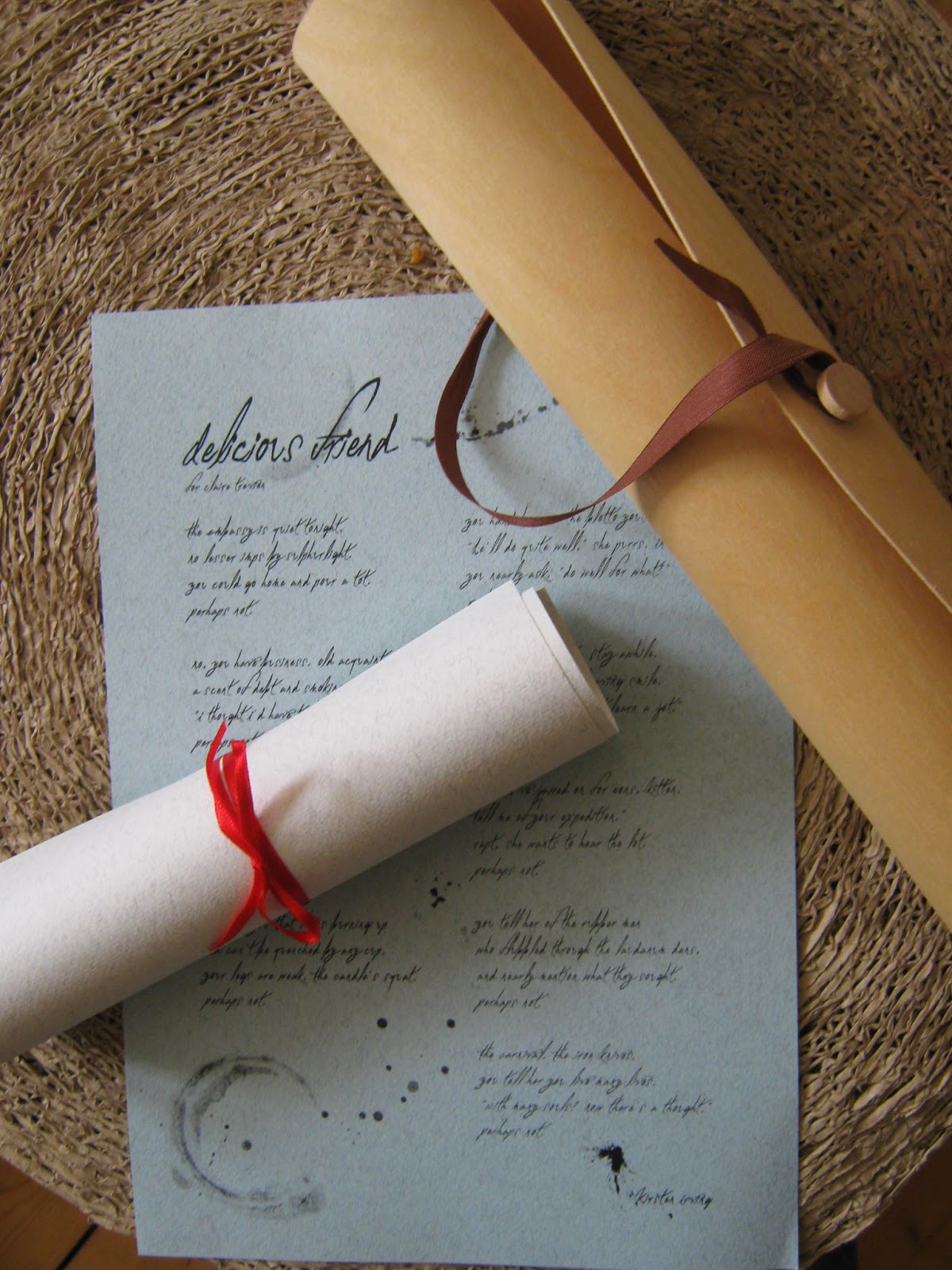
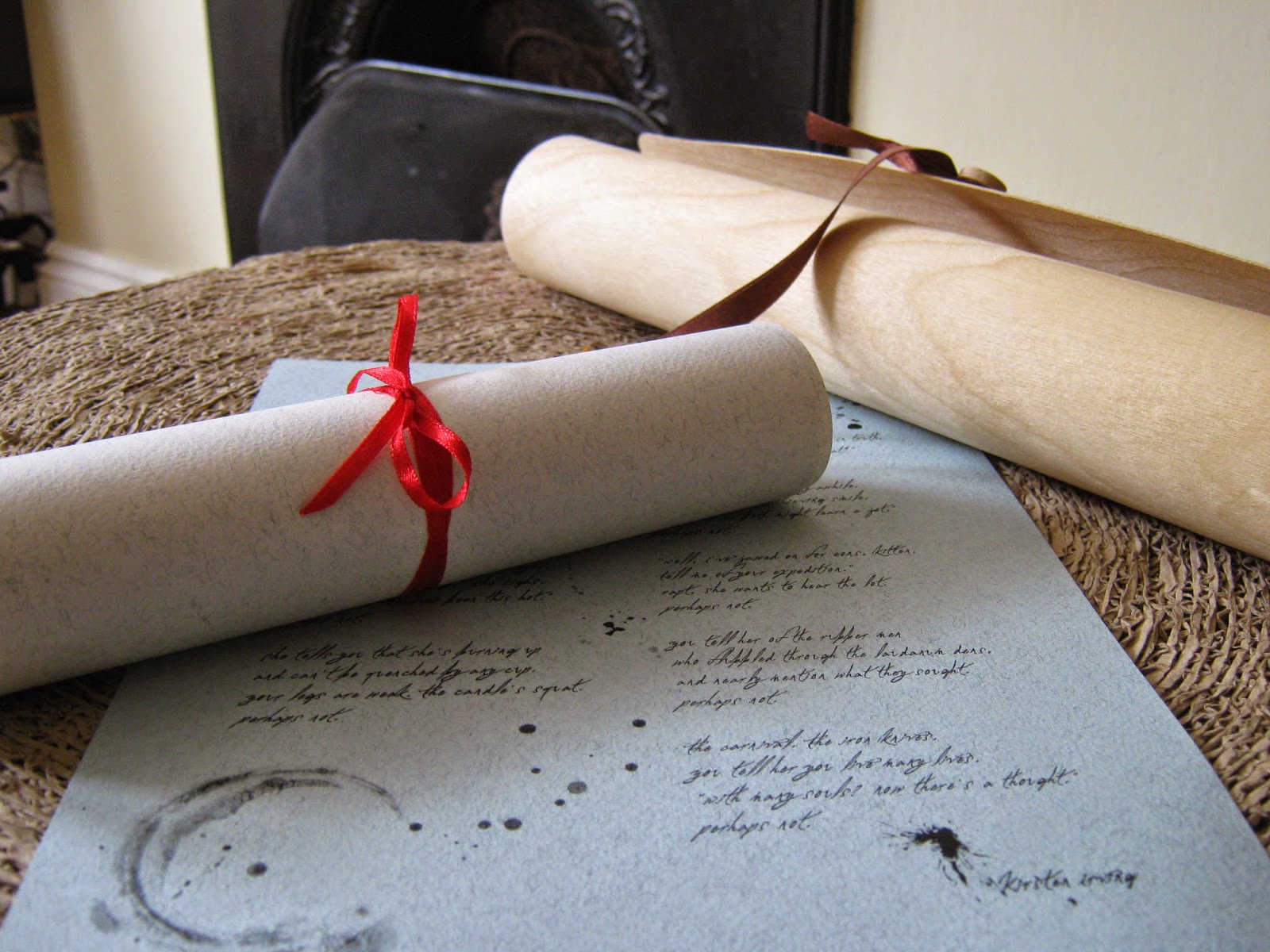
Here’s what a mysterious stranger dropped through Claire’s door:


And here’s the poem to read (simpler text below, as the author was a scrawler):


Hmm. This might be a bit easier on the eye:

Delicious Friend
For Claire Trévien

The Embassy is quiet tonight.
No lesser imps by sulphurlight.
You could go home and pour a tot.
Perhaps not.

No, you have business. Old acquaintance.
A scent of debt and smoking incense.
“I thought I’d have to have you caught.”
Perhaps not.

She welcomes you with blazing eyes.
“I do hope you can help,” she sighs.
“Perhaps you’ve never been this hot.”
Perhaps not.

She tells you that she’s burning up
and can’t be quenched by any cup.
Your legs are weak. The candle’s squat.
Perhaps not.

You hand her now the blotto youth.
“He’ll do quite well,” she purrs. In truth,
you nearly ask, “Do well for what?”
Perhaps not.

“Your hand is empty. Stay awhile.
I’d like to see that thieving smile.
You know, we both might learn a jot.”
Perhaps not.

“Well, I’ve jawed on for eons, kitten.
Tell me of your expedition.”
Rapt, she wants to hear the lot.
Perhaps not.

You tell her of the rubber men
who flubbled through the laudanum dens,
and nearly mention what they sought.
Perhaps not.

The Carnival. The iron knives.
You tell her you live many lives.
“With many souls? Now there’s a thought.”
Perhaps not.

***

Thanks once again to all of our amazing backers.

Coin Opera II custom poems #4: Civilization V for Helen Lewis

As top-tier rewards during our Kickstarter campaign to fund the printing of video games poetry anthology Coin Opera II, we offered backers the chance to have their own custom poem written on a game of their choice. In the run-up to our Seven-Player Co-op event on Thursday 6th November at Four Quarters Bar, Peckham, we’ll be revealing the finished poems, now in the hands of their wonderful backers.

The fantastic Helen Lewis chose Civilization V for her custom poem, and the finished piece ended up being excavated by Kirsty from many sediments and centuries, with just a dusting of Coleridge left behind.


Here’s the readable text for you to enjoy.


Thanks once again to all of our amazing backers.

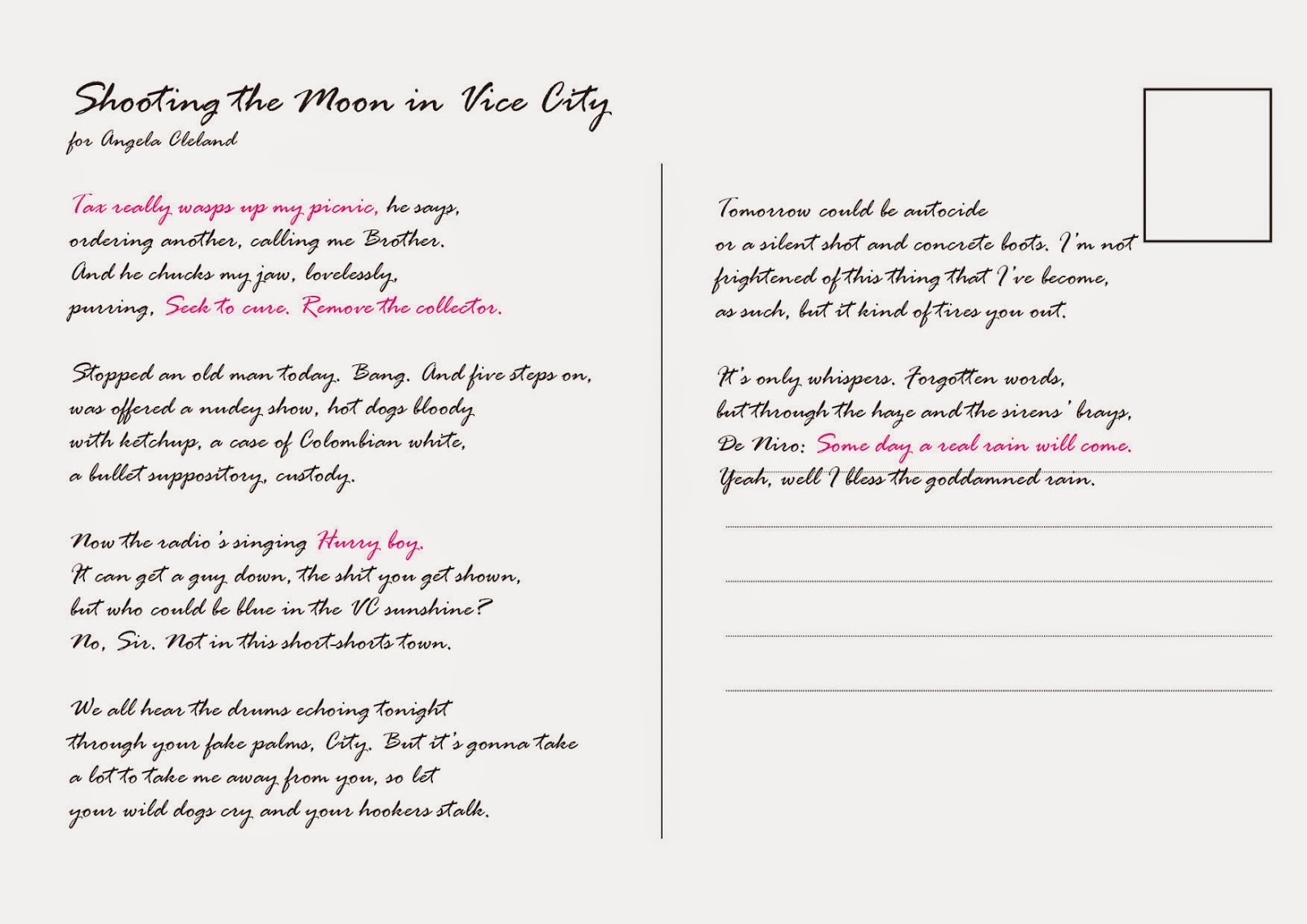
Coin Opera II custom poems #3: GTA Vice City for Angela Cleland

As top-tier rewards during our Kickstarter campaign to fund the printing of video games poetry anthology Coin Opera II, we offered backers the chance to have their own custom poem written on a game of their choice. In the run-up to our Seven-Player Co-op event on Thursday 6th November at Four Quarters Bar, Peckham, we’ll be revealing the finished poems, now in the hands of their wonderful backers.

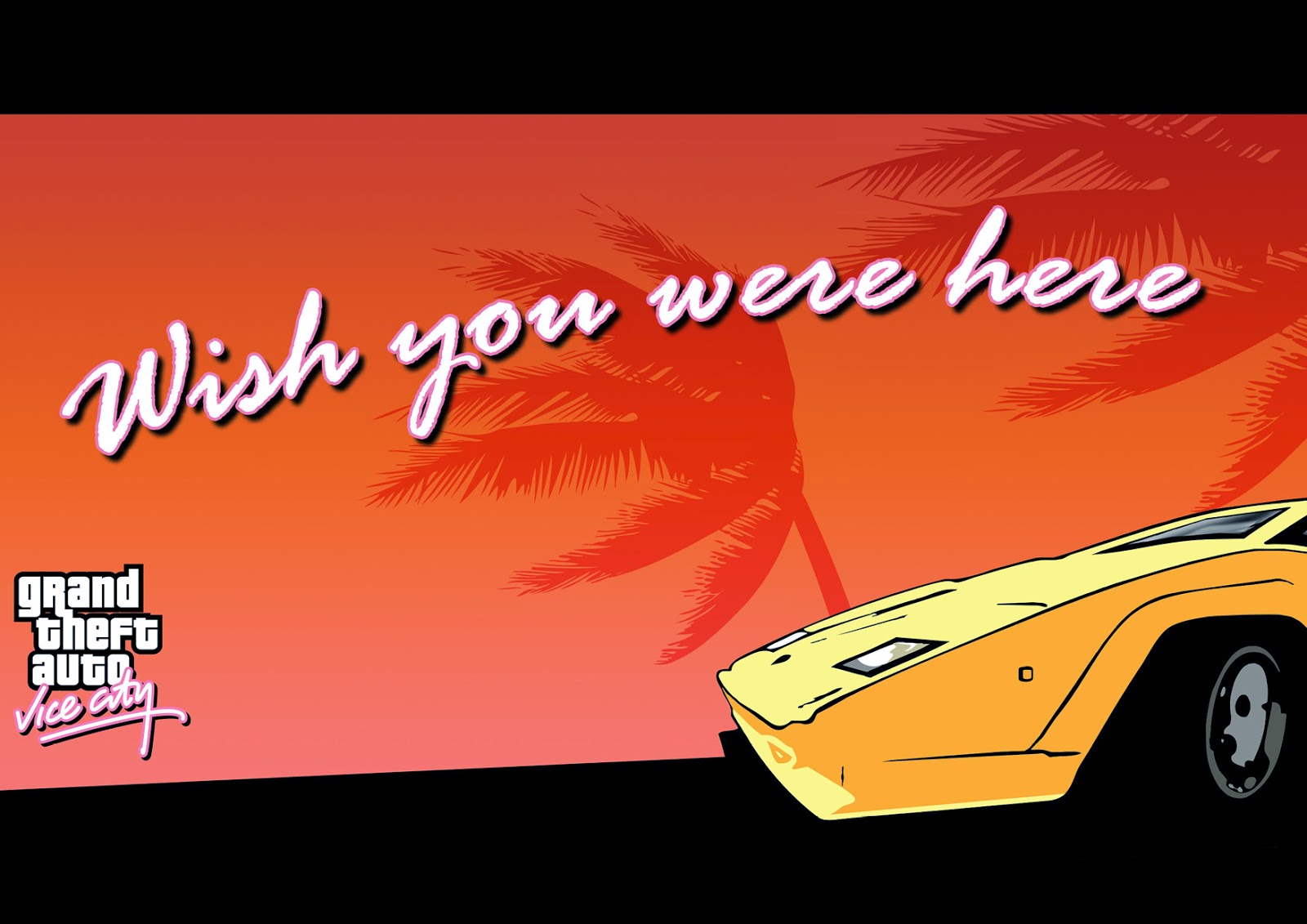
This time it’s the turn of the talented Angela Cleland, who requested a poem on Grand Theft Auto: Vice City. This was huge fun for K to write, and began with Cleland’s memory of a particular song playing on the in-game car stereo: Toto’s Africa.

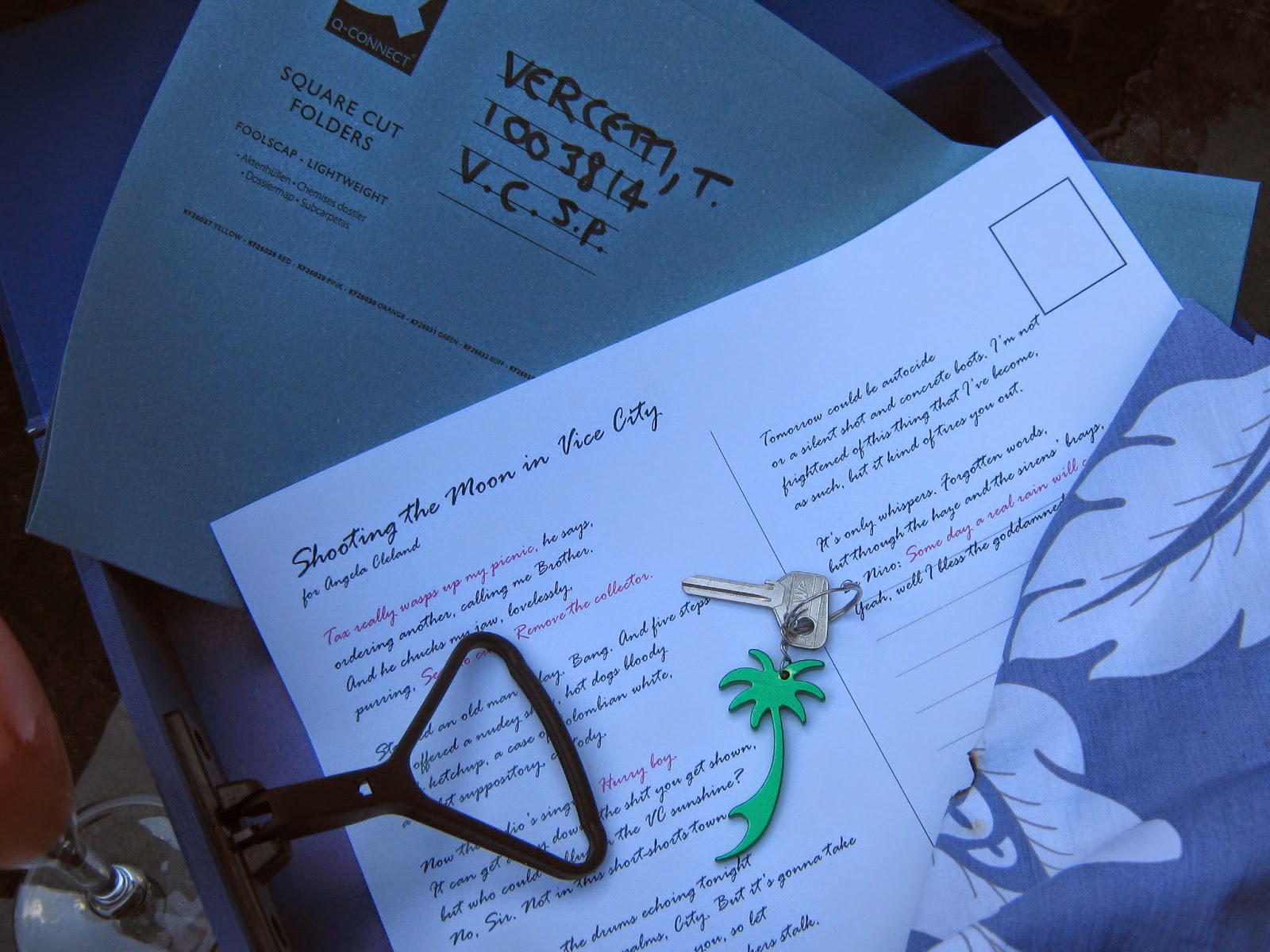
Here’s the physical poem Cleland received, done up as protagonist Tommy Vercetti’s prison-confiscated belongings. Well, it had to catch up with him sooner or later.


And here’s a postcard for you to read.


Thanks once again to all of our amazing backers.

Coin Opera II custom poems #2: Shenmue for Carly Lightfoot

As top-tier rewards during our Kickstarter campaign to fund the printing of video games poetry anthology Coin Opera II, we offered backers the chance to have their own custom poem written on a game of their choice. In the run-up to our Seven-Player Co-op event on Thursday 6th November at Four Quarters Bar, Peckham, we’ll be revealing the finished poems, now in the hands of their wonderful backers.

This time, it’s the turn of the splendid Carly Lightfoot, who chose 1999 action-adventure game Shenmue.

Here’s the physical poem she received:


And here is a readable version, just for you:


Thanks once again to all of our amazing backers.

Coin Opera II custom poems #1: Ecstatica II for John Clegg

As top-tier rewards during our Kickstarter campaign to fund the printing of video games poetry anthology Coin Opera II, we offered backers the chance to have their own custom poem written on a game of their choice. In the run-up to our Seven-Player Co-op event on Thursday 6th November at Four Quarters Bar, Peckham, we’ll be revealing the finished poems, now in the hands of their wonderful backers.

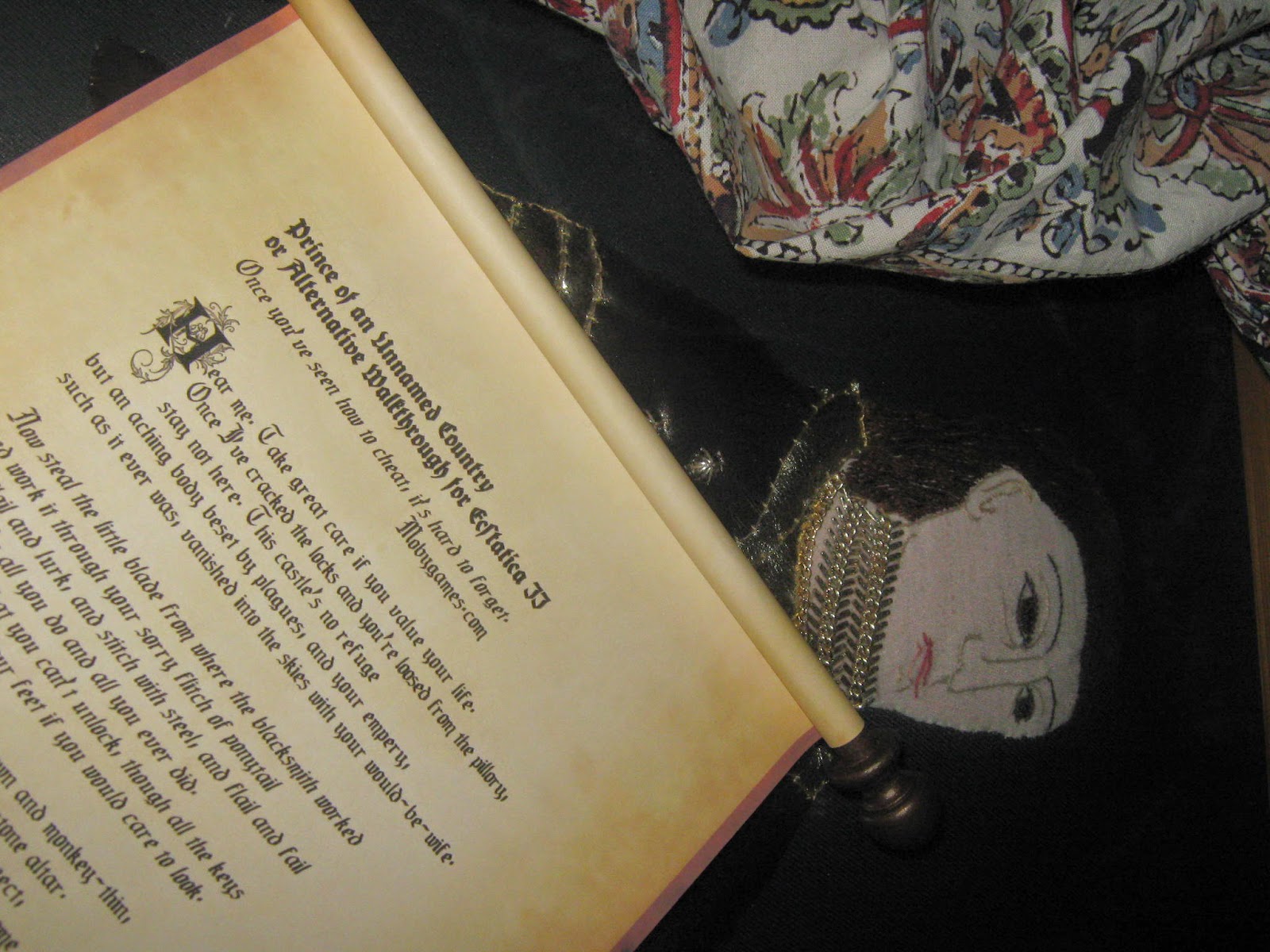
First up, it’s Ecstatica II, chosen by John Clegg. This piece was unique in being the only poem in the series written jointly by Jon and Kirsty as rivals for the protagonist’s attention. Here is the physical poem John received, in the form of a glorious medieval-style scroll (and here’s a video of him receiving it):


And here is the poem itself:


Thanks once again to all of our amazing backers.

Toby Martinez de las Rivas and his Terror – OF SEX!!!

Or: everything you wanted to know about Terror, but I couldn’t find the space to talk about in my review


Considering I just spent a whole damn review talking about Toby Martinez de las Rivas (I can get the name right when I’m writing it) it might seem like overkill to go back to him this early. But in truth there is a lot of stuff in his debut that I wasn’t able to cover in the review, so I think a coda of sorts is warranted.

As I already said in the review, Terror is a very original piece of work and it’s hard to think of other poets in the UK who are doing something similar, other than perhaps James Brookes, who shares some of the historical concerns but writes in a completely different style. That said, there was one point in Terror where Toby reminded me sharply of another talented young poet in the UK, whose name I shall temporarily withhold for dramatic effect.

Who is our mystery wo/man?

Which English poet is most like Toby Martinez de las Rivas, the bard utterly unlike all other bards of his time?

We’ll get to that. First, though, a small preamble – of Terror‘s four sections, the one that did not find space in my review was the third, a brief pamphlet of prose poems entitled Renovatur. It’s actually a very interesting section – so interesting, in truth, that it’s worth treating it separately in this article.

One of the best things about the writing in Terror is that it’s incredibly subtle – Toby has an extraordinary talent for picking words that, strung together in the bead of a sentence, allow for a great variety of readings. Consider the following lines (I am quoting from Renovatur, as I will be doing without exception for the remainder of this article).

Do not turn from them though they waver & diminish in the fundamental blank of the eye, beacons of vacillate, scared light, or the unrehearsable memory of being born
The gravel beds beyond them, & beyond them, the cress beds

These lines are from a poem called Through the Window into the Garden that was His Last Sight. Starting from the title, and from the opening lines (which are about the birthday of Toby’s son), the poem seems to have a lot to do with the mirror processes of coming into and out of life. This concern is immediately followed through in the poem that succeeds Through the Window…, which begins with the line ‘I write this on the XVII of March, which is the day I brought you into the world to die’. (Toby’s poems seldom work in isolation from each other and this parallelism is not coincidental, but – I would contend – one of the poet’s most successful and conscious strategies) 


While the ‘unrehearsable memory of being born’ is clearly connected to the above topic, what does the last line have to do with anything? ‘The gravel beds beyond, & beyond them, the cress beds’. There may be symbolic connotations to real gravel and cress that I’m missing, but on first examination it just looks a solid image in which to anchor the conclusion of the poem after much abstraction.

The line actually works on that level too, BUT – notice for a moment what other words re-echo within that line, by pure strength of consonance:
The grave beds beyond them, & beyond them, the cross beds

‘Gravel’ folds over into ‘grave’ and ‘cress’ folds over into ‘cross’. The line then takes on a whole new meaning, one that strongly connects with the rest of the poem, as the ‘bed of the grave’ lies inevitably beyond birth, and the cross – an overt religious symbol – lies beyond death itself. If you read it this way, the last line of this poem seems to lead quite naturally into the first line of the next.

So a verse that at first seemed to have been placed there almost arbitrarily conceals, in fact, a highly suggestive spiritual arc.

I made my case by this individual poem but I could take examples from almost anywhere. Terror is packed with astoundingly rich verse, the subtlety and ambiguity of which is – and here I must add my voice to the consensus – quite unrivalled in contemporary English poetry, at least from what I’ve read.


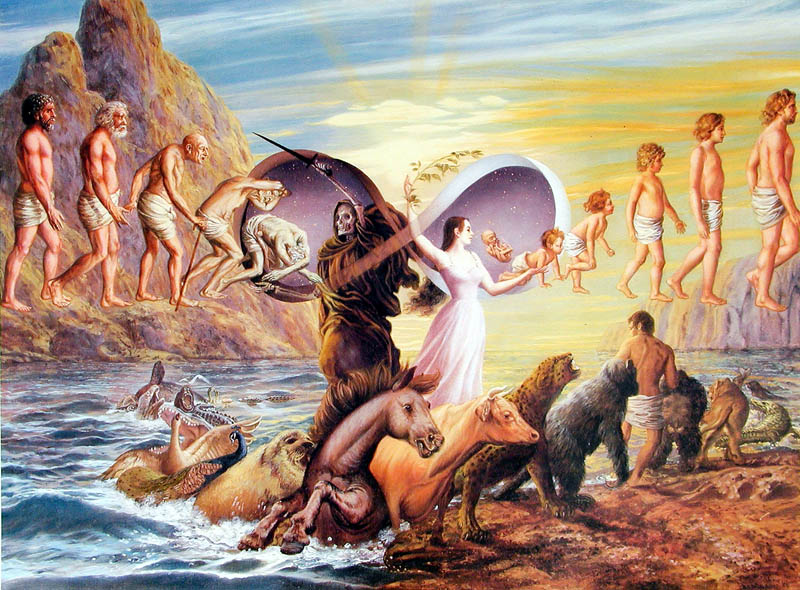
Somehow this image comes up when you Google “unrivalled”
Now I wouldn’t be writing this article if I just wanted to spread Nutella onto Toby’s already well-buttered toast – and indeed the point is that this incredibly subtle language is a double-edged sword. What I mean is that Toby is able to use this language to adumbrate some enormously suggestive and inspiring ideas, yes, but on the other hand he can’t keep it from revealing those aspects of his thinking that are less appealing and grounded.

Allow me to elucidate. The opening line of the beautifully titled Pyropsalm goes like this:
Separate. Radically alone, even inside each other. Physical bliss equals extinction.

I remember that I was immediately struck by this because it resonates with an oddly naïve – even a bit childish – anxiety about sexuality and relationships. I mean, it may be heresy to evoke such a comparison, but the first thing that ‘Radically alone, even inside each other’ reminded me of was Linkin Park’s With You, which goes ‘Even though you’re so close to me, you’re still so distant’.

Pyropsalm, which opens with at least an element of simplistic sexual anxiety, then closes with these lines:
Its denotion of self: vertical, lowering, isolate. Unblent, unbearable in the tower of its resolution 
How far have I fallen? My fontanelle is still open

A fontanelle, as per dictionary, is ‘a space between the bones of the skull in an infant or fetus, where ossification is not complete and the sutures not fully formed.’ So the final line can be read to mean a lot of things. As an image it brings to mind vulnerability, while philosophically one might read it to say that the mind is open to physical intrusion – possibly violation, echoing Toby’s concerns in previous parts of the book about ‘The body as image of the state, violated and violating’. In this case, the poet is conflating a physical violation with one of identity – the ‘denotion of self’, instead of being internally developed and explored, is entering Toby’s brain from outside and without permission.


So far, so obvious. But I think there’s at least one more really interesting way to read that line; in particular I am interested in what appears to be a very concealed, very silent ‘elle’, that is to say, French for the pronoun ‘she’. The word ‘fontanelle’ comes from the French and literally means ‘little fountain’; broken down, the words could be read as: ‘My fountain: elle’, where fountain is a source of water, so metaphorically a source of life.

You may say that this reading is about as stretched and convoluted as a rubber octopus. I’ll grant you that, taken in isolation, it sounds a bit crazy – and I probably wouldn’t have thought of it if ‘fontanelle’ weren’t such an uncommon word, one whose very presence commands reaction and active interpretation. Still, I feel it is at least somewhat validated by the context, over and beyond the teen angst in the opening line. The idea that Toby’s poem may be sub-textually privileging the feminine Other is consistent with the terror (what else) that the previous lines express when introducing the phallic signifier: a ‘vertical’ object, a ‘tower’, that is ‘unbearable’ because it contaminates and possibly violates his sense of ‘self’. Even the line ‘How far have I fallen?’ seems to fearfully conflate the self and the phallus – and we can get to this sentiment either by taking the ‘I’ as a phallic symbol in and of itself, in which case the line becomes a statement of impotence (‘How far has my I fallen?’), or simply by consonance: ‘I fallen : I phallus’.

The sentence ‘My fontanelle is still open’ can therefore be decomposed like this.

a.) My fountain: elle means that the speaker finds his sustenance in the Other, specifically the gendered feminine Other, as a classical case of compensation (i.e., his own sexuality is deficient).

b.) is still refers directly to the condition expressed in My fountain: elle, meaning that the condition is chronic. It points to the speaker’s inability to grow out of his dependence on the gendered Other (and by extension, the inability of his language to grow out of similar constraints of gender representation, i.e. gender as necessarily framed in a bipolar dependency relation).

c.) open, aside from the patent Yonic connotations that reinforce the sexual undertones of the line, also closes the poem on a statement of vulnerability – reiterating that the speaker’s condition is one of fear and need, not comfort or acceptance.

So – ‘My fontanelle is still open’, in reverse order, translates to:

I am vulnerable – [because] I cannot grow out of – my dependence on the other gender.

In brief, and for all their lyric transport, these are simply the words of someone who is unable to grow up. Now you may say that this reading is about as stretched as Jean Claude Van Damme’s legs when he does the splits. Judge, you may tell me, lighting up your pipe, your reading is far too abstract and far-fetched. You should stick a bit more closely to the literal meaning of what you read.

Ok then – let’s try that.

What is the literal meaning of ‘My fontanelle is still open’? Well, you say, inhaling from your pipe and blowing rings of scented smoke in the air, typically only an infant has an open fontanelle. So what he’s saying is that he is still an infant.

Wait a second, what’s this? The purely literal reading of the line comes to the same identical conclusion as the wildest abstract reading! In both cases, the poet is giving us the words of someone who can’t grow up. (Go sit in the corner, you and your pipe!)

Captain Sparrow, literally
To be clear, I’m as conscious as anybody else that this reading sounds rather far-fetched. What I want to stress is that this is all, I think, validated by context – or at least in line with it – nor would I have ventured into the reading at all if I didn’t feel that it was corroborated by the rest of the book. Much like I wouldn’t allow for a sexual interpretation of the last line of Pyropsalm if it weren’t supported by the language of the rest of the poem, so I wouldn’t allow for a sexual interpretation of the poem itself if it were an isolated case in the collection.

It is not.

In fact, the Renovatur section of the collection stands apart from the others in that it bubbles over with more or less explicit sexual allusion everywhere. The number of lines you can quote that have some element or imagery of sex in there is almost overwhelming:
the leaf of the tongue, flickering in her mouth’s gospel (p.39) 
I am the unpenned bull of the Lord / whose name confounds me. That is the hunger of women. (p.39)
the lamb might lie beside the vixen, at the nipple of the vixen (p.37)
the water struck by stars & streaked with filth (p.41)
the angel, must suffer us at its nudity (p.46)
the pikeish ventral tank, pillars of flame (p.46)
In my carriage of maleness, I am his radiant bride, bisexual as death. (p.48)
unearned wanting for his bodiless touch (p.48)
lead shot cascading in the broken well (p.49)

Mostly, these lines have in common a sense of unease and inadequacy, especially when it comes to discussing or including masculinity (or tropes thereof). Feminine eroticism is effectively hallowed (‘her mouth’s gospel’), metaphors to describe the phallus are threatening (‘pillars of flame’, the ‘carriage of maleness’ that is associated to ‘death’), and the physical reality that sex forces upon you – that is to say, the reality of confronting your own body and someone else’s – is infallibly brushed away: contrast the dangerous ‘unpenned bull’ associated to masculinity (the ‘Lord’), with the ethereal and apparently unsexed ‘angel’ (I say apparently – if the ‘elle’ in fontanelle is a ‘fountain of life’, then the feminine Other has already been established as an angel of sorts), and ask yourself why the speaker is ‘wanting for his bodiless touch’. Emphasis on the desire for something BODILESS in a collection where the word ‘body’ is everything.

So it seems that much of Renovatur is really about saying ‘I cannot grow up’, at least when it comes to the speaker’s relationship with the other gender. And yes, I do think this is a genuine and valid criticism that can be levelled at this part of the collection – and the reason I said in my review that the first and second parts of the book are awesome but this third part is so-so. It’s not bad by any means – on the contrary, the textual and philosophical richness here is real and rewarding. It’s just a shame that it should be held down by this sense of emotional immaturity that rather undermines the composed intelligence of the verse.

In this, Toby Martinez de las Rivas very much reminded me of another rising star of English contemporary poetry, and this would be – drum-roll – our mystery man, a.k.a. Sam Riviere.

It’s been a couple of years since I read Riviere, so he may just have grown into his shoes by now, but my conclusion when I reviewed his debut 81 Austerities was that the guy was very creative and intelligent et all, but suffered from a bothersome tendency towards infantilism, evident especially in his approach to sexuality. This is very much the problem with Renovatur – albeit not with Terror as a whole, and I can’t explain why this problem surfaces only in the book’s third section (parts one and two are, in my opinion, flawless, while part four suffers from other, more serious problems that I explore in the review).

Other than this particular weakness, Martinez has very little in common with Riviere – as indeed he has little in common with any other poet, barring superficial or (arguably) coincidental aspects of his verse. I’d agree with those praising Toby for his originality, as I for one haven’t seen anything out there quite like his work. That being said, I sometimes have the impression that when faced with the considerable difficulty of his poetry, some people respond with the Margaret Atwood line: ‘I don’t understand a word of it, so it must be good’. That’s the moment when praise just turns into hype, and in which I step out of the bus. I’d argue that the challenges posed by Terror are an invitation to engage and potentially disagree with it. If this means identifying some aspects of the book where it – or the arguments it forwards – are lacking in coherence or relevance, and also accosting Martinez to other poets in terms of his shortcomings rather than his merits, then I for one am more than happy to bite the bullet. There are many things that should, can and do terrify me, but sex – and for that matter masculinity – are not on the list.


Suzanne Collins’ “Catching Fire” and Linda La Plante’s “Wrongful Death”


Ain’t that scary
Autrement, A Concise Reading Journal by the Judge

Airports terrify me. Not for the prospect of flying, rather because the only way to kill time in there is to go leafing in the bookshops, and these always seem to contain the most insulting samples of literature ever assembled in a single place. This is, I fear, an unfortunate necessity of our civilisation: whenever I have to go on a particularly long journey (eight plus hours, staying away two or three weeks), I have to take a book with me that a.) cannot possibly tire me, no matter how long I sit there reading it, and b.) that won’t be over and done with in just one hour. Airport novels are engineered for just that.

The thing is that there are almost no novels that can meet those criteria and still be good. I can think of George Martin’s Songs of Ice and Fire that do the job wondrously, and when I was a kid I could read Michael Crichton from dawn to past midnight. The problem with the former is the release date of his next book (see the self-fulfilling prophecy, when the sun rises in the west and sets in the east, when the seas go dry and mountains blow in the mind like leaves), and I’ve kind of grown out of the latter. So I go for whatever I can, crossing my fingers that it’ll keep my mind distracted while I sit inside that box ten-thousand feet above-ground.
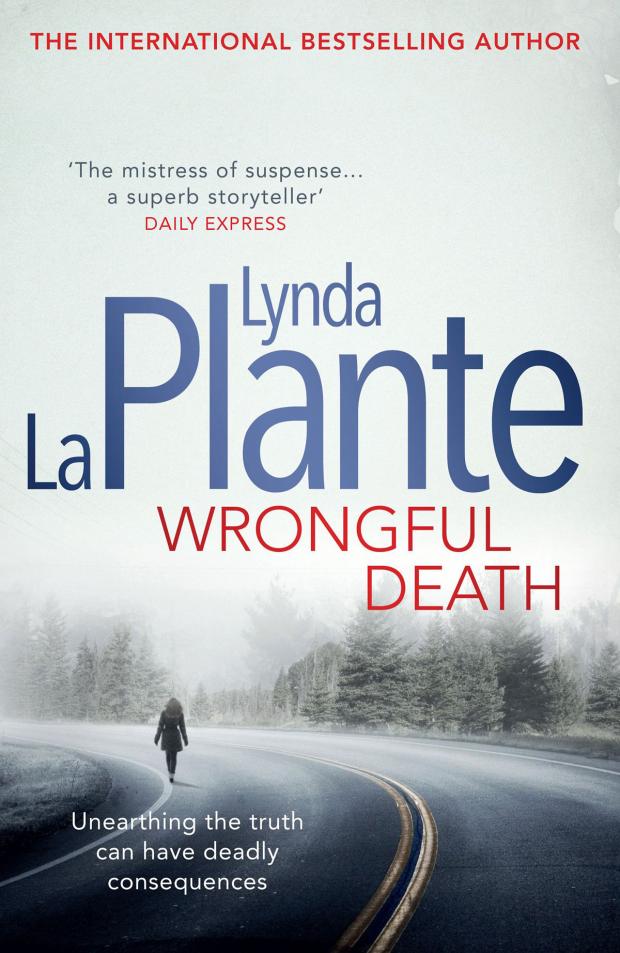
Most recent reads: Suzanne Collins’ Catching Fire and Lynda La Plante’s Wrongful Death.

Golly. Did I steer that car into the tree this time.

(For what it’s worth, the journey was to Brazil – I was there for three weeks over the World Cup – and these books certainly did not live up to the rest of the trip, which admittedly is not a fair comparison as it would take one hell of a novel to beat an evening spent snogging a Brazilian girl).

I suppose this isn’t a ‘review’ as much as an exorcism. These novels have made me so cynical and morose that I’d be recounting them to my therapist, if I had one. Yes, I could dress this up as an intelligent discussion about the ‘airport novel phenomenon’ and what it means to literature, but the idea seems to me like that of studying tarantulas – I’m sure there are plenty of fascinating things to be learnt, but Christ, who the heck wants to go near those things?

Let’s start with Catching Fire. I picked it up because its predecessor, The Hunger Games, actually did its job more than decently as an airport novel. It’s not exactly a difficult book to explain: the set-up is old enough that you can almost hear Suzanne Collins yelling ‘Yabba-Dabba-Doo’ as she is pitching the novel. It’s so old in fact that this is one of its strengths – the dystopian totalitarian future that she represents in such crude detail is positively comforting, being after all a trope that was tired in the early seventies, and the plot is just The Running Man except that Arnold Schwarzenegger gets replaced by an angsty teenage girl (just about the most anti-Schwarzenegger type of character they could find, showing if nothing else that this plot can run pretty smoothly without giving two figs about its central character). Then from halfway onwards it’s just Rambo with something like a love interest vaguely shoe-horned into it and some references to Imperial Rome that nobody in the USA will have picked up (oh, the capital is called ‘Panem’, like panem et circenses, that Roman thing they used to say, get it? Get it? Clever!).

The fun in it, from my personal point of view, lay purely in reading about these characters slugging it out in the woods. Everything else is just an excuse to set up the stage. (Does anyone actually give a fuck about Prim?)

(I just typed that question into Google and found out – SPOILER ALERT – that in the third book she dies).

Prim and proper
I was expecting pretty much the same from the second book, so I found it TOTALLY BAFFLING that, in a book of 400 pages, the author decided to wait until after page 300 (THREEHUNDRED) to actually get her characters to DO what her goddamn novel is supposed to be ABOUT, a.k.a. fighting! Instead, Collins seems adamant in her belief that we want to find out everything about Katniss’s mother and her sister and the hot black-haired what’s-his-name-again and the new house where they live. Or else we get to learn how Katniss goes hunting for squirrels. Or the political science behind this ‘complex’ (groan) totalitarian society. Or the baker boy’s paintings (for crying out loud). Or Prim, when things get really bad.

And even when they FINALLY get into the arena, the Rambo narrative is totally thrown out of the window in favour of these ‘alliance strategies’ they decide to undergo, which have them walking around in a goofy party comprising the angsty teenage girl, the romantic baker who always loved her, Edward Cullen with a trident, a mumbling hag piggy-backed onto the aforementioned vampire, and two genius idiots (not making this up) who can’t speak English. They don’t even fight each other much – most of the time they seem too busy stabbing the monkeys on the island (???). The narrative in Catching Fire feels less like Rambothan it does an episode of It’s a Knock-Out.

I eventually lost the novel somewhere in eastern Brazil – Vitoria, or Itabuna – and I can’t say I’ve ever felt so indifferent about losing a book in my life. I was at around page 330 and I might have been more engaged if I’d been listening to a cricket match that was being narrated by a GPS reader.

But I still had to confront the flight home, so I picked up one of those items that have always been completely arcane to me – a crime novel.

Crime, despite being one of the most popular genres in literature (and, in terms of raw economics, certainly one of the most important), is to me a mysterious whirlpool, dark and chronically holding back all of its truths. For someone with an MA in literature, I suppose it’s kind of embarrassing that I can’t name a single contemporary crime author (is Agatha Christie still alive? Does she count? I haven’t actually read any of her books, but look! I know her name! I know it! Cookie!).

But the fact is that crime fiction is DULL. Even in the theoretically more digestible medium of film, I can never bring myself to give a crap as to why Dick Jones was killed with a marble elephant tossed against his balls or how somebody ran over the granny to inherit the stuffed Komodo dragon that she beats herself on the face with whenever she has to read a crime novel. This, to me, is the greatest of mysteries and the only one I’d really like to see solved – why the hell do people read crime fiction? It’s not just dull, it’s almost unpleasant, this sense of reading without being told what you want to know. And why not tell you anyway? You don’t feel any more satisfied once you found out it was Bob Rogers than you did before. Why not skip to the last page and just find out? (Well, because then you’ve thrown £8.99 into the toilet – there’s your economics).

But I told myself. ‘I’ve read so little, surely I talk out of prejudice’. These novels must at least be entertaining. And there’s nothing else in this bookshop other than ‘How To Make More Money’ by Rich Bastard (whose idea seems to be that I should spend it on his book) or graphic novels about Captain America, which cost about $45 and would scarcely last me an hour. So I picked up the first thing I could find – Lynda La Plante’s Wrongful Death.

Anna Travis, detective. Not looking too bad here.
In retrospect, the title should have blown the whistle and rang the alarm bells. This is a serious question – can you think of anything more banal for a crime novel than titling it ‘Wrongful Death’? Every single crime story ever could have been titled like that – if the death were not ‘wrongful’, then what in the world would the novel be about? What kind of a blurb could you write for a crime novel in which the death is not ‘wrongful’? Josh Malcolm was found dead in his bed at 08:47 in the morning. The coroner initially declared his death to be by natural causes, but when detective Cypher Rage re-examines the scene two days later, he ends up agreeing that it was by natural causes. Malcolm’s death didn’t leave anyone terribly disturbed as he was a bit of an ordinary chap. Now his wife Brenda must make arrangements for the funeral… But to be fair the novel doesn’t start out too bad, and in spite of the prose being rather dry (but I’m happy to overlook this in airport novels), I found myself interested in some of the characters. As often as not the only appealing thing in crime stories, to me at least, is the intellectual cockfight of the main characters, all or most of whom compete at who’s the smartest. Sherlock took this to levels so ridiculous that they usually tumbled into self-parody, but it shows how potent the narrative trick is – and WD uses it appropriately as we are introduced to a remarkably smart American FBI agent, a Ms Jessie Dewar.

Together with the main detective, Anna Travis, they set off to investigate a fishy suicide.

And this is where the novel goes not just downhill but off the cliff altogether. The more I went into it, the less could I bring myself to care whether this guy had actually killed himself or whether he’d been murdered and why. It looks like perhaps his wife, or the wife’s sister, plotted to kill him – because, hmm, probably not for money as they’re already rich, some family feud of some kind I suppose OH GOD WHO GIVES A F –

The novel started losing me around page 50, but I managed to bring myself past page 200 (out of almost 500) before I was back home – and then I put WD on the desk and haven’t touched it since. I doubt if I ever will. I doubt, too, if I’ll ever read another crime novel, but that’s going to depend on whether my next substantial holiday is going to take place before or after George RR Martins releases his next book. The fact that both these things are set in a future more distant than Star Warsis a somewhat depressing prospect.

CONTACT:

contact [a] sidekickbooks.com

Sidekick Books Site assembled by Jon.
Wordpress TwentySixteen theme used to power the news and books sections.