After a long, long time under tarpaulin, attended by sinister figures in black, we unleash upon you, the public, not only a gorgeous new website, courtesy of Jon’s tireless graftery, but also Fuselit‘s 17th issue, Contraption!
Available to read online, or as a free (or pay-what-you-want-if-you-like) download for your Kindle or e-book reader, as well as in its traditional paper/card/ribbon/unicorn toenail hand-made format, it’s a modern marvel!
Award-winning university newspaper The Boar has reviewed Ian McLachlan and Phil Cooper’s ‘Confronting the Danger of Art’ thus:
“Imagine a world in which artistic expression is suppressed and condemned by the government. Not too difficult, is it, considering the cuts we have suffered in recent years. Both wonderfully relevant therefore and also intriguing in its portrayal of the thing is Ian McLachlan’s ‘Confronting The Danger Of Art’, a short poetry pamphlet that talks about how to survive an influx of creative types and their work in the style of a 70s nuclear safety information booklet. It is a marriage of ideas that does not sound quite as effective as it actually is; the poetry within providing a hilarious and searing look at the way people do sometimes treat the arts, and how it is a slippery slope potentially towards more totalitarian views … perfectly crafted and delightfully witty.”
Buy ‘Confronting the Danger of Art’here, and make an old alchemist marginally wealthier.
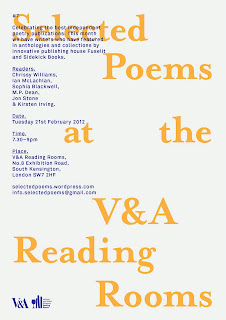
Much like St Gundebert, we’re very much looking forward to 21 February. Unlike St Gundebert, we don’t get an entire day dedicated to our work, and nobody, to my knowledge, prays to us on a regular basis.
So why are we stoked? Fuselit and Sidekick Books, in collaboration with Selected Poems, are all set for a night of poetry-based frolics to launch Fuselit Contraption and celebrate our ramshackle brand of collaborative poetry!
As well as Jon and K, Dr Fulminare’s ambassadors for the night will be: •the winsome and whimsical Chrissy Williams, whose collection, The Jam Trap, is due in March from Soaring Penguin; •Department for Public Safety spokespoet and co-author of the recently released report, Confronting the Danger of Art, Ian McLachlan; •schmoove raconteuse and crafter of poetic contraptions, Sophia Blackwell; •Fuselit and Birdbook formal firestarter, M.P. Dean.
Come down and say hello!
Facebook event here. Past events have hit capacity, so get in quick. Follow Selected Poems on Twitter.
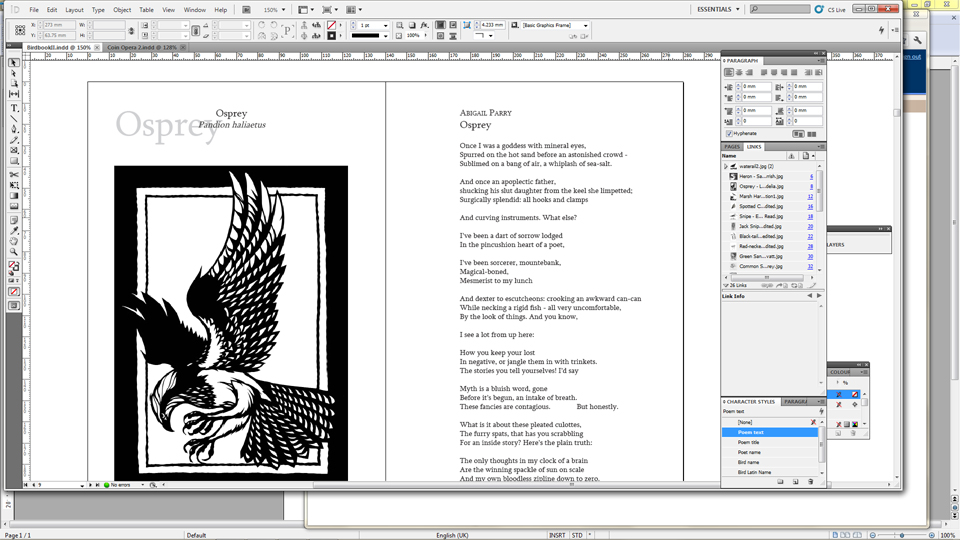
Today I’ve been working on our forthcoming Birdbook II: Freshwater Habitats, specifically the layout and picture-editing. Birdbook I was designed in a very old version of Quark that won’t run on my new computer, whereas this one is being designed on a brand-spanking new copy of InDesign we’ve shelled out for, which means I’ve had to spend a lot of time recreating the old templates as best I can. Here’s a screenshot a few pages in:
Curiously, it’s been a lot more work to integrate the pictures this time round. In the first volume, nearly all the artwork came either as a framed rectangle (see the osprey above) or with the bird alone in a stark white space so that it could be easily dropped onto the page.
Quite a few of the artists for BB2, however, have submitted work on tinted or textured paper, or with some elements surrounding the bird that are abruptly cut off at an edge. I hadn’t counted on this, and it’s been tricky trying to work out how best to place them on the page. This red-necked phalarope by Anna Le Moine Gray is painted in soft watercolours on a slightly bubbly paper that fades to grey towards the bottom (a side effect of the scanning process, I think).
Cutting off everything but the bird and signature left it looking like it had been scissored out and stuck to our page, when we really wanted it to look as if it’s part of the page. So in the end I deleted large swathes of the texture around the edges but left some of it around the bird, fading out:
Le Moine Gray’s common sandpiper was a tougher challenge – the paper was much greyer, so that where the feet end is very suggestive and hard to pin-point when cutting around it.
At first I tried blending the feet in with a pencil version of the same piece the artist had sent us, so that the feet had a starker outline. No matter how hard I squinted, it looked messy. Upping the contrast ruined all the precise and subtle shading on the bird itself, and fading out to white made it look like the sort of misty portrait you might find on a collector’s plate. So I ended up deploying a similar method to the above piece, but having the texture fade out to grey instead of white. Then I placed it inside a larger grey rectangle in InDesign that filled up most of the page:
Still need to do a little work on it, but getting there!
We’ve not yet got the full Irregular Features section of the site back up and running, but we have written two new pages of reviews – one rounding up various releases from Salt Publishing in the past year, the other doing the same for Donut Press. We thought it might help the poetry-reading public with a few Christmas present choices, and indeed, we have reports of a sale here and there consequent upon these reviews being published.
We have a backlog of books to review here at Sidekick HQ, so it’s lucky that poetry reviews are usually minimally time-sensitive. Expect more in the new year!
This Wednesday sees the fourth and final We Eat Poets event of the year taking place (see the Facebook event or We Eat Poets website for further details) and as part of that event, we’ve pulled together a set of six poems, each based on a character from Charles Dickens’ A Christmas Carol, and printed them onto cream greetings cards. They’re now available from the Sidekick Books main page.
Any orders we get in the next few days, we’ll be sure to send them out first class post as soon as we’re able, but since they can also be used post-Christmas (they’re blank inside) or saved until next Christmas, we’ll keep them available for the next month or so.
Firstly, a new poem-video from Sidekick Flicks, in which Aiko Harman (recently spied in The Best British Poetry 2011) reads ‘Kappa’, originally published in Obakarama:
Here I am, in the middle of editing and laying out Coin Opera 2, an anthology of poems about computer games that was originally supposed to come out last year, a book that may be ignored by poetry readers (“Computer games? Please”) and by gamers (“Poetry? Please”) alike. As you might expect, I’ve been thinking a lot about what games are, what poetry is, what art is, what they all have to do with each other, and particular on that vexatious topic: can games be art?
I. Don’t focus so much on thematic messages!
I’ve been spurred on in my thinking by this recent article, posted by Film Crit Hulk, which is a worthwhile read and makes some important points but ultimately comes to, I think, the wrong conclusion. While Hulk has a strong argument about the social responsibility of art (and, more importantly, how most games developers have yet to face up to that responsibility, to put it mildly) his narrow definition ultimately leads him to conclude that games “don’t even belong in the same conversation as movies” and that art in computer games is only a “grand possibility”.
When I say his definition of art is narrow, I refer to this part of the article:
“HULK DEFINES ART AS SOMETHING WHERE THE THEMATIC MESSAGES (EVEN IF THOSE MESSAGES ARE AMBIVALENT) ARE THE SINGLE MOST IMPORTANT ASPECT OF THE PRODUCTS INCEPTION AND IDENTITY.”
This leads him down the route of (rightly) critiquing the risible Call of Duty series for its thematic immaturity and moral cowardice.
But that is just not an adequate definition of art. People do not parade around the world’s most lavish galleries looking at pieces whose thematic messages are the single most important aspect of their inception and identity.
Hulk is closer, I think, than the author of this article, who brushes this issue aside and argues that artistic achievement is synonymous with technical achievement in a given field, ie. good games are always good art. That strikes me as even further away from the mark.
So too do cruder attempts along the lines of: art is what makes you look at something a different way; art makes you consider the world and your place in it; art is something that is remembered beyond its author’s lifetime. All no good, I’m afraid.
I’m not myself going to attempt a ‘definition’ of art right now. It is the slipperiest of concepts, and we should be thankful for that; otherwise, we’d all be necking government-regulated ‘art’ pills. What I will say, though, is that any definition should recognise that when we appreciate something as art, we are often enjoying and admiring its mere existence, disconnected from its original purpose (if any ever existed). Think of Wilde’s “all art is quite useless“ or Auden’s “poetry makes nothing happen”. We are moved by the medium as well as – perhaps more than – the message.
It’s one thing for Hulk to say art should be socially responsible. There I think I agree. It’s quite another to say that something can’t be art at all if it isn’t socially responsible.
Think of the gallery example again. The purpose of many renowned paintings was to portray the artist’s patrons in a favourable light. When we admire such a painting, we are not concerned that the subject now looks like an overdressed buffoon, or that his death has rendered the art pointless. When we look at Lely’s Portrait of a young lady and child, we don’t shake our heads sadly because a naked Nell Gwynn no longer stirs the loins as it once might have.
No – the work is still admired for its form, for the abilities of the artist working within their medium, for its peculiarity or overall coherence.
I’m going to move on from paintings now because I know very little about them. One related point: much poetry, of course, resists disclosing its practical purpose (if it has one), principally because of the distraction it causes. An overtly political poem is more likely to be noticed/admired/derided for its politics than for its form, for example – whereupon it might as well be a blog post and not a poem at all.
II. You’re looking in the wrong direction
One of things that keeps me coming back to the art/games debate is the persistent belief in what Hulk calls ‘the grand possibility’. Gamers and games critics insist on looking to the future for games to cross the line into art, when they should be looking to the past.
Why? Because what we call ‘retro’ games – games that are antiquated and no longer popularly played – are now, from a modern gamer’s perspective, more appreciable as artifacts than they are as games. As games, their mechanics have been improved upon to the point where many seem crude, frustrating and overly repetitive. What is left is the enjoyment and admiration we might still feel for creativity and technical accomplishments within the confines of a difficult medium.
Anyone who reads the UK magazine Retro Gamer will know that they frequently fill double-page spreads with single screenshots of games from the 70s, 80s and early 90s, purely because they are beautiful to look at – or certainly, at least, the reader takes pleasure in merely looking. Similarly so the countless youtube videos of retro games.
In the same respect, ‘pixel art’ is now an acknowledged subgenre of illustration. What once was a practical solution to severe technical restrictions is now, in an age of CGI polygons and lavish pixel depth, imitated and expanded for its aesthetic quality.
Why does it matter then if we no longer admire old games for their original intended purpose? In one sense, they have transcended the short-term limitations of that purpose.
III. So have modern games lost it?
There are a few odd holy grails in modern gaming which serve to obscure any attempt to assess the artistic merits of a particular game. For one thing, there is the obsession with perfecting the ‘movie-where-YOU-are-the-star’ genre, with its increasing graphical fidelity to real life. These games, as Hulk points out, more often than not want to be as much like action films as possible, and it’s difficult to know what on earth to assess them against except each other, so confused are their identities. Are they a means of acting out a fantasy? Interactive movies? Virtual playgrounds?
Then there’s the enthralment to ‘open-ended’ gaming, where the player is not forced down any particular path and can make decisions that permanently affect the in-game storyline beyond a simple win/lose dichotomy. The latest flag-carrier in this regard is The Elder Scrolls V: Skyrim, a game which seems to have temporarily deactivated many people’s ability to think critically at all. I have seen none of what is noted below, for example, mentioned in a professional review:
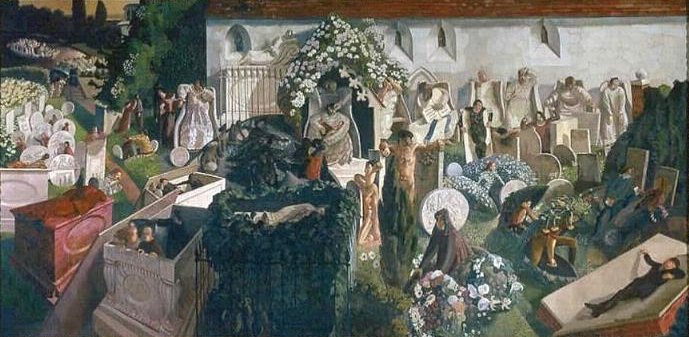
Interestingly, though, what I’m seeing with Skyrim (I think) is a generation bypassing the flaws in the game aspect because they’re too busy admiring it as a piece of art. The first thing many reviewers remark on, for instance, is the vastness of the in-game world. This reminds me of the reaction you might expect from someone seeing a huge painted canvas for the first time – something like The Night Watch or Stanley Spencer’s The Resurrection:
There are appreciative mentions of the story’s length and depth, but not a single actual character named (that I have come across), which suggests, again, admiration without engagement. A good potboiler or thriller delivers the story through a medium that is largely invisible, while what we vaguely term ‘literature’ forces us to notice and appreciate the means of delivery. Skyrim‘s story and characters are apparently largely forgettable, but people seem to be endlessly impressed with the delivery system.
That’s not to say, even if it is art, it’s great or long-lasting art. It could be a flash in the pan, particularly if everything admirable about the game is something that can be done better by larger teams of developers in the future, with even more money and technology at their disposal. And however much there is to admire about a game, it seems to me a problematic sign that something so fundamental to the role-playing genre – the narrative – should apparently be unremarkable.
The anecdotes I have come across regarding people’s experiences playing Skyrim repeatedly emphasise the pleasure of the journey – wandering across tracts of aesthetically pleasing virtual landscape. Or else they emphasise the freedom: kill who you want, rob who you want, collect books, ignore missions, lolligag. None of this, to my mind, sounds like the makings of a great game. Bernard Suits’ definition of playing a game is “the voluntary attempt to overcome unnecessary obstacles”. But if the emphasis is on freedom, that connotes a lack of obstacles. So it sounds like the pleasure comes from somewhere else. It sounds sometimes like people are talking about specifically enjoying not playing the game.
Some would argue the primary purpose of computer games is pleasure through interaction, and therefore that a game that delights the player has succeeded as a game, even if it doesn’t conform to the expected conventions of a game. After all, there is Dead or Alive: Beach Volleyball:
But there must be a line in the sand (and DoA:BV surely approaches it), where the pleasure derived from interaction cannot really be called ‘gaming’ or ‘playing a game’, just as there is a point where admiration of an image is no longer artistic appreciation.
I’m not too worried about where that line in the sand is. All I note is that there is at least the possibility that games are already being approached and experienced as art, perhaps in some cases more than they are as games.
In part 2 of this, I’m going to go on to talk about Facade, ‘masterpieces’ and why Portal 2 is an unsurpassable example of a game that is also an artistic achievement.
Last week, Kirsty read at the launch of S.J. Fowler‘s Minimum Security Prison Dentistry, published on 23rd November by Anything Anymore Anywhere and available to purchase from their website. The event took place at The Horse Hospital in London, and was recorded on video. Here’s Kirsty’s short set: