posted by the Judge
We’ve already had the chance for a chat with Kate Noakes in the past. She was pretty chuffed about it, at least judging by the photo we took after the interview (see above).
Now we’re taking it to the next level (ok, the football references are already overbearing) by reviewing her poetry collection Cape Town. The review was tackled (uh) by Shane A., who had never written for us before and is therefore kicking off, er, opening his career with us. The goal is to – ok I give up. Is it derby day or something?
Happy Sunday everyone!!
Author: Kirsten Irving
Coin Opera II preview at GEEK2013!
Along with debonaire compere Dan Simpson, on Saturday 23 February Sidekick Books will be taking a seaside trip to Margate to top games expo GEEK2013!
We’ll be performing a special preview of Coin Opera II: Fulminare’s Revenge, our second, and much expanded, anthology of computer games poetry. Expect epic Lemmings escape sagas, remixed Sonic and the tragedy of Pac Man’s orange ghost.
The Debris Field and ‘Out of the Debris’ event
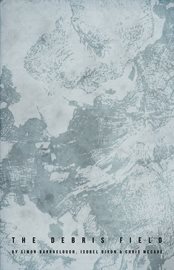
Sidekick Books is very excited to announce that we will shortly be publishing the book to accompany multi-media poetry production and Titanic tribute, The Debris Field. Devised, written and performed by poets Isobel Dixon, Simon Barraclough and Chris McCabe, The Debris Field had its British Film Institute premiere in a sell-out show on 14 April 2012, the centenary of the sinking of Titanic.
Don’t miss the trio’s one-off performance on Thursday 21 February, ‘Out of the Debris’, at The Rich Mix, London. Alongside composer Oli Barrett and film-maker Jack Wake-Walker, Barraclough, Dixon and McCabe will present poetry, images and sound as ‘live cinema’. This is a rare chance to catch an immersive and haunting show.
For more info, and to buy tickets, go here: http://www.richmix.org.uk/whats-on/event/out-of-the-debris/
Facebook event here.
Don’t miss the trio’s one-off performance on Thursday 21 February, ‘Out of the Debris’, at The Rich Mix, London. Alongside composer Oli Barrett and film-maker Jack Wake-Walker, Barraclough, Dixon and McCabe will present poetry, images and sound as ‘live cinema’. This is a rare chance to catch an immersive and haunting show.
For more info, and to buy tickets, go here: http://www.richmix.org.uk/whats-on/event/out-of-the-debris/
Facebook event here.
Sunday Review: Morgan Harlow’s Midwest Ritual Burning
posted by the Judge
Well, here we are once more. It’s Sunday, and like all Sundays, we’re cramming the trunk with beer-packs and setting off for Somerset, where we shall visit the grave of King Arthur in Glastonbury.
No hold on a second. That’s for the blog on ancient rituals behind beer. What happens here is that we have a poetry review, one which you can read by clicking on this particular link. Morgan Harlow wrote a collection called Midwest Ritual Burning, referring to the fact that she kept burning her fingers whenever she was a kid and they had barbecues (the cover for the book, with the original title, is displayed above). Anthony Adler, our reviewer for the day, was actually supposed to review some of my own work, but he got back to me telling mehe’d rather gouge his eyes out than plod through my bull he was very keen on doing Morgan, so he’s back to the reviewing boards.
Have a great Sunday!
Well, here we are once more. It’s Sunday, and like all Sundays, we’re cramming the trunk with beer-packs and setting off for Somerset, where we shall visit the grave of King Arthur in Glastonbury.
No hold on a second. That’s for the blog on ancient rituals behind beer. What happens here is that we have a poetry review, one which you can read by clicking on this particular link. Morgan Harlow wrote a collection called Midwest Ritual Burning, referring to the fact that she kept burning her fingers whenever she was a kid and they had barbecues (the cover for the book, with the original title, is displayed above). Anthony Adler, our reviewer for the day, was actually supposed to review some of my own work, but he got back to me telling me
Have a great Sunday!
Glyn Maxwell’s ‘On Poetry’ (Part 2 of 2)
in which the Judge continues the argument he started last week.
Maxwell opens his book with a promising discussion on evolutionary psychology and the way that we process and appreciate images and symbols. It is an anthropological outlook on poetic studies – one which could yield a great deal of results. Unfortunately, he abandons it almost right away in favour of his ‘primal’ discussion of the black and the white. This is a pretty transparent attempt at festooning his theory with a little bit of scientific legitimacy. It is sad, because he is going the wrong way round: he would probably find more fertile ground if he took a scientific approach to his aesthetic categories, rather than an aesthetic approach to a scientific idea. The latter is best left to poetry – using it in criticism only seduces the reader without actually revealing anything about the subject matter at hand. Indeed, the only thing that you can learn from this type of criticism is how the author thinks (which is enough of a reward with thinkers like Eliot or Calvino, and which was certainly enough for me when looking into a poet I admire as much as Maxwell). On Poetryis most interesting when Maxwell chronicles his own attempts, his own failures and successes, in his approach to the art. At those points you really learn a lot. For the rest of the time, however, there is little that comes with a sense of permanence. Today, nobody uses the word ‘classic’ in the sense that Eliot did. When reading On Poetry, you can never quite get rid of the feeling that even though Maxwell’s words are very pretty, no-one will ever use them if not in circumstantial exchange (“Oh, this reminds me about that wonderful book by Glyn Maxwell, he said something about pulse”…). This is necessarily the case, because they are not useful; and they are not useful because they are not true. By the time I reached the final chapter, ‘Time’, and found out it was entirely written in verse, I decided there was no point in bothering with a review and I closed the book.
On Poetry is a good book. It’s enjoyable and written with gusto and verve. But it’s certainly not the best book on poetry I have ever read (I’m picking on you, Newey – sorry), for the simple reason that it’s hardly about poetry at all. What it is, is a frolic. It’s a little exercise in form that only an established writer / poet can get away with (because the only thing that makes it interesting is what it reveals about the author). It could stand neatly in a library next to, say, Margaret Atwood’s Negotiating with the Dead. But it is also a book that loves to dress up. It wants to look like it’s bringing new ideas to the table, like its approach is fresh and original. And it’s all the more disappointing that there should be nothing new or original in this book because new concepts and possibilities in criticism areemerging, and there are so many things that we could learn from them.
The trouble with the circularity of literary criticism – i.e., having no means other than the poetic ones to describe poetry – is one that has on occasion been transcended. In the nineteenth century, psychoanalysis and Marxism pointed the way to new methodologies for reading literature. These schools have opened new doors for us in ways that more ‘poetic’ studies of literature (the preface to Wordsworth and Coleridge’s Lyrical Ballads, Poe’s The Poetic Principle, Baudelaire’s The Painter of Modern Life) could never dream of doing.
Today – and this is where I stray away from Maxwell’s book and why I didn’t want to write this as a review, but then I said that’s what I’d do, didn’t I? – we are faced with new concepts and ideas that have the same potential to open new doors for criticism. This isn’t the place for a rigorous enumeration of them, but off the top of my head, I might start with the school of cognitive poetics, which has revolutionised our idea of how ‘beauty’ is attained by studying the effects of poetry on the brain. Then there’s the fact that texts are now being uploaded digitally, which allows for an exponentially faster process of cross-reference. A group of scholars (whom I was, alas, unable to trace down) used this to find the ‘signature’ of famous writers, the traits and memes that generally identify someone like Jane Austen or Gustave Flaubert, and this allows us – among other things – to study their real effects on other writers by finding out where these patterns have been picked up again and recycled. And since I mentioned a meme, I should say a word about memetics – if only because Maxwell does borrow a memetic framework for some of his arguments, but – again – I would argue that his treatment is superficial and appropriative. Memetics is the school of thought according to which ideas develop according to the same evolutionary principles as genes; the applications of such a concept to the world of literature – if done rigorously, with a proper mathematical model behind them – would be endless. And since I mentioned maths, it is only recently that small attempts at using the formidable means of mathematics in the study of literature are being made, and this too links with a digital study of literature (the first, tiny fruits are coming out).
Things such as these, and not a vague reference to anthropology, give twenty-first century criticism the potential to truly renew our understanding of poetry. Some of it may sound like a fantasy, or even semi-blasphemous – I’m sure someone will call me a positivist or something for suggesting that mathematics may be used in understanding literature – but I’m not suggesting that new methods such as those I outlined above should supplant more traditional forms of criticism. There is the space for new ideas and established methods to coexist in harmony, especially in the humanities. The problem is that for a book such as Maxwell’s, it is dishonest to flirt with apparently unorthodox critical approaches (such as the ‘scientific’ backdrop of anthropology and evolutionary theory) and then be remiss to actually use them. Things have changed enormously in the last few decades and we have many new means of studying literature – Maxwell is employing none of them. In fact, his own means are no different than those used by Aristotle twenty-five centuries ago – except that Aristotle understood the need for rigour. To the best of his ability, Aristotle investigates – he never tries to seduce. Maxwell may not be expected to write a text comparable to the Poetics, but precisely for that reason he could at least try doing something different.
One final note in closing – and this isn’t strictly necessary, but I can’t help myself. Here’s a line from the back cover, detailing one of the things that Maxwell does in his book:
He speaks of his inspirations, his models, and takes us inside the strange world of the Creative Writing Class, where four young hopefuls grapple with love, sex, cheap wine and hard work.
Usually, the blurb behind the book throws around hyperbolic adjectives to encourage us to find out more about apparently dull subjects. You will find the memoirs of someone who worked in the ‘fascinating realm of space engineering’, or a novel set in the ‘mysterious alleyways of Paris’, or some pop science about the ‘revolutionary field of nanotechnology’. So I think it’s a sad measure of just how mind-numbingly boring some circles of poetry have become that even the editor couldn’t find any more exciting term to describe the setting than ‘the strange world of the Creative Writing Class’ (assuming it can even be called that – the only ‘strange’ thing about those classes I can think of is that they involve writers paying their readers, rather than the other way round). And I can overlook the fact that Maxwell’s description of the interactions between these four jocks is a collection of clichés, though I often wonder at older men who look at university students and assume they’re having casual sex every minute they’re not in a classroom (that, or I must have studied at the wrong universities). I’m not saying that everyone has to be Lord Byron, but really – have we come to the point of thinking that a Creative Writing class is a subject worth writing about? Then perhaps a book on poetry that is not actually about poetry really is the only type of product we deserve.
Sunday Review: James Brookes’ Sins of the Leopard
posted by the Judge
Sunday again, and I’ve just got time enough to post this review before I pack my bags (I’m moving to Birmingham). I am reviewing ‘Sins of the Leopard‘ by James Brookes. It’s a stupendous book, and the sins of the leopard are of course those of bad taste in dress and the use of foul language, which leopards famously indulge in (see pic).
The collection was actually supposed to be entitled ‘Since there’s a Leopard‘, in reference to the fact that Brookes used to work right outside of a zoo and was unable to write because the big cats kept mieowing, but apparently it was changed into the catchier ‘Sins of the Leopard‘ by his editors. I have no idea how they’re going to edit his upcoming second collection (‘That gelatinous platypus‘), but I’m sure they’ll come up with something equally good.
Seriously though. This collection kicked my ass. If you’re not going to read the review, do yourself a favour and read the book.
Have a great Sunday!
Sunday again, and I’ve just got time enough to post this review before I pack my bags (I’m moving to Birmingham). I am reviewing ‘Sins of the Leopard‘ by James Brookes. It’s a stupendous book, and the sins of the leopard are of course those of bad taste in dress and the use of foul language, which leopards famously indulge in (see pic).
The collection was actually supposed to be entitled ‘Since there’s a Leopard‘, in reference to the fact that Brookes used to work right outside of a zoo and was unable to write because the big cats kept mieowing, but apparently it was changed into the catchier ‘Sins of the Leopard‘ by his editors. I have no idea how they’re going to edit his upcoming second collection (‘That gelatinous platypus‘), but I’m sure they’ll come up with something equally good.
Seriously though. This collection kicked my ass. If you’re not going to read the review, do yourself a favour and read the book.
Have a great Sunday!
Poems in Which
Jon and I have poems in the latest issue of new poetry magazine Poems in Which. The concept is simple but fantastic. Remember all those poems that begin in this way? So do editors Amy Key and Nia Davies.
The manifesto for PiW reads:
Poems In Which is an occasional poetry journal edited by Amy Key and Nia Davies. Poems published here share a common title, ‘Poem in Which’ and they must be new, written for this journal, rather than post-titled to fit. Beyond that there are no constraints, nothing is true, everything is permitted.
As a challenge, writing a piece along these lines was at the same time was a free but focused experience. Given those three words as a kick-off, your brain immediately starts building scenarios. I worked with three possible titles before hitting upon ‘Poem in which I am captured. Again.’, and in the end I wrote something out of character/voice, which is always mighty satisfying.
Check out issues one and two here!
Glyn Maxwell’s ‘On Poetry’ (Part 1 of 2)
written by the Judge
I was uncertain whether to write about Glyn Maxwell’s On Poetry in the form of a review or in a feature article. Ultimately I went for the latter, and this for a number of reasons. One is that our reviews section is dedicated to poetry, not to essay writing, even when it is an essay on poetry. Another is that I wanted to discuss matters that extend a little beyond Maxwell’s work, and a more general article gives me the space to go a few yards (or a few miles) out on a limb.
The final reason is that I still haven’t made up my mind what I think about Glyn Maxwell. When I first read Hide Now, one of his most recent collections, I thought I was faced with a genius. I still think of that book as the best contemporary poetry in English that I know of. But then I went on to read another of his works, The Sugar Mile, and I was left rather cold. Of course, these are only opinions – the Guardian’s critic Adam Newey sees things exactly the other way round. He also says about On Poetry that it is “the best book on poetry I have ever read“.
I’d love to meet this Newey guy, because his opinions are so limpidly antithetical to my own. I imagine a dinner together would see us discussing how he likes jazz and I like classical music, he likes sushi and I like pizza, he loves cricket and I enjoy meaningful pursuits. Chances are he’d even tell me that he prefers the new Star Wars trilogy to the old one – but I digress.
For those who haven’t read it, On Poetry collects a number of thematically related essays in which Maxwell attempts to outline a theory of poetry. The titles of the various essays are, in order, White, Black, Form, Pulse, Chime, Space, Time. These are all, in his treatment, essentially aesthetic categories. The ‘White’ is the whiteness of the page where nothing is inscribed, while the ‘Black’ is that of the ink upon it. In his own words:
The nine sheets are nine battlefields. The black will win some, the white will win some, it will be silly as war and bloody as chess. If you get any poems out of it, any lines at all, pin them to your breast. If you get any white sheets, bury them with honours. Remember where you won, remember where you lost.
The paragraph pretty much encapsulates the style of the book as a whole. Maxwell relies heavily on metaphor to get his points across. He frequently brings up extracts from famous poems and proffers readings in a metaphorical form; since Maxwell is a fine poet, the metaphors work well and are colourful and enjoyable – indeed the whole book is very readable and pleasant.
So what’s the problem? Well, I wonder how many of my readers I’d alienate if I were to put it like this: none of what he says is true. I suppose a more diplomatic way of putting it would be ‘these arguments make no sense’ – I can settle on that, if you prefer. Maxwell says that ‘your meeting with a poem is like your meeting with a person. The more like that it is, the better the poem is’. That is – I really can’t find any other way of saying this – not true. It’s not a matter of my opinion or his opinion or your opinion, it’s just not true. Meeting a poem (which I assume means reading a poem for the first time) is nothing like meeting a person – except, of course, in metaphorical terms, and very abstract ones at that. It works as a poetic image, but it fails as a critical proposition.
It may be objected that I am being deliberately obtuse. Right, perhaps I should be more accommodating. But then again maybe what prompts me to be so obtuse is that I’ve seen this particular trick before, and I am getting a little tired of it. TS Eliot’s essay What is a Classic?, which Maxwell cites here with palpable admiration, is an example of the same train of thought at work. You make up your own aesthetical category (Maxwell goes for ‘black and white’, Eliot goes for ‘classic’), then you are allowed to draw the connections that you like and build a castle in the air that looks exactly how you want it to look. Since these aesthetical categories are neither verifiable nor quantifiable, and since they are not given any precise historical grounding but only one that is convenient and selective, you can pretty much say anything you like about them, and you will always be right. You can even contradict yourself, if you’re clever enough to present it as a ‘symbolic paradox’ or a ‘dramatic tension’ or what have you. I used to make use of this kind of sophistry myself back when I was into writing football journalism, precisely because it is so irresistibly seductive, and because you can look like an expert while saying almost nothing at all. A touch of good prose, or a clever use of metaphor, and you can describe the difference between Italian and English football in terms of the differences in these two countries’ drinking culture:
Like beer, English football is attractive because it exhausts and justifies itself in its own isolated turn of the wheel. It consumes itself as we consume it. Like wine, Italian football is at heart referential, never fully understood or explained, always subsisting under a shadow thrown by a shadow.
These articles were enormously successful – one of the sites I wrote for still features a permanent link to them in the front page. But they were never meant to be true. And neither is Glyn Maxwell’s On Poetry.
Maxwell’s type of criticism has enjoyed a great deal of popularity in the twentieth century. Personally, I think the finest example remains Italo Calvino’s American Lessons, which is essentially the same book as On Poetry, but a bit more elegant and subtle in its presentation (instead of ‘black and white’ Calvino has ‘heaviness and lightness’, and you can imagine how the rest of the book goes). I use the word ‘criticism’ to describe this type of writing, but with a little reluctance. Given that the readings, connections and historical interpretations they draw are fictional and arbitrary, they have less in common with the work of someone like Walter Benjamin, Mikhail Bakhtin or Northrop Frye than they do with the genre of occult literature represented by the likes of Aleister Crowley, Madame Blavatsky or Dion Fortune. Try reading some of the texts by the latter authors, and notice the parallel in style – if anything, the attempts by the magicians are much more schematic (if more poorly written).
The problem with this line of thinking is not that it isn’t pretty, it’s just that it’s circular. I am going to borrow a phrase from Cormac McCarthy: “A man’s at odds to know his mind cause his mind is aught he has to know it with.” You cannot analyse your analytical abilities for the same reason that you cannot bite your teeth. Likewise, you cannot hope to use ‘poetic’ means to analyse poetry, because all you do is produce more poetry. And indeed Maxwell’s work, like those I quoted above, is frequently and peculiarly beautiful. No-one could deny his ability with words. What’s lacking is the willingness (perhaps even the courage) to look outside of his own ranch, at animals different than his own stock. (Rats. I used a metaphor).

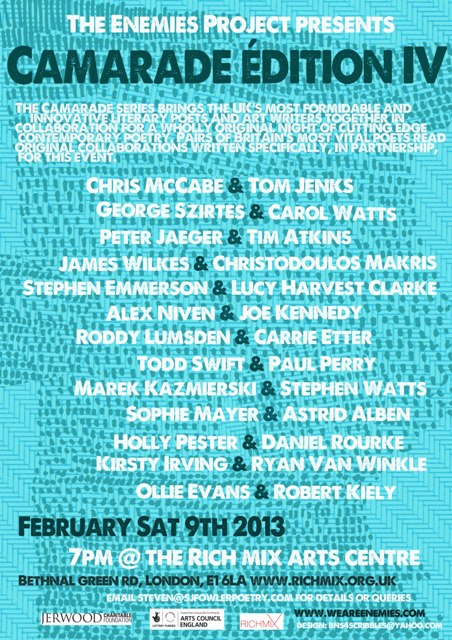
Camarade Poetry Reading: K v Ryan Van Winkle!
On Saturday 9th February, SJ Fowler presents the fourth edition of his collaboration project Camarade. 26 poets have been paired up and challenged to create something unholy incredible together. Kirsty will be joining forces with Ryan Van Winkle (investigate his book, Tomorrow We Will Live Here) on a very strange love letter.
The full line-up promises an impressive mixture of sonic, experimental, formal and free-flowing poetry. If you fancy something a little different to your average reading, get thee to Shoreditch.
Click on the flyer for more information.
Nearest tubes: Shoreditch High Street, Liverpool Street, Old Street.
Sunday Review (Winter Special Edition!): Ice / Skate
posted by the Judge
Aye aye! It’s Sunday, and it’s also quite cold outside. Since we’re all still enveloped in the white embrace of winter, here at Dr Fulminare we’re bringing you a review that is all about the cold season: two books in one go, one is called Ice, the other is called Skate, both edited by Meredith Collins, and for this special occasion they are being reviewed of course by Jon Snow.
No, hold on a second. Jon Snow was a character from Game of Thrones, the illegitimate son of Eddard Stark. The one I’m probably thinking about is Jon Stone, who works with me at this site. But come to think of it there was another character in Game of Thrones called Mya Stone, who was the illegitimate daughter of Robert Baratheon. What the heck? Are these guys all from the same family?
Never mind. Read the review by clicking on this link while I go ask Kirsten Lannister who was who.
Have a great Sunday!
Aye aye! It’s Sunday, and it’s also quite cold outside. Since we’re all still enveloped in the white embrace of winter, here at Dr Fulminare we’re bringing you a review that is all about the cold season: two books in one go, one is called Ice, the other is called Skate, both edited by Meredith Collins, and for this special occasion they are being reviewed of course by Jon Snow.
No, hold on a second. Jon Snow was a character from Game of Thrones, the illegitimate son of Eddard Stark. The one I’m probably thinking about is Jon Stone, who works with me at this site. But come to think of it there was another character in Game of Thrones called Mya Stone, who was the illegitimate daughter of Robert Baratheon. What the heck? Are these guys all from the same family?
Never mind. Read the review by clicking on this link while I go ask Kirsten Lannister who was who.
Have a great Sunday!