posted by the Judge
Time for our Sunday review again! It’s a funny coincidence because after dealing with Emma Wright last week, now we’re handling Luke Wright, and his collection Mondeo Man. Are the two related? Are they lost siblings who now reconnect their forsaken genetic link via the ethereal chains of language? (I haven’t bothered googling this, but if it turns out that the two *really* are siblings, I swear I’m dropping poetry and going into occultism).
This mystery and many others shall be revealed in Harry Giles’ review, which you can read by clicking here.
Enjoy your Sunday!
Category: Uncategorized
Reads Like A Dream
I don’t think I’ve enjoyed an event in ages as much as I did ‘Reads Like A Seven‘. It’s tricky to run an event themed around computer games and keep it varied, entertaining and the right balance of accessible to non-gamers and interesting to those who do play. RLA7 got it spot on.
New Statesman Deputy Editor and keen gamer Helen Lewis kicked off proceedings, discussing women in gaming and the rise of female participation (we’re going to overtake the guys if the pattern continues, apparently). She discussed the online lynching of feminist games critic and documentary-maker Anita Sarkeesian and the hostility towards even questioning the culture of booth babes and jiggling Lara Croft’s relics.
We went up next, with some preview poems from Coin Opera II, which we will be (drumroll!) launching a Kickstarter for, as soon as KS have approved the project. Covering Streetfighter, Pinball Dreams, Portal and many more, we had a grand time (and I got to do my GLaDOS impression). The audience gave us a lovely welcome and it struck me that mixing poetry and micro-talks is the ideal format in which to bring out the strengths of both forms.
Guardian Games Correspondent Keith Stuart took us through the trauma of having your world destroyed by children. Your Minecraft world, that is. Following explicit instructions to offspring to stay away from his saved state, he returned to find his virtual world literally up in flames.
Guardian writer Steven Poole, who by the way has a magnificent reading voice, waxed lyrical on zombies and our cultural obsession with them. He explored the phenomenon through games such as Resident Evil, suggesting we might even be envious of such creatures, who can shamble about without “phoning in sick to the zombie office”, worrying about nothing but the odd shotgun to the face
Following an interval, broadcaster and game developer Ste Curran took us through the parallels between computer games and cricket, in a hypnotic looping piece about the rules and interactions of both. It was interesting to see gaming brought into the light, to stand beside classical games and be counted.
Our host, and the organiser of the event, New Yorker games correspondent Simon Parkin, read a fascinating piece on Japanese RPGs, and the lack of peer-aged protagonists in today’s games for lifelong players who began in the 80s.
Christian Donlan, senior staff writer at Eurogamer, closed the night with a beautifully-written, funny and magical description of sharing LA Noir with his Dad, discussing the ways in which it depicted the 1940s Los Angeles in which he’d grown up. It was incredibly poignant and funny, with descriptions of dysfunctional ancestors and Donlan’s grandfather, a beat cop not wanting to kill his target, shooting the criminal in the arse.
Afterwards, as the cherry on top of a great night, we also received a frankly delicious gold parcel of home-made goodies from the gentleman who’d invited us to read, writer and raconteur Bruno Vincent. Thank you Bruno – they were delicious!
A great mix and a night in which I learned a great deal via sheer enjoyment. A bit like a good game in that respect.
Only low point was finding out today that my childhood hero from the show Bad Influence, Violet Berlin, was there and I didn’t get to meet her! Actually perhaps it’s for the best. I would have just spat while I talked or something, or mentioned my embarrassing Arkanoid habit before slinking off, muttering “stupid…stupid…”.
Looking forward to the next #RLA7. Very much so.
New Statesman Deputy Editor and keen gamer Helen Lewis kicked off proceedings, discussing women in gaming and the rise of female participation (we’re going to overtake the guys if the pattern continues, apparently). She discussed the online lynching of feminist games critic and documentary-maker Anita Sarkeesian and the hostility towards even questioning the culture of booth babes and jiggling Lara Croft’s relics.
We went up next, with some preview poems from Coin Opera II, which we will be (drumroll!) launching a Kickstarter for, as soon as KS have approved the project. Covering Streetfighter, Pinball Dreams, Portal and many more, we had a grand time (and I got to do my GLaDOS impression). The audience gave us a lovely welcome and it struck me that mixing poetry and micro-talks is the ideal format in which to bring out the strengths of both forms.
Guardian Games Correspondent Keith Stuart took us through the trauma of having your world destroyed by children. Your Minecraft world, that is. Following explicit instructions to offspring to stay away from his saved state, he returned to find his virtual world literally up in flames.
Guardian writer Steven Poole, who by the way has a magnificent reading voice, waxed lyrical on zombies and our cultural obsession with them. He explored the phenomenon through games such as Resident Evil, suggesting we might even be envious of such creatures, who can shamble about without “phoning in sick to the zombie office”, worrying about nothing but the odd shotgun to the face
Following an interval, broadcaster and game developer Ste Curran took us through the parallels between computer games and cricket, in a hypnotic looping piece about the rules and interactions of both. It was interesting to see gaming brought into the light, to stand beside classical games and be counted.
Our host, and the organiser of the event, New Yorker games correspondent Simon Parkin, read a fascinating piece on Japanese RPGs, and the lack of peer-aged protagonists in today’s games for lifelong players who began in the 80s.
Christian Donlan, senior staff writer at Eurogamer, closed the night with a beautifully-written, funny and magical description of sharing LA Noir with his Dad, discussing the ways in which it depicted the 1940s Los Angeles in which he’d grown up. It was incredibly poignant and funny, with descriptions of dysfunctional ancestors and Donlan’s grandfather, a beat cop not wanting to kill his target, shooting the criminal in the arse.
Afterwards, as the cherry on top of a great night, we also received a frankly delicious gold parcel of home-made goodies from the gentleman who’d invited us to read, writer and raconteur Bruno Vincent. Thank you Bruno – they were delicious!
A great mix and a night in which I learned a great deal via sheer enjoyment. A bit like a good game in that respect.
Only low point was finding out today that my childhood hero from the show Bad Influence, Violet Berlin, was there and I didn’t get to meet her! Actually perhaps it’s for the best. I would have just spat while I talked or something, or mentioned my embarrassing Arkanoid habit before slinking off, muttering “stupid…stupid…”.
Looking forward to the next #RLA7. Very much so.
Sunday review: Jude Cowan Montague’s ‘The Groodoyals of Terre Rouge’
posted by the Judge
I’ve got no idea what a groodoyal is.
I say this because when I blog about our Sunday reviews I usually add a pic that has something to do with the book we’re reviewing. But since this week we’re doing Jude Cowan Montague‘s The Groodoyals of Terre Rouge (or to be more precise, Charles Whalley is ‘doing’ it), I found myself kind of at a loss for words. I mean, pics.
Fortunately there seems to be some kind of unwritten rule on the internet that when you’ve got no idea what image to use in any given context, you can add pictures of stormtroopers. So here ya go. Solved.
You can read the review by clicking on this link.
Once you’ve done that, enjoy what’s left of your Sunday! (Seven minutes, from where I stand).
I’ve got no idea what a groodoyal is.
I say this because when I blog about our Sunday reviews I usually add a pic that has something to do with the book we’re reviewing. But since this week we’re doing Jude Cowan Montague‘s The Groodoyals of Terre Rouge (or to be more precise, Charles Whalley is ‘doing’ it), I found myself kind of at a loss for words. I mean, pics.
Fortunately there seems to be some kind of unwritten rule on the internet that when you’ve got no idea what image to use in any given context, you can add pictures of stormtroopers. So here ya go. Solved.
You can read the review by clicking on this link.
Once you’ve done that, enjoy what’s left of your Sunday! (Seven minutes, from where I stand).
Is Poetry a Subculture?
written by the Judge
To return to the initial point, though it is true that you can find a great deal of excess and exaggeration in the haberdashery of poets if you look for it, you can hardly make of that a consistent rule. But hear me out – while there may not be so much excess and exaggeration in terms of clothes, there is in terms of ideology. Ultimately, the two things are not even that distant. The fact that poetry can express itself directly through language – and the fact that all members of this subculture are poets, while not all punks are musicians – makes the self-expression allowed by clothes a bit redundant. And yet extremity is very common in terms of the statements made, the positions held and the emotions expressed in the actual verse.
Is poetry a subculture? It might be worth asking ourselves that question. I’m not a sociology student and I’ve never been part of a subculture myself, so my point of view can only be partial. (But then isn’t a monocular focus only on one’s own field itself characteristic of subcultures? Isn’t my failure to represent perspectives on poetry that originate outside of poetry a fact symptomatic of subcultural hermeticism, and evidence that I belong to this subculture – for the good and for the bad?).
A subculture is more than just ‘a group of people with common interests’, like a bridge club or bungee jumping. It has codes, beliefs, clans, heroes. For me, the term is one I most readily associate to music. The two words that immediately spring to my mind when I hear it are ‘punk’ and ‘goth’. There are others, of course. There are also many subcultures that are not really defined by music, though they may be related to it in some ways or another (hippies, to name a big one). And there’s supposed to be a whole world of sexual subcultures, especially in the gay community, but I’m even more ignorant of those than I am of the musical ones.
Here’s the thing though – there is a substantial difference between the way these groups are perceived and represented in (popular?) culture and the way that poetry and poets are (or are supposed to be). Not to put too fine a point on it, all of the above are understood as peripheral to our culture, as living in the margins, as colourful but – at least when taken individually – not essential to the workings of society. They allow for the kind of vocabulary that everyone else can use to crack a mild joke: Cartman’s celebrated phrase, ‘it’s all a bunch of tree-huggin’ hippie crap’, is funny because it’s so easy to relate to it (no offence, hippies).
But poetry is supposed to be central. It’s meant to be one of the barometers of a culture’s vitality; poets encapsulate and represent an age for the generations later to come; they define and shape the identity of nations. Surely something’s a bit off when you put them in the same category as your neighbour and the four nerd friends of his who get together every Saturday night (!) to play fantasy role and/or board games about dragons fighting unicorns.
So what exactly is a subculture? Ken Gelder identified six key ways to recognise them:
1. Their often negative relations to work (as ‘idle’, ‘parasitic’, at play or at leisure, etc.);
2. Their negative or ambivalent relation to class (since subcultures are not ‘class-conscious’ and don’t conform to traditional class definitions);
3. Their association with territory (the ‘street’, the ‘hood’, the club, etc.), rather than property;
4. Their movement out of the home and into non-domestic forms of belonging (i.e. social groups other than the family);
5. Their stylistic ties to excess and exaggeration (with some exceptions);
6. Their refusal of the banalities of ordinary life and massification.
(In passing, I don’t have a clue who this Gelder guy is – I’m only using him because his was one of the clearest of the quotations I found onWikipedia – but what he says seems to make sense, so until a real sociology student comes along, let’s roll with it.)
I’d say that one, two and six are pretty obviously true of poetry. Three is plainly off – though it’s true that poets do not associate with property, I wouldn’t say they do so with territory either. Four and five are a bit more debatable, but I’d say poetry flicks the switch for both. Poets do, on the whole, display a movement out of the home and into non-domestic forms of belonging, notably when they first go to university and start forming ties with other aspiring poets; it’s at that point that they first come in touch with the community, one which does not speak to / with their family or their other social circles. In brief, the literary community does something that is typical of subcultures – it assists its member(s) in the formation of a new, non-domestic identity. This process usually starts in the academic arena, and it works so well that many poets never even leave it – witness the number of artists who work in universities. But it is certainly not limited to that territory (hence, I don’t think #3 holds).
Number five, the stylistic ties to excess and exaggeration (note on the run that Gelder allows for ‘exceptions’), revolves around the word ‘stylistic’, and brings us to one of the primary differences between the poetic subculture and the others I mentioned (the music ones in particular). The latter appear to be much more interested in external appearance and clothing; their codes are embedded in the way they dress. Superficially, this doesn’t seem to be the case with poetry – I say superficially because I’m of the opinion that there is such a thing as a dress-code common to poets, too, it’s just much harder to pin down. Since the leading principle is that of rule number six (see above), clothes are used to reject mainstream codes; they are therefore used – not necessarily in a conscious manner – to go against expectations. The problem is that while a fan of goth music has the common and relatively transparent codes of mainstream music that s / he can simply turn on their head to express his / her rejection, poets each respond to their own societal codes. So it is perfectly possible – and consistent – for a poet to ‘go against expectations’ by dressing in seemingly shabby clothes while another does the same by wearing a gala suit. This does not mean that their identity as poets may not correspond to the same societal construction, and therefore not share a drive in terms of social expression – but I digress.
![]() |
| Ginsberg’s outrageous head-wear |
So yes – if Gelder’s little list is anything to go by, poetry does have a lot in common with subcultures. In sociological terms, it operates in much the same way. It also has some traits which make it differ. One example is the effort, within the poetry subculture, to expand its borders and get poetry to more people and wider audiences. This contrasts with the attitude taken by more traditional subcultures, which are rather content with the marginal state in which they subsist (though they too can be flustered and frustrated when the media misrepresent them). It might be the result of poetry’s inability to recognise itself as a subculture, insisting instead that it is more ‘central’ to society. An identity crisis, if you will, but on a grand scale. Or it might be one of the individual characteristics of this subculture, the same way that a drive towards political anarchy is (I think) one of the drives of punk.
And here is my point. Poetry is central to society, just not thispoetry. Not the community. Not the subculture. Attempting to expand poetry in these terms means attempting to get more people be like us – while a more effective strategy would be that of having your poetry speak to those who are not like us. This is not as obvious as it sounds – there are some people out there who genuinely do not deserve being spoken to. Furthermore, it might involve letting go of just those values that we hold so dear about our community, like our point number six, the ‘refusal of the banalities of ordinary life and massification’. Most people don’t refuse these things, and are not interested in investigating the possibility; communicating with them, therefore, might involve relinquishing this refusal. Is this something you are ready to do? And if poetry really involves non-conformism, then here’s the thing – could it be that the best way for you to write it is to do what others don’t do – and stay the hell away from this community, and not even read this article in the first place?
Sunday Review: Particle Soup by Lindsey Holland
posted by the Judge
I wanted to post this yesterday, but for anyone who doesn’t follow us on Facebook or Twitter (what exactly do you use to communicate? Do you throw rocks at each other?), we have the latest review out.
We’re doing Particle Soup this Sunday, by Lindsey Holland. Not in the sense that we’re making soup, I mean that we’re reviewing the book – which is not a book about soup, or at least not cook-book like. It’s more about science. Argh. Ian Chung explains this much better than I ever could, here.
Have a great… er, Monday?
I wanted to post this yesterday, but for anyone who doesn’t follow us on Facebook or Twitter (what exactly do you use to communicate? Do you throw rocks at each other?), we have the latest review out.
We’re doing Particle Soup this Sunday, by Lindsey Holland. Not in the sense that we’re making soup, I mean that we’re reviewing the book – which is not a book about soup, or at least not cook-book like. It’s more about science. Argh. Ian Chung explains this much better than I ever could, here.
Have a great… er, Monday?
Very Short Essays: Salt / Marketing / Individuality
Note
Many of these short pieces refine views I’ve already aired, either here or on other forums.
On Salt
Last week, Salt announced they would no longer be publishing single author collections of poetry. This decision should be understood as commercially sensible at least: over their 13 years of poetry publishing, Salt barely made a dent in the major prize shortlists, one of the few known routes to respectable sales for poetry collections. Last year, however, one of their novels was shortlisted for the Man Booker Prize, proving that in the world of fiction at least there’s still room left for independent presses. As the publishing industry leans more and more heavily on break-out success stories, it would certainly be risky for Salt to continue to pin its hopes on a medium whose major prizes might be said to be almost entirely culturally and critically aligned with the lists of older, more established presses.
But Salt authors (including myself and Kirsty) still have reason to feel gipped. Salt were generous when it came to making room on their list; even in recent years, they courted young and new poets through the Crashaw Prize. This meant they stood out as one of – if not the – main delivery mechanisms for a major new wave of poetry, characterised by writers like Luke Kennard, Chris McCabe, Sophie Mayer and Mark Waldron. At their best, the quality of book production also outshone their heavyweight contemporaries. The flipside of this was no author advance, an often-strained system of promotional support, and the perennial instability of the press itself.
Some poets will almost certainly have opted for Salt when the possibility of a more secure deal with a bigger press was not entirely distant, and done so in the spirit of joining in a mutual endeavour to challenge the existing hegemony, or at least join a fresher stable. An adventure in parallel with one’s contemporaries, rather than in competition. Faith in the quality of work over faith in marketing weight. They may have done so in the full knowledge that Salt might fail, that all would go down together. What they won’t necessarily have expected is for Salt to take off in a newly discovered lifeboat, leaving them stranded. It’s the non-transference of the publisher’s good fortune to its authors that is most disappointing.
The most cynical commentators could accuse Salt of harvesting an optimistic and richly talented generation for the sake of finding what they eventually found in Alison Moore – an unexpected overnight success – the kind of behaviour that mainstream publishers are often charged with. This would, however, be to forget the genuine and infectious enthusiasm with which Salt’s Chris Hamilton-Emery publicly spoke of his list and the consistent quality of his selections.
What the move appears to be symptomatic of, however, is a literary culture which struggles to contend with that greater part of the writing spectrum between established seniority and hot young thing. It’s no surprise that, as Clare Pollard astutely observes in her post on the subject, the notion of ‘emerging talent’ has grown more and more elastic, as this is where the bulk of funding is targeted and where money is to be made from courses, academies and ‘sensational’ debuts. Ultimately, Salt, in taking on so many such debuts, put itself in a situation where it would have to market second and third collections by poets who were not heavyweight prize-fighters, a daunting challenge for any press.
On marketing
Here’s a quote from that same post by Clare Pollard:
Marketing poetry books is difficult. This is especially true of the slim single-author collection, a medium whose main role is arguably to confer an illusory status on the author (this is true of prizes even more so, but that’s another matter). It doesn’t help that so many are sold as if they were almost the same book with a different name: a significant poet’s debut or latest collection, breaking new territory while remaining grounded in human (ie. relatable) experiences. An intimate connection with history/the past, a gift for words that resonate, and so on. This is not because poetry publishers are so much less imaginative than fiction or non-fiction publishers; it’s because reflecting the individuality of a book of poetry in blurb and cover image is a mystical art in itself. Style and voice do not lend themselves to summary the way plot and subject matter do.
Faber’s block-colour approach serves them well. Colours carry associations of mood and temperament that aid us in intuiting character and making personal choices. Display seven block-colour books in a row, innocuously titled, by equally unknown authors, and the reader will still likely be drawn to one or two over the others. Their copy, however, is no better than anyone else’s, and whatever your promotional tack, you will almost certainly be relying, at some point, on the copy.
Put simply, as I’ve noted before, poetry is difficult to talk about, and that is as true for its publishers as it is for its audience. This is not how it has to be – it’s partially the result of publishers and promoters (including, manifestly, poets themselves) circling the same expressional formulae, those that have served poets well in the past. The unspoken assumption here is that describing poetry is not itself a creative process but an analytical one, a matter of judiciousness. Supposedly, the tools are in the box and it’s a matter of using them appropriately. In fact, what we need are new tools. And lots of them.
I suggested in the previous set of micro-essays that the sheer abundance of new poetry being written is a positive thing. Where there is, perhaps, a failing is that instead of this abundance of poetry striking out in many different directions, much of it ends up advancing on the same spot, promoting itself to the same slowly shrinking audience – the known rather than the unknown. I don’t want to be absolute about this – clearly, there is considerable effort to do otherwise, at grassroots level at least. I also don’t wish to suggest that there is some obvious alternative tack that is being unaccountably missed – who knows what other audiences truly exist? But I would suggest that it’s this predominantly conservative (commercially sensible?) approach that has led in itself to a lack of marketing options and to the difficulty we now collectively experience in finding ways to individualise poets in the eyes of potential consumers.
On individuality
Why do I suggest, earlier on, that there should be a particular problem marketing second or third collections? Partly it is the funding situation with its emphasis on ‘emergence’, which itself seems to be founded on the myth that a first collection represents the final stage of a poet’s journey towards his or her appreciative audience. Funding is tight across the board, but see if you can find anything anywhere earmarked for nurturing writers who are just past the point of their first collection.
Partly, however, it’s an issue of individualisation. Poets (with the help of their publishers) aim, one way or another, to project an identity, and a successful first collection will usually evince that identity. The title, cover and copy all play their part in setting out the poet’s stall. If all the elements work well together, they will imbue the work with a sense of supreme freshness and individuality. Here he/she is, like nothing you’ve ever read before!
Second and third collections inevitably risk coming across as a repeat. They can’t reset the poet’s identity, and so they fall to reemphasising it or attempting to convince the audience of some meandering ‘evolution’. Fiction has a double advantage here: the plot, at least, is always new, and, more importantly, fiction is easily spent. Once the story is exhausted, the only way to get more of the same is to buy the author’s next book. But poetry boasts depth. It has a far longer half-life. It releases its secrets and its flavour slowly at first, and always seems to keep some held back. Very often, therefore, readers who want more from the same well can return to it and keep drawing. The second or third collection is not just a repeat but a surfeit.
It’s therefore far more urgent for publishers to individualise not just every poet, but every book of poetry, in order to appeal to the widest range of tastes and partialities imaginable. That is, unless they have that most unlikely of things: a cash cow or runaway success, for which no surefire formula exists.
Many of these short pieces refine views I’ve already aired, either here or on other forums.
On Salt
Last week, Salt announced they would no longer be publishing single author collections of poetry. This decision should be understood as commercially sensible at least: over their 13 years of poetry publishing, Salt barely made a dent in the major prize shortlists, one of the few known routes to respectable sales for poetry collections. Last year, however, one of their novels was shortlisted for the Man Booker Prize, proving that in the world of fiction at least there’s still room left for independent presses. As the publishing industry leans more and more heavily on break-out success stories, it would certainly be risky for Salt to continue to pin its hopes on a medium whose major prizes might be said to be almost entirely culturally and critically aligned with the lists of older, more established presses.
But Salt authors (including myself and Kirsty) still have reason to feel gipped. Salt were generous when it came to making room on their list; even in recent years, they courted young and new poets through the Crashaw Prize. This meant they stood out as one of – if not the – main delivery mechanisms for a major new wave of poetry, characterised by writers like Luke Kennard, Chris McCabe, Sophie Mayer and Mark Waldron. At their best, the quality of book production also outshone their heavyweight contemporaries. The flipside of this was no author advance, an often-strained system of promotional support, and the perennial instability of the press itself.
Some poets will almost certainly have opted for Salt when the possibility of a more secure deal with a bigger press was not entirely distant, and done so in the spirit of joining in a mutual endeavour to challenge the existing hegemony, or at least join a fresher stable. An adventure in parallel with one’s contemporaries, rather than in competition. Faith in the quality of work over faith in marketing weight. They may have done so in the full knowledge that Salt might fail, that all would go down together. What they won’t necessarily have expected is for Salt to take off in a newly discovered lifeboat, leaving them stranded. It’s the non-transference of the publisher’s good fortune to its authors that is most disappointing.
The most cynical commentators could accuse Salt of harvesting an optimistic and richly talented generation for the sake of finding what they eventually found in Alison Moore – an unexpected overnight success – the kind of behaviour that mainstream publishers are often charged with. This would, however, be to forget the genuine and infectious enthusiasm with which Salt’s Chris Hamilton-Emery publicly spoke of his list and the consistent quality of his selections.
What the move appears to be symptomatic of, however, is a literary culture which struggles to contend with that greater part of the writing spectrum between established seniority and hot young thing. It’s no surprise that, as Clare Pollard astutely observes in her post on the subject, the notion of ‘emerging talent’ has grown more and more elastic, as this is where the bulk of funding is targeted and where money is to be made from courses, academies and ‘sensational’ debuts. Ultimately, Salt, in taking on so many such debuts, put itself in a situation where it would have to market second and third collections by poets who were not heavyweight prize-fighters, a daunting challenge for any press.
On marketing
Here’s a quote from that same post by Clare Pollard:
It seems to me there are choices to be made. One option is for arts bodies to start supporting ‘emerged’ poets as actively as those who are ‘emerging’. Another might be to accept that the days of the physical, 60-page collection are over and find a different model of poetic success.
Marketing poetry books is difficult. This is especially true of the slim single-author collection, a medium whose main role is arguably to confer an illusory status on the author (this is true of prizes even more so, but that’s another matter). It doesn’t help that so many are sold as if they were almost the same book with a different name: a significant poet’s debut or latest collection, breaking new territory while remaining grounded in human (ie. relatable) experiences. An intimate connection with history/the past, a gift for words that resonate, and so on. This is not because poetry publishers are so much less imaginative than fiction or non-fiction publishers; it’s because reflecting the individuality of a book of poetry in blurb and cover image is a mystical art in itself. Style and voice do not lend themselves to summary the way plot and subject matter do.
Faber’s block-colour approach serves them well. Colours carry associations of mood and temperament that aid us in intuiting character and making personal choices. Display seven block-colour books in a row, innocuously titled, by equally unknown authors, and the reader will still likely be drawn to one or two over the others. Their copy, however, is no better than anyone else’s, and whatever your promotional tack, you will almost certainly be relying, at some point, on the copy.
Put simply, as I’ve noted before, poetry is difficult to talk about, and that is as true for its publishers as it is for its audience. This is not how it has to be – it’s partially the result of publishers and promoters (including, manifestly, poets themselves) circling the same expressional formulae, those that have served poets well in the past. The unspoken assumption here is that describing poetry is not itself a creative process but an analytical one, a matter of judiciousness. Supposedly, the tools are in the box and it’s a matter of using them appropriately. In fact, what we need are new tools. And lots of them.
I suggested in the previous set of micro-essays that the sheer abundance of new poetry being written is a positive thing. Where there is, perhaps, a failing is that instead of this abundance of poetry striking out in many different directions, much of it ends up advancing on the same spot, promoting itself to the same slowly shrinking audience – the known rather than the unknown. I don’t want to be absolute about this – clearly, there is considerable effort to do otherwise, at grassroots level at least. I also don’t wish to suggest that there is some obvious alternative tack that is being unaccountably missed – who knows what other audiences truly exist? But I would suggest that it’s this predominantly conservative (commercially sensible?) approach that has led in itself to a lack of marketing options and to the difficulty we now collectively experience in finding ways to individualise poets in the eyes of potential consumers.
On individuality
Why do I suggest, earlier on, that there should be a particular problem marketing second or third collections? Partly it is the funding situation with its emphasis on ‘emergence’, which itself seems to be founded on the myth that a first collection represents the final stage of a poet’s journey towards his or her appreciative audience. Funding is tight across the board, but see if you can find anything anywhere earmarked for nurturing writers who are just past the point of their first collection.
Partly, however, it’s an issue of individualisation. Poets (with the help of their publishers) aim, one way or another, to project an identity, and a successful first collection will usually evince that identity. The title, cover and copy all play their part in setting out the poet’s stall. If all the elements work well together, they will imbue the work with a sense of supreme freshness and individuality. Here he/she is, like nothing you’ve ever read before!
Second and third collections inevitably risk coming across as a repeat. They can’t reset the poet’s identity, and so they fall to reemphasising it or attempting to convince the audience of some meandering ‘evolution’. Fiction has a double advantage here: the plot, at least, is always new, and, more importantly, fiction is easily spent. Once the story is exhausted, the only way to get more of the same is to buy the author’s next book. But poetry boasts depth. It has a far longer half-life. It releases its secrets and its flavour slowly at first, and always seems to keep some held back. Very often, therefore, readers who want more from the same well can return to it and keep drawing. The second or third collection is not just a repeat but a surfeit.
It’s therefore far more urgent for publishers to individualise not just every poet, but every book of poetry, in order to appeal to the widest range of tastes and partialities imaginable. That is, unless they have that most unlikely of things: a cash cow or runaway success, for which no surefire formula exists.
Sunday Review: Quite Frankly by Peter Hughes
posted by the Judge
Sunday, and for once I am PERFECTLY on time to post our review. Normally I either do it really late on a Saturday night (like, three or four a.m.) or just before midnight on Sunday night. But nah, check me out. Good timing.
More importantly, check out our Sunday review. This week Simon Turner takes on a work by Peter Hughes, a strange rendition of Petrarch that is part translation, part modern rewrite. The title is Quite Frankly: After Petrarch, Canzoniere 1-28. I’ll admit that I was a bit skeptical when I read of the concept, but the review sold me over completely. It must be worth reading.
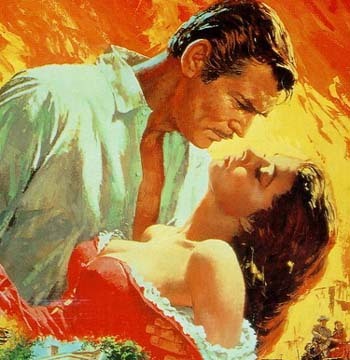
Incidentally, if you get the reason I put a Gone With The Wind pic as the poster for this review, then you either know your movies really well, or you’re almost as old as Petrarch.
Have a great Sunday!
Sunday, and for once I am PERFECTLY on time to post our review. Normally I either do it really late on a Saturday night (like, three or four a.m.) or just before midnight on Sunday night. But nah, check me out. Good timing.
More importantly, check out our Sunday review. This week Simon Turner takes on a work by Peter Hughes, a strange rendition of Petrarch that is part translation, part modern rewrite. The title is Quite Frankly: After Petrarch, Canzoniere 1-28. I’ll admit that I was a bit skeptical when I read of the concept, but the review sold me over completely. It must be worth reading.
Incidentally, if you get the reason I put a Gone With The Wind pic as the poster for this review, then you either know your movies really well, or you’re almost as old as Petrarch.
Have a great Sunday!
Why is poetry not popular?
posted by the Judge
Salt are dead! No, not really – they’ve just decided to stop publishing collections by individual new poets. I don’t really know the reasons why, though I’ve just read a discussion in which people said it was a matter of money. Poetry doesn’t sell, and we all need to eat – there’s no shame in that.
But one of the points that was raised was the question of why poetry doesn’t sell. Here’s one of our own critics, Judi Sutherland, scratching her head on the subject:
So what has gone wrong? Why is poetry such a minority sport? Is there something wrong with the way poetry is taught in schools that turns people off? Is it about the way it is marketed and sold? Or is it such an acquired taste that it simply does not speak to anyone who hasn’t studied it in depth?
In this article, I am of course going to settle the argument once and for all.
(I should take a moment to say how grateful I am at times for the existence of blogs – without them, certain discussions might really draw on forever).
There is an obvious literary dichotomy between poetry and prose, and it’s common knowledge that prose sells much more (and much more easily) than poetry. The novel, then, is a good point of comparison: why don’t poetry books sell as much as novels?
Naturally, poetry and prose offer different experiences. One may then be led to wonder what it is, in the experience of the prose story, that appeals to an audience so much greater than the poetry book’s. In my opinion, one important thing to bear in mind is the way that the ‘experience’ offered by these two art-forms overlaps with that which is offered by other media. Place together a poem, a music video, a novel, and a film. Which one of these works has the most in common with which other? Technically, the poem and the novel are both forms of literature, while the music video and the film are both cases of visual media. At the same time, poetry has powerful, unbreakable ties to song (the two were born together) – and a music video is more of a scaffolding to a song than the other way round. From this point of view, furthermore, a novel is closer to a film, in that they are both essentially about telling a story (and stories do frequently cross over from book to film).
I believe that one of the reasons poetry sells so little is its failure to ‘cross over’ in the same way that novels do. Novels respond to a basic human need – a need to hear stories, which flicks many important switches in our psyche. Movies do exactly the same, though their ‘response’ to this need is given by different means and techniques. Therefore they do not compete with but complement each other, providing material that enriches both media. Poetry and the music industry, by contrast, do not communicate at all, except when some poet deplores pop culture in one way or another.
I think that poetry also responds to basic human needs; in particular it stages certain cathartic effects that we usually refer to as lyric or epic. One mistaken assumption that the poetry reader – unlike the prose reader – may be tempted to make, is that his / hers is the only medium that stages these effects. Songs, even the simplest pop songs, have a very similar function, and other media can reproduce those effects too. In fact, any form of representation that makes use of language – including prose! – can potentially be lyric or epic in parts. Unfortunately, poetry seems to deliberately cast itself in competition with other media that share in its function. It insists that it is doing something ‘different’ or ‘more’ – and admittedly it does: contemporary poetry couches its lyric parables in sophisticated performative arguments that touch on an enormous variety of subjects (though some, like identity and language, are particularly common). Songs generally make use of a much simpler language (expressed in what we know as lyrics), in part because they can share the burden of their emotive effect with the music.
As we mentioned, poetry and song were born together – at least in Western culture. In Classical Greece, verse was always performed with a musical complement, and early medieval poetry is rooted in the performances of musical troubadours. Metre is a quality that denotes poetry’s affinity with song, and its decline in popularity over the last century reflects the increasing distance that the art form has taken from what may be called its original or more popular function.
| The original poet |
One understands, then, why poetry is so hard to popularise by comparison with prose. The novel, in its many forms, is still essentially true to its original function, sharing it in equal means with the newer media. Poetry instead has opted to go ‘beyond’, and left that original task to other arts; pop songs are in many ways closer to ancient poetry than modern verse is. Indeed, poems that attempt to be ‘just’ lyrical (e.g. certain types of love poems, or a poem that speaks about, say, the sunset) are understood to be intellectually shallow, because they are doing nothing that we can’t already find in songs.
I should say at this point that I do not deplore the directions in which modern poetry has gone. I don’t think that poetry has lost its way, in part because it didn’t really ‘choose’ to go anywhere as much as it evolved, responding to how the world itself has changed, and in part because the new things it does are just as important. I would even go so far as to say that, in lyrical terms, poetry is a poorer art form than song, with less means of expression, and it is therefore natural that it should not (try to) compete with the bigger dog in the yard. Rather, poetry has a more openly critical rather than just lyrical role – one which awakens from rather than lulls into sleep.
The critical role, however, is neither as basic nor as immediately necessary as that of pure lyricism. We need lyric transport, the same way that we need to be told stories, simply to function as human beings. It’s as important to our psyches as eating and breathing are to our bodies. We do not ‘need’ to be critical, or at least not nearly as much. And even if we do, we must also bear in mind that poetry is not the only form of critical engagement with the world that there is (though it is certainly the one more closely engaged with language). Reading history and philosophy, for example, can be just as educational as reading poetry. This is not to say that history and philosophy can do the same things as poetry, of course, only that they share some of its functions, particularly the more intellectual ones.
Poetry is not popular, and in its current form, it can’t be. While the novel performs every aspect of its story-telling function, from reading in the airport to studying it at university, poetry has become a marginalised aspect of its original purpose; reading poetry is always also an intellectual engagement, one which transcends the pure lyrical enjoyment of a song you may hear on the radio as you drive to work. (This may not be the most charming example, but one thing that makes this argument empirically true for me is that I am unable to read poetry while sitting on the toilet, while I can happily leaf through a comic or a novel in the same condition. I am also unable to read poetry continuously for very long stretches of time, more than one or two hours; by contrast there are some novels I can take on a train journey and read non-stop for eight hours or more).
For what my own feelings are worth, the fact that poetry is not popular does not disturb me. Saying that we need more people reading poetry, or a better education on the art form, is a truism – we will always need more people in any art and better education on any subject, though we are probably in a preferable (or at least more democratic) condition now than we have been in hundreds of years, if ever. And I’m not particularly frustrated by the lack of attention that poetry is getting – if I’d wanted attention, I’d be doing something different in the first place. If anything, I am much more concerned by the lack of cultural variety within the community – too many poets seem to be coming from the same background or doing the same things. This may in itself be a deterrent to new readers – there is less range for people to identify themselves with poets, and I understand why a young man at school might find a more relatable model in a rapper from the suburbs than in a poet from a university. In any case, I don’t really see the benefits of having many more readers in poetry if they are not also quality readers. Other media have enormous consumer-bases, but they are plagued with stupidity and ignorance; it’s the price of their own popularity.
The argument that poetry should be put out to more people, or made more popular, starts from the assumption that poetry as we know it now can be expanded. This misses the point that expanding poetry changes it. There are few people reading poetry now because poetry is a really smart engagement with language and there aren’t so many people who are quite that smart or who are interested in language. This isn’t an elitist argument, it’s just a reflection on the normal way that people distribute their interests – and it would be vain and self-centred of us to think that poetry should be privileged over other potentially rewarding interests that are available in life. If you really want to bring your poetry to those who don’t usually read this stuff, then good luck. Just be careful you don’t do that by making your poetry more stupid.
Sunday (video!) review: Maurice Riordan’s The Holy Land
posted by the Judge
Sunday review… and here’s something you weren’t expecting: it’s a video review! As for details on who is being reviewed, what the title is, etc., well… just click on the video.
For the record – this is a very new format and something that, we think, no-one else is doing in poetry criticism at the moment. Precisely on this account, we’d love to hear what you think! Did you like it? Do you want to see more video reviews? Do you have any ideas on how it could / should be improved? Can you help us work on the format in any way? And not least – is there any book you’d particularly want to see video-reviewed?
We’re just getting started, fellas. Hang around.
Sunday review… and here’s something you weren’t expecting: it’s a video review! As for details on who is being reviewed, what the title is, etc., well… just click on the video.
For the record – this is a very new format and something that, we think, no-one else is doing in poetry criticism at the moment. Precisely on this account, we’d love to hear what you think! Did you like it? Do you want to see more video reviews? Do you have any ideas on how it could / should be improved? Can you help us work on the format in any way? And not least – is there any book you’d particularly want to see video-reviewed?
We’re just getting started, fellas. Hang around.
Poets in Film
written by the Judge
And that’s our list done! If I’ve forgotten anything particularly important, feel free to title-drop it into our comments section.
So here I am, sitting in front of my laptop, thinking I’ve got to get something written for Dr Fulminare, and weighing out my options. I could work on that review of Maurice Riordan, but I already have another one ready and lined up for publication, so that can wait. I could write a feature article, but on what subject? I’ve recently finished that monstrous series on tragedy, so I guess I could go for another similarly megalomaniac topic (“A Brief History of Pessimism”, in twelve parts). Or I could crack open a beer, throw some blues in the background and just let my brain go in whichever direction it pleases.
What the hell. Pour that Heineken.
On the subject of letting my brain go – I’ve already managed to piss off the fans of Glyn Maxwell and those of Anthony Anaxagorou, so I want to do my best this time to shoot on a target that won’t infuriate anyone. I’m gonna write about the representation of literature (poetry inclusive, but not exclusive) in film.
The reason I know this shouldn’t get on anyone’s nerves is that, a few months ago, I was thinking I could do a serious article on the misrepresentations of literature (and its practitioners) in film; but once I started thinking about it a little more closely, I saw there was just too much meat on the roast for me to start chopping and be called a master chef of some kind. It’s just too easy to claim that, hey look, poets aren’t really like that!! HOLLYWOOD LIED!!
Instead, I’m just going to look at literature in film in a casual manner, making a disordered list of all the films on the topic that I can remember (and not bothering to watch the ones I haven’t seen). As I said, don’t expect insights to blow your worldview away, but those of you who don’t have a girlfriend might find this article a passable way of spending this rainy Wednesday evening.
(Notes at this point. 1. I don’t have a girlfriend. 2. At the time of writing, a couple of weeks before this thing goes online, I’m gambling on next Wednesday being rainy. The way this spring has been going so far, the odds shouldn’t be too high, but if it turns out to be the only rainy Wednesday since last August, I’m flipping!! 3. I’m more than 400 words in and I still haven’t even really started with the article. Yeah, A plus).
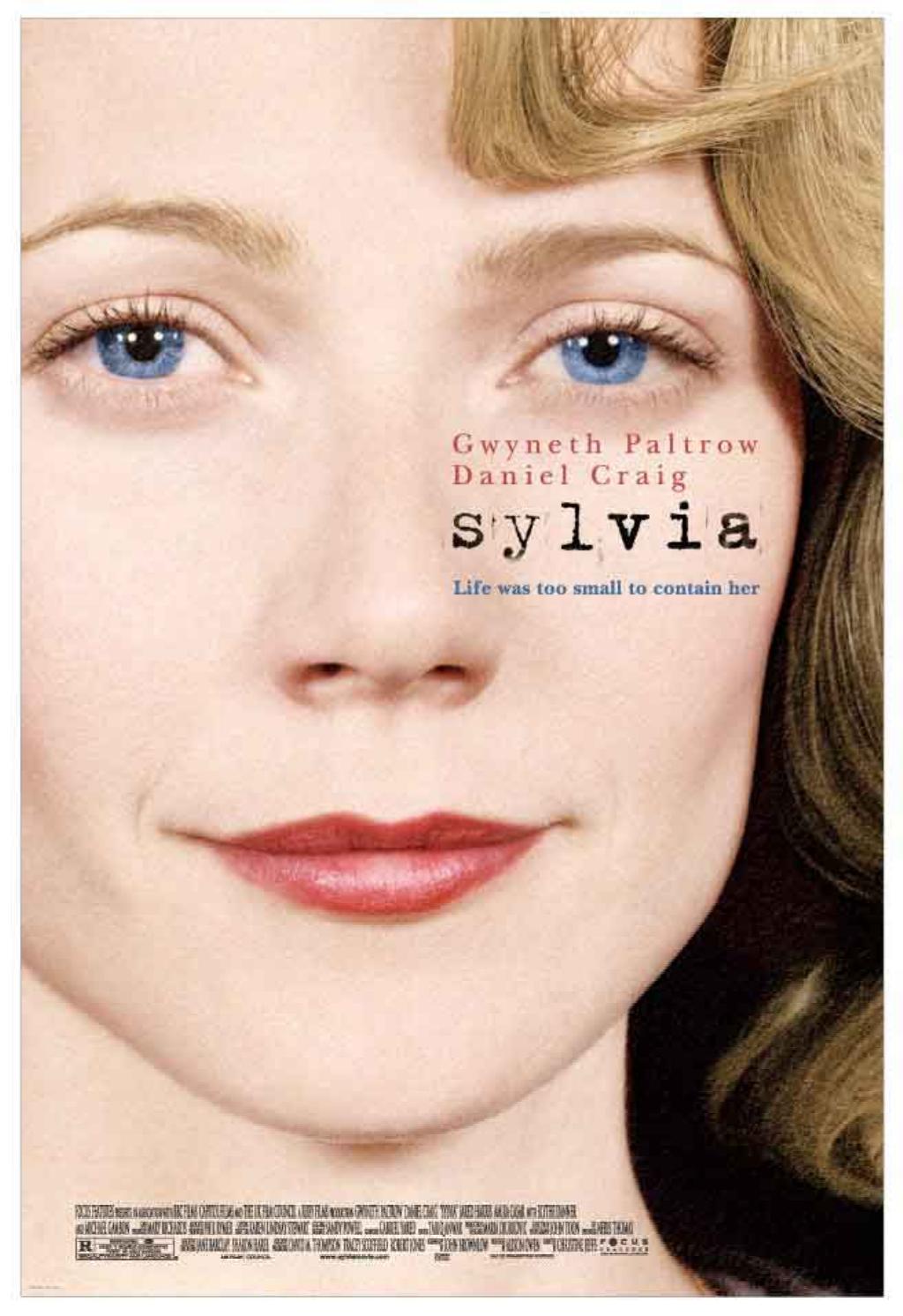
Ok! So, film and poetry… two apparently irreconcilable arts, yet somehow touching each other by the effortless inspiration of some BLAH BLAH BLAH platitudes to open the article. Done. Now, films about literature generally come in two varieties: we have fictional stories, and stories inspired by real literary figures. The former are, I think, the more entertaining (though often the more stupid), so I’ll concentrate this article on them and leave the various films like Bright Star, Shakespeare in Love, Sylvia & co. for another Wednesday.
What are these films like? The first one that comes to mind, of course, is Dead Poets Society. It’s so prominent in the landscape that it almost single-handedly convinced me a serious examination of clichés about literature wasn’t worth writing – no doubt every literature student has rolled their eyes a few times when seeing this film (there’ll be the oddball who objects here, but seriously – when the guy tries to appropriate the line “Shall I compare thee to a summer’s day”, you’ve got to love the Chinese box – the boy assumes the girls are stupid, the audience assumes the boy is stupid, the director assumes the audience is stupid, and I, from my ivory tower, assume the director is stupid). It’s actually not that bad as a popcorn flick, except the ending is so fucked up – spoilers ahoy, but seriously now… he dies? The *insert second-hand actor who goes on to work in Dr House* dies? I’m sorry, but then what on earth is the point? I mean, all those kids yack Captain my captain freedom individualism sincerity etc. but what is the use of all that if you are dead? (Oh, yeah. DEAD poets society. I get it. Clever, Pete).
(Notes at this point. 4. I couldn’t be arsed to see the film again just for this article, so the guy might have appropriated some other line than “Shall I compare…” Could have been Marlowe instead. Please tell me you don’t need to be reminded. 5. Time to crack open the second beer. 6. My nerd landlords have already gone to sleep. Time to switch the music to headphones… oh, and I shifted to Django Reinhardt, for what it’s worth. One of those names you learn through Woody Allen. I’ll bet there’s some other young intellectual out there who learnt Caruso thanks to WA).
Now Dead Poets Society came almost ten years before Good Will Hunting, which is kind of like the apotheosis for Robin Williams. I’m inclined to see it as the dress rehearsal: he tried out the lines, he discovered he looks more authoritative with a beard (though the role of the bearded mentor who dies was really perfected by Liam Neeson), and he found out that physics is much more amenable than poetry when it comes to making films that people will understand (perhaps because physics itself is actually harder to understand than poetry, so it’s easier to make up bullshit that people don’t recognise and pass it for brilliance – this is, of course, a principle that the screenwriters of Star Trek figured out many decades ago. ‘We are going towards a singularity! Quick! Enable the tachionic positron inverter!’ Enable the what the fuck did you just say?).
Now the thing about science – most notably, physics and maths – is that it’s quite easy to represent a ‘genius’ character. You show Matt Damon scribbling abstruse formulae on a chalkboard, and everybody knows he’s got to be a genius. Besides, such people really do exist – math wizards are real people (that must be so frustrating for their colleagues… boy am I glad I’m on the other side of the intellectual river). When it comes to literature, it’s really much harder to say what makes of someone a great writer. Writers don’t really agree on it either. There is a consensus, however, that it’s not just brainpower / raw talent. Other factors come into it, like life experience, literary models, historical contingency and even blind luck. These things are a bit harder to represent concisely, and – more importantly – they fly in the face of what people want to believe, that artists are actually special in their DNA, that they are ‘gifted’ or ‘destined’ for greatness (an especially popular prejudice with the younger, aspiring artists – anyone would rather believe that s/he’s inherently special rather than that you have to work for it).
Therein, then, the greatest problem when it comes to films about literature. They’re not sure how to represent the writer. And in an attempt to display (or just splay) their genius, they end up forgetting about their humanity. Quod erat demonstrandum, Finding Forrester (you can tell I’m drinking beer cause I’m starting to use Latin… look forward to the spelling mistakes, fellas).
FF (yeah yeah, in geek lingo that acronym’s been annexed by Final Fantasy – sad that I don’t give a crap, eh?) came out in 2000. By then Sean Connery must have figured out that the Bearded Mentor was a pretty lucrative role, cause he pretty much lifted the Robin Williams part from one of his movies and took it up for himself. (Apparently his Forrester character was based on JD Salinger… I haven’t read his book since I was a kid, but I don’t remember it making me all whoozy so I never investigated the author that much and I can’t talk of whether it’s accurate or not). The film is the story of a talented black kid who happens to grow up in the hood (*sigh*), who is tutored by Indiana Jones’ father and thus gets to go to college and shag the chick.
So what was I saying about the weakness of fictional films about literature? This one has the kid being something like a walking Wikipedia, able to provide accurate histories on the most random bullshit (apparently you’ve got to be a great poet if you know the date when Rolls Royce started making engines). I mean, it’s not like James Joyce has a scene in the Portrait in which Stephen starts saying ‘Molluscs are the largest marine phylum, comprising almost a quarter of the water invertebrates’ to show how goddamn smart he is, but I digress.
I think a much more human representation of what writers are like is given in Misery, Stephen King’s thriller about a writer who gets kidnapped by one of his fans. I actually loved this film for precisely that reason – that it’s the only film I’ve ever seen in which a writer seems like a human being, though King’s narrative techniques aren’t really my cup of tea. (As an aside, I’m deliberately excluding films in which the protagonist is a writer but the film really has very little to do with literature, i.e. The Basketball Diaries , The Shining, Dangerous Minds and the like. This article’s long enough as it is).
Ok, back to the myth! Albatross is a piece of crap. It’s the only non-American film I’m quoting because I know British readers may be familiar with it (and because if I start looking at European, South American or Asian films about writers this is going to take an age). But it’s really quite daft. Almost all of the characters are clichés, with the mother being especially intolerable… she’s presented as some sort of hysterical bitch, which is her ‘punishment’ for not allowing her husband’s concupiscent desires to whip out onto the sixteen-year-old friend of his daughter (dude… ew?). Naturally, this is the director’s little fantasy – which he tries to hide behind another, more commercially viable fantasy, that of the dualism between the Dionysian, wild girl who smokes cigarettes, dresses like an eighty-year-old’s idea of a junkie, and is the agent of chaos VERSUS the pristine, ordered, Apollonian, well-behaved girl who has to go to Oxford and probably to church every Sunday (this duality is even worse than the thing about the black kid in the hood… and it doesn’t help that the film doesn’t have the balls to condone anything past cigarettes: even the chaotic girl ***NOTE WELL KIDS*** makes no use of weed). Ruby Sparks is also a piece of shit, which a girl forced me to go see, and which I can only be bothered to resume: a clichéd writer dreams about a clichéd girlfriend who comes to life (gosh!) and they start this clichéd and kind of emo relationship. Somehow the script was described as one of the most ‘intelligent’ and ‘original’ of 2012. Beats me why – Pirandello did the same thing, but properly, about a century ago. And I’ve really had it with films that try to represent hippies as weirdos to be laughed at. Scrap.
Hmmm, what else is there? Ah, but of course! A Love Song for Bobby Long, to close on a positive note (pun not intended), is quite possibly my favourite film about literature. Scarlett Johansson’s in it, which is reason enough to love any movie really, along with John Travolta. The only major cliché is the (inevitable) one about the guy who writes a story about the film he just lived, and it becomes a bestseller. And the quotations are kind of abused, as the film again needs to find a way of showing us that the protagonists are really effing brilliant and it thinks the measure of a man’s literary abilities is found in the number of lines he can remember from famous poets. But all that aside, I thought the film did a wonderful job at capturing a certain atmosphere of fashionable ennui. It shows you a world of intellectuals who live in alcohol and cigarettes and seem to like it… and you sort of understand why they do. It’s certainly more appealing than the idea of spending all your life in a classroom. I guess the worst thing about this film is that it impelled me to smoke cigarettes like nothing I’ve ever seen since noir movies. Does it corrupt? Many good things do.
(Chill gents. I’m like the girl in Albatross. I act all big but really I’m politically correct deep down).
And that’s our list done! If I’ve forgotten anything particularly important, feel free to title-drop it into our comments section.