Books | Poems | News | About

sidekickBOOKS

Musings on rock and roll

written by the Judge


Guidelines to writing a great article. 1.) Research thoroughly. 2.) Redraft substantially and ask for editing advice before publishing it. 3.) Don’t leave writing the article to the night before it has to be posted. 4.) Don’t drink while writing (duh). 5.) If you really have to drink, then at least don’t drink Budweiser. 6.) Don’t swear in the article.

7.) Don’t let your personal bias enter the discussion. Having said that, let’s talk about rock and roll.

The only reason I’m writing about this topic is that I recently noticed the connection (or the particular rift) between rock and poetry. It all goes back to this truth universally acknowledged that rock is dead (or dying, or whatever). I mean, of course it’s been dying since 1959, but now it seems like it might be dying in a more prosaic sense – the rivers of money are drying up. There’s no more of it in the business. Buying music is passé. Heck, it’s an insult: you’re so white that you buy rap music.

This helps when you’re writing
In fact, just about the only time the orbit of my life intersects with that of Planet Rock is when someone on Facebook links me to an article on the topic – and they are all the same. It’s always someone taking up a tone that Aeschylus wouldn’t have the nerve to include in his plays, informing us that there is no money (or no popularity, grit, enthusiasm, etc. – because there is no money) in rock and roll anymore. I mean, not only don’t people buy albums anymore – not only aren’t the stars shovelling in the millions – but aspiring rockers can barely cover the expenses for gas money after the tours, and the Monday after the show they have to go back to work! You know, just like normal people! What kind of a rock star is that??

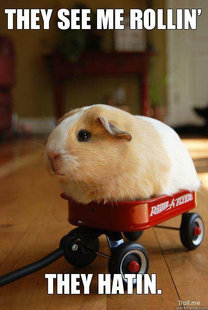
I’d probably be a bit more sensitive if I weren’t imbibing this goddamn Budweiser right now, but reading these kind of complaints, from the point of view of someone who works (ha ha) in the subculture of poetry, my reaction always goes kind of like this guy with the pink background:


(And I’m going to spare myself a full paragraph of self-indulgent examples here by assuming that, if you’re reading this article, you know exactly how much money even the most successful poets can hope to make, and what it means to reconcile that passion with your needs).

So to put this delicately – the doom & gloom from the music industry comes across to me as potentially legitimate and correct, yes, but at the same time completely hilarious. Not because I don’t believe that their (financial) bubble is actually imploding, but because from the position where I work – and where all my friends work – postulating an equation in which the quality of creative work has something to do with your ability to make a living out of it is a JOKE.

It led me to momentarily fantasise what things would be like if poets and rock stars could swap positions – not an unfamiliar exercise, because I suppose that (almost) anyone who ever dreamt of being a poet started out by visualising a guy / gal who has something (not everything, but something) in common with the roaming guitarist. There’s a reason Rimbaud as the original rock star (or prototype punk – he’s a flexible figure) never gets old. Aside from the brilliant poetry, I mean.

Some time ago I wrote an article in which I claimed that having more people in poetry could make it less subtle and intelligent. This was in response to the discontent expressed by poets (parallel to that of rockers) who point out that not enough people read poetry. Be careful what thou wishest for.

So maybe if rock really keeps dying the way that it purportedly is, it’s going to become smarter and more subtle. It could even make people like me interested.

Probably more representative of youth music now
This, however, is the point where the parallel collapses (in part because the Bud is really beginning to go to my head, and I’ve got to start wrapping up the arguments while they still look like arguments). There are many good reasons why rock and poetry will never trade positions. One, just off the top of my head, is that poetry is more ‘pure’ as an art. Rock and roll presupposes an involvement with (if not a commitment to) a certain lifestyle. Lester Bangs didn’t just write about the stuff, he lived it. He did the drugs. He got laid. He buried the bodies. Poetry isn’t cool like that. So many of our best poets are people with utterly boring CVs who conjure incredible worlds only out of their imaginations. There is no cultural script that you have to follow in order to ‘qualify’ as a poet.

Another reason is that poetry is, I think, much better positioned to confront the techno-cultural challenges of a changing world. Rock and roll isn’t losing out to fashion or taste – it’s being killed by globalisation and the internet. Besides, the poetry subculture has the advantage that its representatives DO NOT GIVE A FLYING FUCK about money. If there is, or has ever been, an artistic vocation that cares *less* than poets do about la plata, then I’ve never heard of it. So if anyone told a poet that someone had downloaded his / her book and distributed five-thousand copies of it totally for free, the reaction would be one of unadulterated joy. You got me five-thousand readers, for free?! Heck, we’d probably be encouraging piracy, if it could get more of our stuff out there.

Rock and roll – well, I don’t know if it’s really dead / dying. To be honest I don’t care that much, as I never really listened to it a great deal. I used to have a thing for Metallica and a couple of their offspring when I was sixteen, but I listen to them now and it’s amazing just how crushingly boring all of their songs have become to me. In terms of my personal interest, rock and roll hits an unfortunate middle point – it’s neither as easy as pop and electronica, nor as sophisticated as jazz and classical, meaning that the rewards of investing in it are going to be limited either way.

But even though I don’t know if it is dying, one thing I feel I can say with a certain confidence is that rock is old. I’ll be more precise – rock is no longer a cultural signifier that is associated with youth, and this has nothing to do with the fact that 90% of the major news stories about rockers out there concern some old fart who is releasing his 20thalbum or who died (I mean, even friggin’ Jack Black in School of Rock was thirty-four years old. That’s well past the age of college shenanigans, man). Even in the nineties, when I was less than ten years old and still reading trashy stuff like, y’know, Conan Doyle and Melville, there was this cultural dichotomy about classical music being for old people and rock ‘n’ roll being for the new generations. It wasn’t because of the relative ages of those who actually listened to it – no, it was the meta-narrative that supported rock and roll from its inception onwards. Now it is that same meta-narrative that has vanished from popular culture (despite still being trumpeted within the corrals of the rock subculture). When you see clichés and stereotypes representing contemporary teens, they’re seldom listening to / talking about rock music. The drugs are still there, of course, and so is the sex (as if…). But the closest thing to a product for young rockers that I recall is something as embarrassing as Freaky Friday, assuming that fantasy can be called rock at all, and that’s a remake of a 1976 film. The rest borders on parody: Guitar Hero is its own popular myth now, and the title itself is tongue-in-cheek.

Poetry doesn’t have an age. It’s always been the stuff that our forebears did, which may be why poetry books only really start selling something once the poet is dead. And that’s why poetry itself can never die.

And hey, maybe rock isn’t dead at all. Maybe it’s just evolved (or in-volved) from a mass phenomenon into a subculture. If that’s the case, then welcome to the club. I’ll buy you a drink with the sum profits of my first four books (whenever I publish them).

Sunday Review: D. Nurkse’s ‘A Night in Brooklyn’


Dee Nurkse wrote a collection. His actual name is Dee, but when he told this to his publisher, the guy thought he was just abbreviating. So we have D. Nurkse’s A Night in Brooklyn, which reminds me strangely of Woody Allen’s Midnight in Paris. Uncanny associations? Harry Giles dissects them extensively in his review.

A bit late to say enjoy the Sunday, but hey, enjoy the review!

Poets in Film 2

written by the Judge

Oh, Daniel Radcliffe. I do not envy you. Well actually I do envy you, at least as far as your bank account goes. I’m just being rhetorical for a moment, so please humour me: it must be hard to claw your way out of the well that JK Rowling tossed you into some ten years ago (I forget). Once you were down as Harry Potter, that was it. You tried to get out of it and recast yourself as an actor by making that goofy horror flick that about twelve people went to see (and which includes a poem in the trailer, perhaps prefiguring your upcoming career move), and then you must have realised that Kristen Stewart gathered some decent attention when she went from playing the girl who is cursed with Robert Pattinson (aren’t we all?) to the sixteen-year-old in the American Novel You Read in High School (R). So you followed suit (hopefully not in that you too banged the director of your movie… magic wand, my ass) ( ß Not a directive).

And that’s how I found myself, minutes before enjoying Clooney’s attempts at winning an Oscar by talking to himself inside a helmet, watching a trailer in which you play a tormented schoolboy and his whiny best friend. Harry Potter 9! No wait, it’s about Allen Ginsberg. Unicorns in this one? Considering how much that guy tripped in his time, I wouldn’t be surprised.

(Light that magic wand) ( ßVery much a directive).

Anyway, while we all wait for the release date (by building trenches), I thought it would be a good occasion to continue a series I began a long time ago, when I had both time & beer. Last time I analysed the representation of fictional poets in film. Today I will investigate the representation of real poets in film.

Of course, it would help if I had seen the fucking films before I started writing about them, but I’ve got about seven hours before we’re off schedule and I’ve just stepped off an Easyjet flight in which the captain literally followed the trajectory of a Chinese dragon before landing and I feel like a pair of eggs after they’ve been scrambled. No films right now. Especially not about poetry.

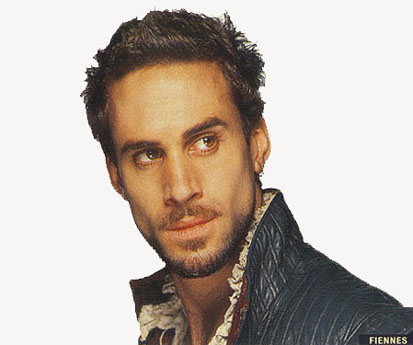
I’ll have to go by what I remember, rather than what I have diligently revised. And we might as well start with the biggest name of them all: William Shakespeare, who stars in the much beloved Shakespeare in Love. I guess a commentary on this one is kind of redundant because there must be about twelve people in all of England who haven’t already seen it (probably the same idiots who went and saw Radcliffe’s The Woman in Black…). I actually quite enjoyed this movie, in spite of its Americanism (that whole thing at the end about her leaving for the new world and thus being his inspiration was as LAME as the Handsome Stranger character in The Villain). It was certainly better than Anonymous, which messes things up because of its overambition – it’s an outlandish enough story without trying to make it into an actual Shakespearean tragedy. At least SIL kind of gets the fun about making a movie about such a universally famous character, and that’s why it is sprent with little references to other people and events from the time. Also, Judi Dench as the Queen rocks. Also also, Gwyneth Paltrow also rocked. Also also also, the guy who played Shakespeare also wasn’t too bad.

To be completely honest I think that’s half the success of the film – that it showed Shakespeare as this handsome young man (certainly more appealing than that goose, De Vere). It gave people what they wanted to see. Of course they’d like it. And in a film like this – in which it is impossible to actually represent The Truth because we’ve got jack on Will in the first place – I think that’s forgivable, and even smarter and more respectable than most of the fictional films about poets.

See what I mean?
On the topic of Gwyneth Paltrow – and it’s usually one of my favourite topics, but she kind of spoiled it by making a film about Sylvia Plath, going by the extremely original title of Sylvia.

I must confess I gaped throughout almost the entire thing because I couldn’t wrap my brain around the fact that Sylvia Plath here was *blonde*, while I’d spent my entire adolescence imagining her as a brunette. WTF? Then there’s Daniel Craig playing Ted Hughes (leave it a couple of years and we’d have seen Daniel Radcliffe in the role), before he bench-pressed and girls started saying he was handsome, that is (seriously, what kind of trajectory takes Bond from Sean Connery to Daniel Craig? Who’s going to replace Johnny Depp in the next Pirates of the Caribbean movie, the lizard from Spiderman?). The whole film struck me as linear and unimaginative – a bit dull, even – and the only scene that really stuck with me was the one where they (Paltrow and Hughes) are on a rowing boat and they seem to get lost. It stuck, I mean, because I too was lost as to what the devil that scene was doing there – it really goes nowhere, just like the characters. But maybe I’m not remembering it correctly. I look forward to seeing the flipside when they make the companion film, hopeful as I am that they will give it a more original title. (God forbid I see Craig’s face on the poster: Ted. I’m almost grateful to MacFarlane for having copyrighted that.)

But execution aside… what happened to Plath’s poetry? The whole film revolves around the relationship between the two poets and so rarely do we actually get a sense of what Plath (or for that matter Hughes) is writing and why. I understand they may have trouble rendering the literature in a film about Dickens (what do you do, read a chapter from Great Expectations?) ( ß I am *this* close to making a joke about why Americans shoot each other in cinemas and getting permanently radiated from the British poetry scene, not to mention arrested… thankfully I’m not drunk enough this time around) but why not a few lines of poetry here and there?

You’ve just never been this handsome, Leo. Live with it.
I suppose it was inevitable they would make a film about Rimbaud. If you haven’t seen it, it’s called Total Eclipse. It stars – no less – Leonardo Di Caprio as the unruly French genius, and some other guy with a moustache playing Verlaine. I must say, watching Di Caprio’s early films is very illuminating. He always plays the same part, that of the young, rebellious genius. I thought it worked in Romeo + Juliet, while it got a bit tired in The Basketball Diaries. By the time you get to TE though you can tell that Di Caprio’s young ego was wetting itself all over and this is the whole problem with the film – it’s just Leonardo all over the place, Leo Leo Leo Leo Leo, so dominantly that there is no space for Arthur at all. Like in Sylvia, there’s barely any of his poetry read out. I almost wonder if the actor read any of it, before committing to the part (ok, I’m being insulting, but if Leo read it, he didn’t bring any of it into his performance, or none that I could discern).

On the subject of stars, eclipses, etc. the other inevitable film about the young Romantic poet is Bright Star, about John Keats. I saw this film in bits and pieces in the middle of a holiday in southern Italy, so I was busier eating mozzarella than concentrating on the movie, but I seem to recall this one a bit more affectionately. At least, there’s quite a bit of Keats’ work read out loud, which gives you a sense of what made him so appealing (it may not go in great depth with respects to the content, but it does let you appreciate the lyricism).

What else? Well, there’s Howl, but I haven’t seen that. I’m sure it’s good enough to give Radcliffe a run for his (lots of) money.

Oh what the hell. I’ve done a thousand words. Let’s close it here.


How (Not) to Plagiarise Poetry for Beginners

written by Harry Man


C J Allen’s recent withdrawal from the Forward Prize and his uncovering as a serial plagiarist is just one of many such instances since news broke of Christian Ward’s plagiarising of Helen Mort’s poem ‘The Deer’ earlier this year. In the the more commercial corners of the literary community, copying of this kind would be grounds for career-ending, bank-account-emptying litigation for the plagiarist. The attempts to successfully sue trade authors are so common and so numerous as to give rise to the phrase “Where there’s a hit, there’s a writ.”

Before, we get into a Monty Python style bickering and arguing about plagiarists and “‘oo killed ‘oo” and break the internet, we should look at what constitutes plagiarism and how to ensure you’re not doing it in your poem.

N.B. This guide is for the use of quotations in poetry with reference to the Copyright Act 1988 (in the UK). If you want more information on permissions for use of both poetry and prose in other forms including criticism and reviews, please check the Society of Authors’ guidelines which are freely available here.

What are the rules?

Unless (a) there are clear examples of clear, substantial and direct copying of an original work, or (b) the expression of an idea in the original work is sufficiently and clearly developed in the infringing work as to be easily identifiable, there can be no copyright infringement.

In particular the second point there of the “idea in the original work” being “sufficiently and clearly developed” is tough and expensive to prove. When asked in an interview what his plays were about, Pinter said “the weasel under the cocktail cabinet.” So, good luck with that one.

Whatever your private feelings might be about obtaining permission for something, always ask. You run no risk by asking. Nobody likes don’t ask, don’t tell.

What can I use in my poem?

You can quote as much as you like from any poem that is in the public domain (i.e. out of copyright – for the UK that means the poet has been dead for more than 70 years – NB. This applies to British poets and rules occasionally vary, see ‘The person I’m quoting from is/was not a UK author’ below).

You can also quote from published poetry from poets who are still alive. Anything under 25 words is considered ‘fair use’ (also ‘fair dealing’) in ordinary circumstances.

If you are in any doubt, or if you have exceeded these 25 words by a small amount and want to be on the safe side, then ask the poet, and their publisher for permission. There may well be a fee attached.

In some cases you’ll find that the publisher is the rightsholder. Make sure that you check the rights situation with the poet before going to press or sending your work out for publication.

A poet should be flattered that you are quoting their work and it is perfectly normal to go looking for details in your contract for the sake of another writer.

What about ‘found’ poems?

If your work is a ‘found’ work, it can fall into two categories:

i. The poem is made from a ‘found’ text. i.e. writing in complete consecutive order as an extended quote.

ii. ‘Found’ poetry where material has been unrecognisably changed from the original.

If it is the former you will need permission from the copyright holder if your quote is more than about 125 words of prose. For poetry, as above, it’s usually about 25 words, but check with the rightsholder.

If your work falls under the second category, the unrecognisable, then you do not need to seek permission. It is always polite to ask. This applies to centos, melitzahs and every other type of ‘found’ form.

For other media, head over here 

How does getting permission work?

Ideally the rightsholder, or their representative will already have a permissions form. Get in touch with them. You fill out two copies of their permission form, sign them and send them to the rightsholder, who signs and returns a copy to you for your files.

You can also go through the Poetry Society, details of which are on their website.

The Society of Authors also have a permission form on the last page of their permissions guide.

Things to consider before requesting permission.
  • Where is your work going to appear?
  • How is it going to appear? Eg. Online, physical anthology, hardback, DVD of your spoken word gig, etc.
  • How many copies will be made of this poem, e.g. the print run of the magazine, will it appear online, how long for?
  • Lastly, are you quoting from material that has yet to be published? If so then visit the Society of Authors permissions guidefor further information.
  • This guide also has helpful information on what to do if the poet you’re trying to find is unreachable.
  • Is the person I’m quoting from a British author? If not, see below.
  • Typically, rightsholders will ask for a copyright line to be inserted either on the page where the text appears or in the preliminary pages of the publication.
The person I’m quoting from is/was not a UK author.

You’ll have to check copyright in the relevant territory. Most countries around the world have signed up to the Berne convention which says you’re okay if it’s 70 years after death of the author, but some have not. Check, check, check and double check here.

Will I Have to Sell My Lego Death Star to Pay a Permission Fee?

No, it’s okay, the Empire lives to fight another day…probably. The rule of thumb is that a permission should be charged at a fee that is, according to the Copyright Act ‘reasonable’ (there are some guide rates here). Very few people will charge a fearsome amount of money for a few lines of poetry because poetry doesn’t make very much money.  If someone’s charging you a substantial amount for a permission then consider whether or not you want their work to be more widely read. So, charge other people what you’d be willing to pay yourself and vice versa. Hooray for Darth Vader.

How do I protect my own work?

If your poems have gone to press and are subsequently plagiarised, you ought to have a publication record, correspondence and perhaps even original notes, all of which would illustrate that you were indeed the original author. Congratulations, by writing a poem, that poem is already your own copyright. If you are concerned that your work might be stolen before it’s printed, which is vanishingly unlikely (although did happen to – for example – Coleridge), you can protect yourself by printing off your poems, putting them into an envelope and sending them to yourself so that they are postmarked. Be sure not to open the envelope but to put it away somewhere safe. And besides, it doesn’t matter when they arrive; who doesn’t like to get poems in the post?


***

Harry Man was born in 1982. His poetry has appeared in New Welsh Review, Well Versed, Elbow Room, Poems in the Waiting Room, Poems in Which, and Eyewear’s Poetry Focus among other places. He works as a digital editor in South London. His first pamphlet, ‘Lift’, is forthcoming from Tall Lighthouse.

Angela is Coming!

“There’s just something that doesn’t seem right …”

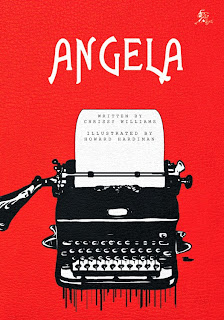
Sidekick is very pleased to announce the imminent launch of the sinister, hilarious and oddly poignant Angela!


Who can explain the mysterious allure of Angela Lansbury? In this Sidekick Team-Up, Chrissy Williams and Howard Hardiman gaze upon (and into) the many facets of Angela and her most famous fictional counterpart, Jessica Fletcher, as wonderstruck miners might scrutinise a fist-sized diamond freshly cut from the rock. But like a tesseract, Angela seems to exist in four dimensions, beyond Euclidean space, her limits impossible to define through observation alone. Thus, further and deeper must our fearless duo travel, through the televisual glass, past all the iterations of ode and approximation, into the parallel universe that is Angela.

Check out Chrissy’s rather excellent trailer for the launch event, to be held on 16th October at Drink, Shop & Do on Caledonian Road, London, and RSVP here for macabre merrymaking!


Nearest tube: King’s Cross St Pancras

Mildly Erotic goings-on south of the river tonight!

Innuendo-o-meter up to 11, and away we go!

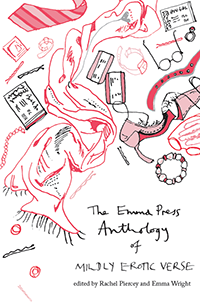
Time to get hot under the collar and weak at the knees, with the launch of bright young publisher The Emma Press’s Anthology of Mildly Erotic Verse!

Gorgeously illustrated, with Audrey Horne-red end papers and choc-full of teasing, tantalisation and tingles, this little minx is going to solve a lot of your Christmas present issues.

It’s all going down tonight (26th September) at the Tea House Theatre in Vauxhall, where Jon and I will be reading at the launch, along with Julia Bird, Hugh Dunkerley, Amy Key, Anja Konig, Ikhda Ayuning Maharsi, Julie Mullen, Richard O’Brien, Emma Reay, Jacqueline Saphra, Stephen Sexton, Ruth Wiggins and Jerrold Yam. (Fact: at least one of these poets has come all the way from Switzerland to mildly eroticise you.)


If you’re busy being unsexy tonight, you have my sympathies. But that’s no problem, for the tingles are going on tour!

We’ll be joining the party on 2nd October and 16th November, but will most assuredly be slinking along to the other dates too.


As The Emma Press themselves put it,


Follow the Trail of Moths this Friday!

Psst! We’re very happy to be publishing Follow the Trail of Moths: the Best of Wayne Holloway-Smith’s Literary Salons (look, that’s it to the left! Ooh!), featuring a ravishing selection of contemporary poets and storytellers, and art by the very talented Sophie Gainsley, who designed the hand-drawn maps after which the anthology is named.

We are even more happy to furtively whisper to you that Mr H-S will be hosting one final fling to launch the collection and round off his infamous Bacchanalian career, on Friday 20th September 2013 at his abode!

Readers confirmed are: Annie Freud, Jack Underwood, Martha Sprackland, John McCullough, Matthew Caley, Mark Waldron, Inua Ellams and Tim Wells.

All are very welcome, but we need to keep tabs on numbers, so please RSVP to us at contact@drfulminare.com to receive your own piece of entomological cartography (aka your moth map!).

Here are a few more lovely moths, just to whet your appetite:


Sunday Review: Charles Ardai’s “The Good-Neighbor Policy”

‘Tis Sunday, and I’m going out to see my girl. We’re gonna hang at her place and watch Batman on her laptop. It’s our ninth date and all the others have been dinners, so our story so far is going to look like this:

dinner dinner dinner dinner
dinner dinner dinner dinner BATMAN!

This reminds me – I’ve just written a review of Charles Ardai‘s The Good-Neighbor Policy, which is a detective story. This means that it probably would never fit in with Batman – for some reason Detective Comics never actually publish detective comics. Even without the cape, though, it’s a great read. And so is my review, naturally. Find it by clicking on this link!

And have a great Sunday!

CONTACT:

contact [a] sidekickbooks.com

Sidekick Books Site assembled by Jon.
Wordpress TwentySixteen theme used to power the news and books sections.